Live Rates
30-Yr Fixed6.627%APR 6.875%15-Yr Fixed5.840%APR 6.027%FHA 30-Yr6.125%APR 6.375%VA 30-Yr5.990%APR 6.210%Jumbo 30-Yr6.750%APR 6.910%
1st Florida Lending — When Banks Say No! We Say Yes!
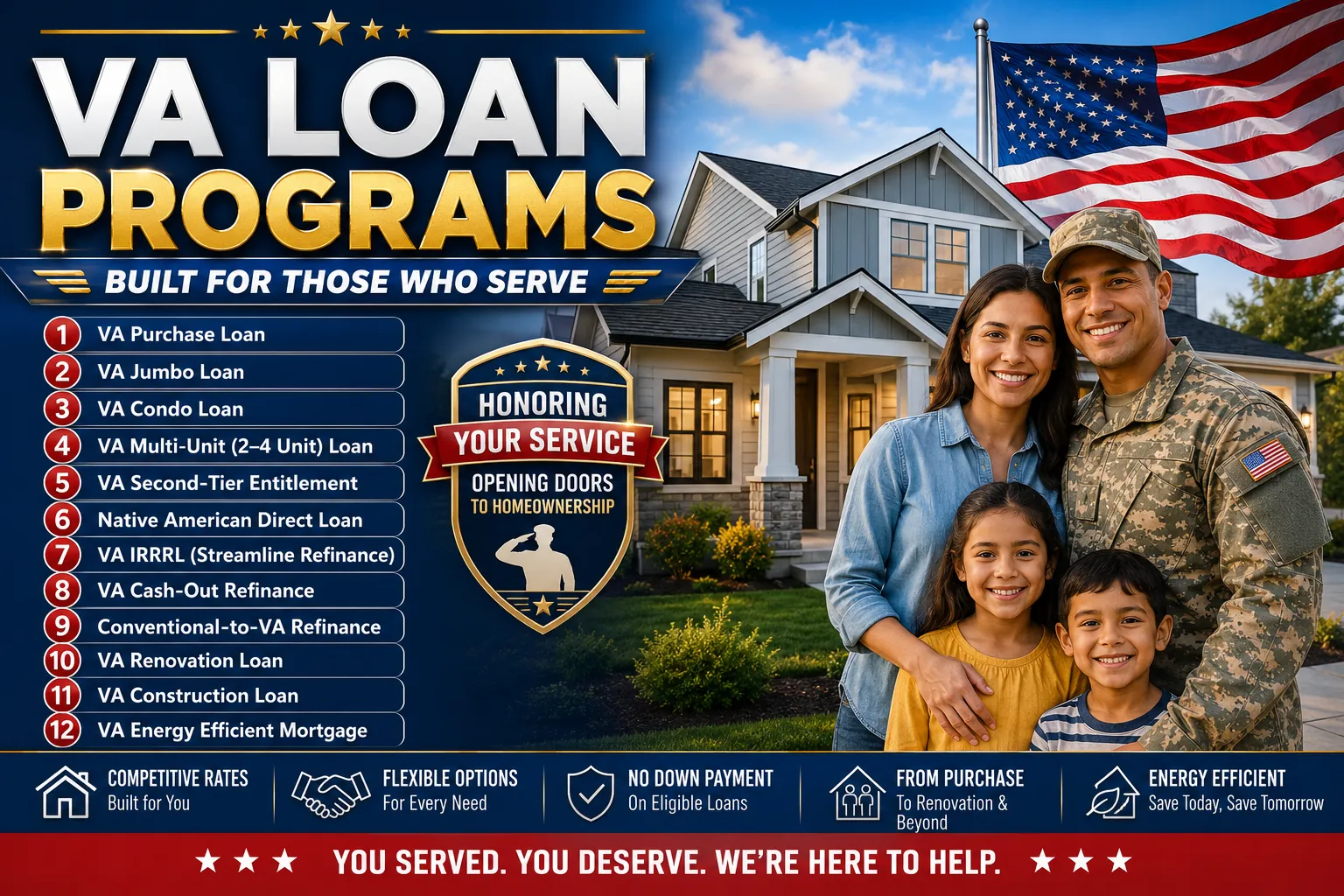
VA Loan Programs — a military family standing in front of their new home with the American flag flying
Built For Those Who Serve

VA Loan Programs

Serving those who served. 1st Florida Lending Corp is proud to offer a full range of VA-backed home financing solutions for eligible Veterans, active-duty service members, National Guard and Reserve members, and eligible surviving spouses — with $0 down options, no monthly mortgage insurance, and competitive terms, subject to qualification.

What Are VA Loan Programs?

Home financing backed by the U.S. Department of Veterans Affairs

VA loan programs are home financing options backed by the U.S. Department of Veterans Affairs and made available through approved private lenders like 1st Florida Lending Corp. The VA does not lend the money itself on most programs — instead, it guarantees a portion of the loan, which allows lenders to offer eligible borrowers exceptionally favorable terms that are typically not available through conventional financing. These advantages often include no down payment on the full purchase price (when the borrower has full entitlement and the property appraises accordingly), no monthly private mortgage insurance, competitive interest rates, limited closing costs, and more flexible credit and debt-to-income guidelines.

VA loan programs can help eligible borrowers purchase, refinance, renovate, build, or improve an owner-occupied primary residence. This includes single-family homes, VA-approved condominiums, and certain multi-unit properties of two to four units, provided the borrower occupies one of the units as their primary residence and VA occupancy requirements are met. Whether you are buying your first home, moving with PCS orders, tapping into home equity, lowering your rate, or building a home from the ground up, there is likely a VA program designed for your situation.

Eligibility generally extends to Veterans who meet minimum service requirements, active-duty service members, members of the National Guard and Reserves with qualifying service, and certain surviving spouses. Most borrowers document their eligibility with a Certificate of Eligibility (COE), which our team can typically help obtain quickly through the VA's automated system. As with all mortgage financing, VA loans are subject to qualification, and final approval, rates, and terms depend on the complete loan application, credit profile, property, and VA and lender guidelines in effect at the time of application.

01.

VA Purchase Loan

The VA Purchase Loan is the cornerstone of the VA home loan benefit. It allows eligible borrowers to buy an owner-occupied primary residence with no down payment in most cases, no monthly mortgage insurance, and competitive fixed or adjustable rates. Because the VA guarantees a portion of the loan, lenders can extend financing terms that typically outperform comparable low-down-payment conventional and FHA options.

Who It's Designed For

Eligible Veterans, active-duty service members, qualifying National Guard and Reserve members, and eligible surviving spouses purchasing a primary residence they intend to occupy.

Common Use Cases

  • First-time homebuyers who want to preserve savings by putting $0 down
  • Relocating service members purchasing near a new duty station
  • Move-up buyers selling one home and purchasing another with restored entitlement
  • Buyers purchasing single-family homes, VA-approved condos, or 2–4 unit properties they will occupy

Key Benefits

  • Typically no down payment required with full entitlement
  • No monthly private mortgage insurance (PMI)
  • Competitive interest rates and limited allowable closing costs
  • Seller concessions permitted, which may reduce cash needed to close
  • No prepayment penalty

Typical Qualifying Considerations

  • Valid Certificate of Eligibility (COE)
  • Satisfactory credit history — VA does not set a minimum score, though lender guidelines apply
  • Stable, verifiable income and acceptable debt-to-income ratio supported by VA residual income standards
  • Property must meet VA Minimum Property Requirements (MPRs) and appraise through a VA appraisal
  • Intent to occupy the home as a primary residence, typically within 60 days of closing

★ Best fit: The ideal VA Purchase Loan borrower is an eligible Veteran or active-duty service member buying a primary residence who wants to keep savings intact. Picture a service member PCSing to Florida with solid income but limited cash reserves: with full entitlement, they may finance 100% of the purchase price, avoid monthly PMI entirely, and negotiate seller-paid closing costs — often getting into a home with remarkably little out of pocket, subject to qualification.

02.

VA Jumbo Loan

A VA Jumbo Loan allows eligible borrowers to finance higher-priced homes that exceed the conforming loan limit — $832,750 in most U.S. counties for 2026, and up to $1,249,125 in designated high-cost areas. For borrowers with full VA entitlement, the VA no longer imposes a loan limit, meaning qualified borrowers may be able to finance a high-value home with no down payment at all, subject to lender approval, appraisal, and full qualification. Borrowers with partial (remaining) entitlement may still qualify, though a down payment may be required on the portion above their county limit.

Who It's Designed For

Eligible VA borrowers with strong income purchasing homes in higher-priced Florida markets — waterfront communities, luxury suburbs, and premium metro neighborhoods — where prices exceed conforming limits.

Common Use Cases

  • Purchasing a luxury or waterfront primary residence above $832,750
  • Senior officers, retirees, and dual-income military households buying in high-cost areas
  • Refinancing an existing jumbo mortgage into VA jumbo financing when eligible

Key Benefits

  • Potential $0 down on high loan amounts with full entitlement — a benefit almost unheard of in jumbo lending
  • No monthly PMI regardless of loan size
  • Rates that are often competitive with, or better than, conventional jumbo pricing

Typical Qualifying Considerations

  • Stronger credit and income documentation is typical for larger loan amounts
  • Residual income requirements scale with loan size and family size
  • Full vs. partial entitlement determines whether a down payment may be needed
  • Lender-specific jumbo overlays and reserve requirements may apply

★ Best fit: The ideal VA Jumbo borrower is a Veteran or active-duty professional with strong, stable income and full entitlement purchasing a higher-priced primary residence — for example, a retired officer buying a $950,000 home in a coastal Florida community. Where conventional jumbo lenders might require 10–20% down plus reserves, this borrower may qualify with little or no down payment and no PMI, subject to qualification.

03.

VA Condo Loan

A VA Condo Loan lets eligible borrowers use their VA benefit to purchase a condominium unit as a primary residence — a popular option throughout Florida's condo-rich markets. The key distinction from a standard purchase is the property itself: the condominium project must appear on the VA's approved condo list (or obtain VA approval) before the loan can close. Our team can check a project's VA approval status early in the process and discuss options if a community is not yet approved.

Who It's Designed For

Eligible VA borrowers seeking lower-maintenance living, an affordable entry point into desirable areas, or amenity-rich communities — including first-time buyers, downsizing Veterans, and service members near coastal or urban duty stations.

Common Use Cases

  • Buying a condo in a VA-approved Florida community as a primary residence
  • Downsizing from a single-family home while preserving VA benefits
  • Purchasing near a duty station where condos dominate the housing stock

Key Benefits

  • Same core VA advantages: typically $0 down, no monthly PMI, competitive rates
  • Access to communities with pools, security, and exterior maintenance included
  • Often a lower purchase price point than comparable single-family homes

Typical Qualifying Considerations

  • Condo project must be VA-approved (we verify this up front)
  • HOA dues are counted in the debt-to-income calculation
  • Project financials, owner-occupancy mix, and litigation status may affect approval
  • Standard VA borrower eligibility, credit, income, and occupancy requirements apply

★ Best fit: The ideal VA Condo borrower is an eligible Veteran or service member who wants an affordable, low-maintenance primary residence in a VA-approved community — for instance, a single service member stationed in Central Florida buying a two-bedroom condo near base. They gain homeownership with typically no down payment while the HOA handles exterior upkeep, subject to project approval and full qualification.

04.

VA Multi-Unit (2–4 Unit) Loan

The VA Multi-Unit Loan allows eligible borrowers to purchase a duplex, triplex, or fourplex with VA financing — typically with no down payment — as long as the borrower occupies one of the units as their primary residence. This “house hacking” strategy lets Veterans live in one unit while collecting rent from the others, and in many cases a portion of the projected rental income from the other units may be used to help qualify, subject to VA and lender guidelines.

Who It's Designed For

Eligible VA borrowers interested in building wealth through real estate while satisfying VA occupancy requirements — often younger service members, Veterans beginning an investment strategy, or multigenerational families.

Common Use Cases

  • Buying a duplex, living in one unit, and renting the other to offset the mortgage
  • Purchasing a fourplex as a first step toward long-term real estate investing
  • Housing extended family members in adjacent units while owning the property

Key Benefits

  • Typically $0 down on 2–4 unit properties with full entitlement
  • Rental income from non-occupied units may help with qualification in many cases
  • No monthly PMI, even on multi-unit financing
  • Potential to live for less while tenants contribute toward the payment

Typical Qualifying Considerations

  • Borrower must occupy one unit as a primary residence, typically within 60 days of closing
  • Use of projected rent generally requires an appraiser's rent schedule; landlord experience or reserves may be required by guideline
  • All units must meet VA Minimum Property Requirements
  • Loan amounts on 2–4 unit properties follow higher conforming limit tiers

★ Best fit: The ideal Multi-Unit borrower is an eligible service member or Veteran who wants their home to work for them — picture a young sergeant buying a Florida duplex with $0 down, living in one side, and renting the other for enough to cover a large share of the monthly payment. They build equity in an income-producing property while meeting VA occupancy rules, subject to qualification.

05.

VA Second-Tier Entitlement

Second-tier (or “bonus”) entitlement allows eligible borrowers to use their VA home loan benefit again — even while an existing VA loan is still outstanding. Many Veterans assume the benefit is one-and-done, but VA entitlement is a dollar-based guaranty that can often be split across more than one loan. This makes it possible to purchase a new primary residence with VA financing after a PCS move, or after keeping a prior VA-financed home, without first paying off or refinancing the original loan.

Who It's Designed For

Veterans and service members who currently have a VA loan (or lost entitlement through a prior foreclosure or short sale) and want to purchase another primary residence using their remaining entitlement.

Common Use Cases

  • PCS relocation: keeping and renting the old home while buying at the new duty station
  • Purchasing again after a previous VA loan was assumed by another buyer
  • Re-using the benefit after a past compromise sale or foreclosure, once seasoning and credit requirements are met

Key Benefits

  • Own two homes financed with VA benefits at the same time, when entitlement math supports it
  • Retain a low-rate existing VA mortgage as a rental while buying again
  • No PMI on the new loan; down payment may be reduced or eliminated depending on remaining entitlement and price

Typical Qualifying Considerations

  • Remaining entitlement is calculated against the county conforming limit ($832,750 baseline in 2026); a down payment may be required above the supported amount
  • Borrower must intend to occupy the new home as a primary residence
  • Qualification must generally support both housing payments, though documented rental income on the departing residence may help
  • Subsequent-use funding fee rates typically apply unless exempt

★ Best fit: The ideal second-tier entitlement borrower is a relocating service member with an existing VA loan — for example, a Navy family transferred from Jacksonville to Orlando who wants to keep their first home as a rental. Using remaining entitlement, they may purchase the new primary residence with little or no down payment while the old home generates income, subject to entitlement calculation and full qualification.

06.

Native American Direct Loan (NADL)

The Native American Direct Loan is a unique program in which the VA itself acts as the lender, providing direct financing to eligible Native American Veterans (or Veterans married to Native Americans) to purchase, build, or improve a home on Federal Trust Land. Because conventional mortgages are often unavailable on trust land, the NADL fills a critical gap — offering a low fixed rate set by the VA, no down payment in most cases, and limited closing costs. The Veteran's tribal government must have a Memorandum of Understanding (MOU) with the VA for the program to be available.

Who It's Designed For

Eligible Native American Veterans, and Veterans whose spouses are Native American, seeking to buy, build, or improve a primary residence on Federal Trust Land where the tribe participates in the program.

Common Use Cases

  • Purchasing a home on tribal trust land where conventional financing is unavailable
  • Constructing a new primary residence on allotted or trust land
  • Improving or renovating an existing home on qualifying land
  • Refinancing an existing NADL to reduce the interest rate

Key Benefits

  • VA is the direct lender — no private lender approval hurdles for trust-land title issues
  • Low fixed interest rate set by the VA; typically no down payment
  • No monthly PMI and a reduced funding fee structure; limited closing costs
  • Benefit may be reused for future NADLs

Typical Qualifying Considerations

  • Valid COE and standard VA credit/income qualification
  • Tribal government must have a signed MOU with the VA
  • Property must be on Federal Trust Land (or qualifying allotted land) and be the borrower's primary residence

★ Best fit: The ideal NADL borrower is a Native American Veteran whose tribe participates in the program and who wants to own or build a home on trust land — a scenario where traditional lenders typically cannot help. Through the VA's direct lending authority, they can access a low fixed rate with no down payment in most cases, subject to program eligibility. Because the VA administers this program directly, our team can help point eligible Veterans to the right VA resources.

07.

VA IRRRL (Interest Rate Reduction Refinance Loan / Streamline Refinance)

The VA IRRRL — commonly called the VA Streamline Refinance — is designed to make refinancing an existing VA loan as fast and simple as possible. Because the borrower already holds a VA loan, the VA permits reduced documentation: typically no new appraisal in many cases, no income re-verification in many cases, and a dramatically reduced funding fee of just 0.50%. The trade-off is purpose: the IRRRL must generally produce a net tangible benefit, such as a lower interest rate, a lower payment, or a move from an adjustable rate to a stable fixed rate. Cash out is not permitted beyond minor allowances.

Who It's Designed For

Borrowers with an existing VA loan who want to lower their rate or payment, or convert an ARM to a fixed rate, with minimal paperwork and cost.

Common Use Cases

  • Dropping the interest rate when market rates fall below the current note rate
  • Converting a VA adjustable-rate mortgage into a predictable fixed rate
  • Reducing the monthly payment to improve household cash flow

Key Benefits

  • Streamlined documentation — often no appraisal and no income re-verification
  • Lowest VA funding fee: 0.50% (and exemptions still apply for qualifying disabled Veterans)
  • Closing costs may often be rolled into the new loan
  • Typically faster closings than a full-documentation refinance

Typical Qualifying Considerations

  • Current loan must be a VA loan; the new loan refinances the same property
  • Net tangible benefit and VA seasoning requirements must be met (generally 210 days and six payments on the loan being refinanced)
  • Acceptable mortgage payment history; lender credit overlays may apply
  • Borrower must certify prior occupancy of the property

★ Best fit: The ideal IRRRL borrower already has a VA loan at a rate above today's market and simply wants a lower payment without the hassle of a full refinance — for example, a Veteran who closed when rates peaked and can now reduce their rate meaningfully. With no appraisal in many cases, minimal documentation, and only a 0.50% funding fee, the streamline can deliver savings quickly, subject to seasoning and qualification.

08.

VA Cash-Out Refinance

The VA Cash-Out Refinance allows eligible homeowners to replace their current mortgage — VA or non-VA — with a new VA-backed loan and take cash out of their home equity at closing. VA guidelines permit financing up to 100% of the appraised value in some cases (many lenders cap at 90%), which is typically more generous than conventional cash-out limits. Funds can be used for debt consolidation, home improvements, education, or other financial goals.

Who It's Designed For

Eligible Veterans and service members with home equity who want to convert part of it to cash, or who want to refinance a non-VA loan into a VA loan while accessing equity, using the home as their primary residence.

Common Use Cases

  • Consolidating higher-interest credit cards or personal loans into one lower-rate mortgage payment
  • Funding home renovations, education costs, or major expenses
  • Refinancing an FHA or conventional loan into VA financing while taking cash out

Key Benefits

  • Higher loan-to-value allowances than most conventional cash-out programs
  • No monthly PMI on the new VA loan
  • Opportunity to improve overall rate or terms while accessing equity

Typical Qualifying Considerations

  • Full documentation: credit, income, and a new VA appraisal are required
  • Property must be the borrower's primary residence
  • Funding fee of 2.15% (first use) or 3.30% (subsequent use) typically applies unless exempt
  • VA seasoning and net tangible benefit requirements apply when refinancing an existing loan

★ Best fit: The ideal Cash-Out borrower is a Veteran homeowner with meaningful equity and a clear purpose for the funds — for example, consolidating $40,000 of high-interest debt into one manageable mortgage payment, or funding a kitchen remodel. Because VA allows higher loan-to-value ratios than conventional programs, this borrower may access more of their equity while keeping a single, PMI-free payment, subject to qualification.

09.

Conventional-to-VA Refinance

Many eligible Veterans are surprised to learn they can refinance an existing conventional, FHA, or USDA loan into a VA-backed loan — even if they have never used their VA benefit before. This is accomplished through the VA cash-out refinance structure (even when little or no cash is actually taken), and it can unlock the core VA advantages: elimination of monthly PMI or FHA mortgage insurance, potentially better rates, and access to higher loan-to-value refinancing than conventional guidelines allow.

Who It's Designed For

Eligible Veterans and service members currently paying on a non-VA mortgage — especially those paying monthly PMI or FHA MIP — who occupy the home as their primary residence.

Common Use Cases

  • Eliminating monthly PMI on a conventional loan originated with less than 20% down
  • Removing FHA mortgage insurance premiums that last for the life of the loan
  • Refinancing to a better rate or term while switching into the VA program
  • Accessing equity at the same time, if desired

Key Benefits

  • Monthly mortgage insurance is eliminated going forward
  • May refinance up to a higher percentage of the home's value than conventional programs typically allow
  • First-use funding fee rate (2.15%) typically applies if the VA benefit has never been used — and exemptions apply for qualifying disabled Veterans

Typical Qualifying Considerations

  • Valid COE — the borrower must be VA-eligible even though the current loan is not VA
  • Full credit, income, and appraisal documentation, as with any cash-out structure
  • Primary residence occupancy required
  • Net tangible benefit test applies

★ Best fit: The ideal Conventional-to-VA borrower is a Veteran who bought with an FHA or low-down-payment conventional loan before realizing the full value of their VA benefit — and is now paying hundreds per month in mortgage insurance. By refinancing into a VA loan, they may eliminate that insurance entirely and potentially improve their rate at the same time, subject to eligibility and qualification.

10.

VA Renovation Loan

The VA Renovation Loan (sometimes called a VA rehab or alteration & repair loan) combines the purchase price of a home plus the cost of eligible repairs and improvements into a single VA-backed mortgage — or adds improvement funds to a refinance of a home the Veteran already owns. This opens the door to homes that need work to meet VA Minimum Property Requirements or simply need updating, without requiring a second loan or paying cash for repairs.

Who It's Designed For

Eligible VA borrowers purchasing homes that need repairs or updates, or current VA-eligible homeowners who want to finance improvements into their mortgage rather than using higher-rate credit.

Common Use Cases

  • Buying an older Florida home and financing a new roof, HVAC, flooring, or kitchen updates into the loan
  • Bringing a property up to VA Minimum Property Requirements so it can qualify
  • Refinancing while adding funds for non-structural repairs and improvements

Key Benefits

  • One loan, one closing, one payment — purchase (or refinance) plus renovation funds
  • Loan amount may be based on the “as-completed” value of the home
  • Retains core VA benefits: typically no down payment and no monthly PMI
  • Expands the pool of eligible homes in competitive, older-inventory markets

Typical Qualifying Considerations

  • Repairs are generally limited to non-structural improvements that enhance livability and safety, subject to program caps
  • Work is typically performed by VA-registered, licensed contractors — not the borrower
  • Renovations usually must be completed within a set timeframe after closing, with funds held in escrow and inspections along the way
  • Not all lenders offer VA renovation lending; program availability and caps vary

★ Best fit: The ideal Renovation Loan borrower is an eligible Veteran who finds a well-located but dated home — say, a solid 1980s Orlando property needing a roof, new AC, and modern flooring. Instead of losing the home because it can't pass VA appraisal as-is, or draining savings for repairs, they finance the purchase and improvements together in one VA loan, subject to program limits and qualification.

11.

VA Construction Loan

The VA Construction Loan allows eligible borrowers to finance the construction of a brand-new primary residence with VA backing — often through a convenient one-time close structure that combines the construction phase and the permanent mortgage into a single loan with a single closing. Land purchase can frequently be included, or land already owned may contribute equity. Once construction is complete, the loan converts to a standard VA mortgage without a second round of closing costs.

Who It's Designed For

Eligible Veterans and service members who want to build a new home to their specifications — especially in growing Florida markets where new construction may be more available or better value than resale inventory.

Common Use Cases

  • Building a custom home on newly purchased or already-owned land
  • Contracting with a builder in a new development using VA one-time-close financing
  • Replacing an existing structure with a new primary residence

Key Benefits

  • Potentially no down payment on the combined land-plus-construction cost with full entitlement
  • One-time close options mean one approval, one closing, one set of costs
  • No monthly PMI and no payment-shock refinance at completion in one-time-close structures
  • Interest-only or deferred payment options during construction may be available, depending on structure

Typical Qualifying Considerations

  • Builder must be VA-registered, licensed, and insured; plans, specs, and budget are reviewed up front
  • The completed home must meet VA Minimum Property Requirements and pass inspections during construction draws
  • Qualification is typically more documentation-intensive than a standard purchase
  • Program availability, structures, and overlays vary by lender

★ Best fit: The ideal Construction Loan borrower is an eligible Veteran with stable income and a clear building plan — for example, a retiring service member who owns a lot in a growing Central Florida county and wants to build a single-story home for the long term. With one-time-close VA financing, they may build with little or no down payment and roll straight into a permanent VA mortgage, subject to builder approval and full qualification.

12.

VA Energy Efficient Mortgage (EEM)

The VA Energy Efficient Mortgage lets eligible borrowers add the cost of qualifying energy-efficiency improvements to a VA purchase or refinance loan — typically up to $6,000, depending on the improvements and documentation. Rather than paying cash or using credit cards for upgrades like insulation, efficient HVAC, solar attic fans, or storm-resistant improvements, borrowers can finance them at mortgage rates in the same transaction.

Who It's Designed For

VA borrowers purchasing or refinancing a home who want to reduce long-term utility costs — particularly valuable in Florida, where cooling costs dominate energy bills and efficiency upgrades pay ongoing dividends.

Common Use Cases

  • Adding attic insulation, radiant barriers, or duct sealing at the time of purchase
  • Financing a high-efficiency HVAC replacement into a VA refinance
  • Installing energy-efficient windows, doors, or water heaters
  • Pairing an EEM with an IRRRL or purchase loan in a single transaction

Key Benefits

  • Improvements financed at low mortgage rates instead of consumer credit rates
  • Amounts up to about $3,000 are typically documented by cost alone; $3,001–$6,000 generally requires showing utility savings exceed the added payment
  • Lower ongoing utility bills can improve the total cost of homeownership
  • Can be combined with most VA purchase and refinance programs

Typical Qualifying Considerations

  • Improvements must be energy-related and documented with contractor bids or an energy audit
  • For larger amounts, projected energy savings generally must offset the increase in the monthly payment
  • Work is typically completed shortly after closing, with funds escrowed
  • The EEM rides on top of an underlying VA loan — standard VA qualification applies

★ Best fit: The ideal EEM borrower is a Veteran buying an older Florida home with an aging AC system and thin insulation. By adding up to $6,000 in efficiency upgrades to their VA purchase loan, they replace the HVAC and insulate the attic at closing — trading high summer electric bills for a modest increase in their mortgage payment, subject to program documentation and qualification.

Ready to use your VA benefit?

Tell us your goal — purchase, refinance, renovate, or build — and we'll match the right VA program, help pull your Certificate of Eligibility, and quote your rate and payment inside 24 hours.

VA Loan Programs — Frequently Asked Questions

Straight answers to the questions Veterans, service members, surviving spouses, and real estate professionals ask most. Individual results depend on your complete application and current VA and lender guidelines.

Direct VA Lender · Licensed in Florida & California · A+ BBB RatingYou Served. You Deserve. We're Here To Help.

  • $0 Down Available
    100% financing with full entitlement
  • No Monthly PMI
    VA guaranty replaces mortgage insurance
  • 12 VA Programs
    Purchase, refinance, renovate, build
  • BBB A+ Accredited
    Google 4.8★ · 48+ Loan Programs

Disclaimer

Legal & Licensing Disclosure: All loans are subject to credit approval, VA eligibility, and property qualification. Program availability, funding fees, entitlement calculations, and county loan limits are set by the U.S. Department of Veterans Affairs and the Federal Housing Finance Agency and are subject to change. Each lender applies its own overlays. Rates and programs subject to change without notice. Equal Housing Lender. © 2026 1st Florida Lending Corp. All rights reserved.