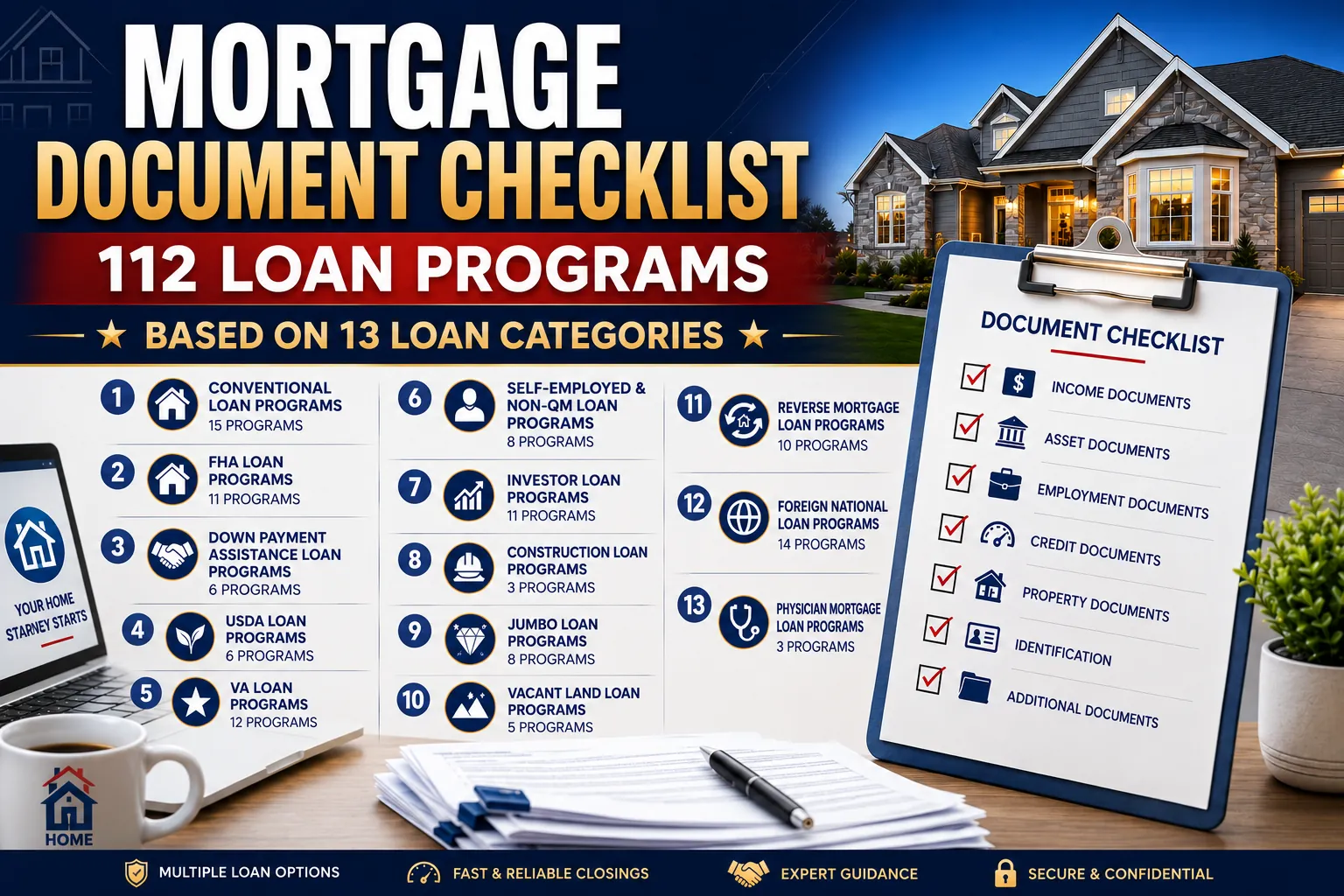
Mortgage Document Checklist by Loan Program
Explore our borrower-friendly document checklist for 112 loan programs, organized by category. Use the drop-down menu to view the documents that may be required for each program, then use the Click to Print button feature, to print checklist page for easy reference.
Documents Every Borrower Should Gather First
No matter which program you choose, nearly every mortgage application starts with the same core package. Gather these first and you're 80% of the way there:
Identity & Income
- Government-issued photo ID for every borrower
- Social Security number documentation (or ITIN, where applicable)
- Pay stubs for the most recent 30 days
- W-2s for the past 2 years (wage earners)
- Federal tax returns for the past 2 years — all pages and schedules
Assets & Funds to Close
- 2 months of bank statements — every page of every account
- Investment and retirement statements, if those funds will be used
- Gift letter and donor paper trail, if any funds are gifted
- Proof of earnest money deposit
How to Avoid the Most Common Delays
Do This
- Send all pages of every statement — even the ones marked "intentionally blank"
- Explain large deposits (anything unusual or non-payroll) with a short signed letter and the source paper trail
- Keep documents current — pay stubs and statements older than 60–90 days will need refreshing before closing
- Use complete files — PDFs downloaded from your bank, not photos of screens
Avoid This
- Never alter a document — cropped, edited, or partial documents stop a file cold
- Don't move money between accounts right before applying without keeping the transfer records
- Don't open new credit or make large purchases during the loan process
- Don't wait on conditional items — send "if applicable" documents upfront if they apply to you
Conventional Loan Programs
15 Programs
Conventional loans follow Fannie Mae and Freddie Mac guidelines and are the most widely used mortgage type. Documentation is standardized, but each program below has its own additions.
Conventional Fixed-Rate LoanThe standard 15-, 20-, or 30-year fixed mortgage.
Required for Most Borrowers
- Government-issued photo ID (driver's license, state ID, or U.S. passport)
- Social Security number documentation (Social Security card or official record)
- Permanent resident card (green card), valid visa, or Employment Authorization Document if you are not a U.S. citizen
- Pay stubs covering the most recent 30 days (include all pages)
- W-2 forms for the past 2 years
- Federal tax returns for the past 2 years, all pages and schedules (if requested or if you have other income)
- Two-year employment history with employer names, addresses, and dates
- Bank statements for the most recent 2 months — all pages, even blank ones, for every account being used
- Most recent statements for any investment or retirement accounts used for down payment, closing costs, or reserves
- Proof of earnest money deposit (copy of check plus the bank statement showing it cleared)
Required If Applicable
- Gift letter signed by the donor, plus the donor's bank statement and proof of transfer, if any funds are gifted
- Written explanation for any large, irregular, or non-payroll deposits on your bank statements
- Divorce decree or separation agreement, if applicable
- Child support or alimony documentation — required if you pay it, or if you want it counted as qualifying income
- Bankruptcy discharge papers and full schedules, if filed within the past 7 years
- Foreclosure, deed-in-lieu, or short sale documentation, if applicable
- Letter of explanation for recent credit inquiries, late payments, or employment gaps
- Student loan statements showing current payment terms, if applicable
Property-Specific Documents
- Fully executed purchase contract with all addenda and signatures
- Homeowners insurance quote or your insurance agent's contact information
- HOA or condo association contact information and fee schedule, if the property has an association
Program-Specific Documents
- Private mortgage insurance (PMI) is arranged by the lender if your down payment is under 20% — no extra documents needed from you
Refinance or Specialty Documents
- Most recent mortgage statement for the loan being paid off
- Homeowners insurance declarations page
- Most recent property tax bill
- Current title or vesting information (how the property is titled and who is on the deed)
- Note or Closing Disclosure from your existing loan, if available
Special Notes
- Submit all pages of every bank statement — missing "intentionally blank" pages are the #1 cause of underwriting conditions.
- Most documents are collected upfront at pre-approval; updated pay stubs and statements may be requested again before closing if 60+ days pass.
Conventional ARM LoanAdjustable-rate mortgage with a fixed period (5, 7, or 10 years) followed by rate adjustments.
Required for Most Borrowers
- Government-issued photo ID (driver's license, state ID, or U.S. passport)
- Social Security number documentation (Social Security card or official record)
- Permanent resident card (green card), valid visa, or Employment Authorization Document if you are not a U.S. citizen
- Pay stubs covering the most recent 30 days (include all pages)
- W-2 forms for the past 2 years
- Federal tax returns for the past 2 years, all pages and schedules (if requested or if you have other income)
- Two-year employment history with employer names, addresses, and dates
- Bank statements for the most recent 2 months — all pages, even blank ones, for every account being used
- Most recent statements for any investment or retirement accounts used for down payment, closing costs, or reserves
- Proof of earnest money deposit (copy of check plus the bank statement showing it cleared)
Required If Applicable
- Gift letter signed by the donor, plus the donor's bank statement and proof of transfer, if any funds are gifted
- Written explanation for any large, irregular, or non-payroll deposits on your bank statements
- Divorce decree or separation agreement, if applicable
- Child support or alimony documentation — required if you pay it, or if you want it counted as qualifying income
- Bankruptcy discharge papers and full schedules, if filed within the past 7 years
- Foreclosure, deed-in-lieu, or short sale documentation, if applicable
- Letter of explanation for recent credit inquiries, late payments, or employment gaps
- Student loan statements showing current payment terms, if applicable
Property-Specific Documents
- Fully executed purchase contract with all addenda and signatures
- Homeowners insurance quote or your insurance agent's contact information
- HOA or condo association contact information and fee schedule, if the property has an association
Program-Specific Documents
- Signed ARM program disclosure acknowledging how and when the rate can adjust
Refinance or Specialty Documents
- Most recent mortgage statement for the loan being paid off
- Homeowners insurance declarations page
- Most recent property tax bill
- Current title or vesting information (how the property is titled and who is on the deed)
- Note or Closing Disclosure from your existing loan, if available
Special Notes
- No extra income documents are required, but you may be qualified at a rate higher than the start rate — plan your budget documents accordingly.
High-Balance Conventional LoanConforming loans between the baseline limit ($832,750 in 2026) and the high-cost ceiling ($1,249,125) in eligible counties.
Required for Most Borrowers
- Government-issued photo ID (driver's license, state ID, or U.S. passport)
- Social Security number documentation (Social Security card or official record)
- Permanent resident card (green card), valid visa, or Employment Authorization Document if you are not a U.S. citizen
- Pay stubs covering the most recent 30 days (include all pages)
- W-2 forms for the past 2 years
- Federal tax returns for the past 2 years, all pages and schedules (if requested or if you have other income)
- Two-year employment history with employer names, addresses, and dates
- Bank statements for the most recent 2 months — all pages, even blank ones, for every account being used
- Most recent statements for any investment or retirement accounts used for down payment, closing costs, or reserves
- Proof of earnest money deposit (copy of check plus the bank statement showing it cleared)
Required If Applicable
- Gift letter signed by the donor, plus the donor's bank statement and proof of transfer, if any funds are gifted
- Written explanation for any large, irregular, or non-payroll deposits on your bank statements
- Divorce decree or separation agreement, if applicable
- Child support or alimony documentation — required if you pay it, or if you want it counted as qualifying income
- Bankruptcy discharge papers and full schedules, if filed within the past 7 years
- Foreclosure, deed-in-lieu, or short sale documentation, if applicable
- Letter of explanation for recent credit inquiries, late payments, or employment gaps
- Student loan statements showing current payment terms, if applicable
Property-Specific Documents
- Fully executed purchase contract with all addenda and signatures
- Homeowners insurance quote or your insurance agent's contact information
- HOA or condo association contact information and fee schedule, if the property has an association
Program-Specific Documents
- Additional asset statements to document stronger reserves (often 3–6 months of payments)
Refinance or Specialty Documents
- Most recent mortgage statement for the loan being paid off
- Homeowners insurance declarations page
- Most recent property tax bill
- Current title or vesting information (how the property is titled and who is on the deed)
- Note or Closing Disclosure from your existing loan, if available
Special Notes
- High-balance limits apply only in designated high-cost counties — your loan officer will confirm your county limit.
- Reserve funds are verified with the same asset statements — expect the lender to confirm several months of mortgage payments remaining in your accounts after closing.
Jumbo Conventional LoanLoan amounts above the conforming limit for your county.
Required for Most Borrowers
- Government-issued photo ID (driver's license, state ID, or U.S. passport)
- Social Security number documentation (Social Security card or official record)
- Permanent resident card (green card), valid visa, or Employment Authorization Document if you are not a U.S. citizen
- Pay stubs covering the most recent 30 days (include all pages)
- W-2 forms for the past 2 years
- Federal tax returns for the past 2 years, all pages and schedules (if requested or if you have other income)
- Two-year employment history with employer names, addresses, and dates
- Federal tax returns for the past 2 years are typically mandatory (not optional) for jumbo loans
- Bank statements for the most recent 2 months — all pages, even blank ones, for every account being used
- Most recent statements for any investment or retirement accounts used for down payment, closing costs, or reserves
- Proof of earnest money deposit (copy of check plus the bank statement showing it cleared)
Required If Applicable
- Gift letter signed by the donor, plus the donor's bank statement and proof of transfer, if any funds are gifted
- Written explanation for any large, irregular, or non-payroll deposits on your bank statements
- Divorce decree or separation agreement, if applicable
- Child support or alimony documentation — required if you pay it, or if you want it counted as qualifying income
- Bankruptcy discharge papers and full schedules, if filed within the past 7 years
- Foreclosure, deed-in-lieu, or short sale documentation, if applicable
- Letter of explanation for recent credit inquiries, late payments, or employment gaps
- Student loan statements showing current payment terms, if applicable
Property-Specific Documents
- Fully executed purchase contract with all addenda and signatures
- Homeowners insurance quote or your insurance agent's contact information
- HOA or condo association contact information and fee schedule, if the property has an association
- A second appraisal may be ordered on larger loan amounts — no documents needed from you, but expect extra time
Program-Specific Documents
- Extended asset statements documenting 6–12 months of reserves
- Documentation of any additional income sources (bonus, RSU, commission history for 2 years)
Refinance or Specialty Documents
- Most recent mortgage statement for the loan being paid off
- Homeowners insurance declarations page
- Most recent property tax bill
- Current title or vesting information (how the property is titled and who is on the deed)
- Note or Closing Disclosure from your existing loan, if available
Special Notes
- Jumbo underwriting is stricter — every explanation letter should be signed and dated.
Construction-to-Perm LoanOne closing that funds construction and converts to a permanent mortgage.
Required for Most Borrowers
- Government-issued photo ID (driver's license, state ID, or U.S. passport)
- Social Security number documentation (Social Security card or official record)
- Permanent resident card (green card), valid visa, or Employment Authorization Document if you are not a U.S. citizen
- Pay stubs covering the most recent 30 days (include all pages)
- W-2 forms for the past 2 years
- Federal tax returns for the past 2 years, all pages and schedules (if requested or if you have other income)
- Two-year employment history with employer names, addresses, and dates
- Bank statements for the most recent 2 months — all pages, even blank ones, for every account being used
- Most recent statements for any investment or retirement accounts used for down payment, closing costs, or reserves
- Proof of earnest money deposit (copy of check plus the bank statement showing it cleared)
Required If Applicable
- Gift letter signed by the donor, plus the donor's bank statement and proof of transfer, if any funds are gifted
- Written explanation for any large, irregular, or non-payroll deposits on your bank statements
- Divorce decree or separation agreement, if applicable
- Child support or alimony documentation — required if you pay it, or if you want it counted as qualifying income
- Bankruptcy discharge papers and full schedules, if filed within the past 7 years
- Foreclosure, deed-in-lieu, or short sale documentation, if applicable
- Letter of explanation for recent credit inquiries, late payments, or employment gaps
- Student loan statements showing current payment terms, if applicable
Property-Specific Documents
- Deed or purchase contract for the lot
- Survey and legal description of the land
- Homeowners insurance quote for the completed home plus builder's risk coverage during construction
Program-Specific Documents
- Signed construction contract with your builder
- Builder's license and proof of general liability / builder's risk insurance
- Complete plans and specifications for the home
- Detailed construction budget or cost breakdown
- Proposed draw schedule
- Deed to the lot (if already owned) or lot purchase contract (if buying the land with the loan)
Special Notes
- Builder documents are the biggest cause of delay — get your builder's license, insurance, and budget package early.
- The appraisal is based on plans and specs ("subject to completion"), so complete plans are required before the appraisal can be ordered.
HomeReady® LoanFannie Mae's 3% down program for low-to-moderate income buyers.
Required for Most Borrowers
- Government-issued photo ID (driver's license, state ID, or U.S. passport)
- Social Security number documentation (Social Security card or official record)
- Permanent resident card (green card), valid visa, or Employment Authorization Document if you are not a U.S. citizen
- Pay stubs covering the most recent 30 days (include all pages)
- W-2 forms for the past 2 years
- Federal tax returns for the past 2 years, all pages and schedules (if requested or if you have other income)
- Two-year employment history with employer names, addresses, and dates
- Bank statements for the most recent 2 months — all pages, even blank ones, for every account being used
- Most recent statements for any investment or retirement accounts used for down payment, closing costs, or reserves
- Proof of earnest money deposit (copy of check plus the bank statement showing it cleared)
Required If Applicable
- Gift letter signed by the donor, plus the donor's bank statement and proof of transfer, if any funds are gifted
- Written explanation for any large, irregular, or non-payroll deposits on your bank statements
- Divorce decree or separation agreement, if applicable
- Child support or alimony documentation — required if you pay it, or if you want it counted as qualifying income
- Bankruptcy discharge papers and full schedules, if filed within the past 7 years
- Foreclosure, deed-in-lieu, or short sale documentation, if applicable
- Letter of explanation for recent credit inquiries, late payments, or employment gaps
- Student loan statements showing current payment terms, if applicable
- Documentation of boarder income (12 months of proof such as canceled checks), if used to qualify
- Lease or rental history for an accessory dwelling unit, if that income is used
Property-Specific Documents
- Fully executed purchase contract with all addenda and signatures
- Homeowners insurance quote or your insurance agent's contact information
- HOA or condo association contact information and fee schedule, if the property has an association
Program-Specific Documents
- Homeownership education certificate (required if all borrowers are first-time buyers)
- Income documentation for the program's area median income (AMI) limit check — your income must be at or below 80% of AMI
Special Notes
- The income limit is based on the property location, not where you live now.
Home Possible® LoanFreddie Mac's 3% down low-to-moderate income program.
Required for Most Borrowers
- Government-issued photo ID (driver's license, state ID, or U.S. passport)
- Social Security number documentation (Social Security card or official record)
- Permanent resident card (green card), valid visa, or Employment Authorization Document if you are not a U.S. citizen
- Pay stubs covering the most recent 30 days (include all pages)
- W-2 forms for the past 2 years
- Federal tax returns for the past 2 years, all pages and schedules (if requested or if you have other income)
- Two-year employment history with employer names, addresses, and dates
- Bank statements for the most recent 2 months — all pages, even blank ones, for every account being used
- Most recent statements for any investment or retirement accounts used for down payment, closing costs, or reserves
- Proof of earnest money deposit (copy of check plus the bank statement showing it cleared)
Required If Applicable
- Gift letter signed by the donor, plus the donor's bank statement and proof of transfer, if any funds are gifted
- Written explanation for any large, irregular, or non-payroll deposits on your bank statements
- Divorce decree or separation agreement, if applicable
- Child support or alimony documentation — required if you pay it, or if you want it counted as qualifying income
- Bankruptcy discharge papers and full schedules, if filed within the past 7 years
- Foreclosure, deed-in-lieu, or short sale documentation, if applicable
- Letter of explanation for recent credit inquiries, late payments, or employment gaps
- Student loan statements showing current payment terms, if applicable
- Documentation of sweat equity contributions (materials receipts, appraiser confirmation), if used toward down payment
Property-Specific Documents
- Fully executed purchase contract with all addenda and signatures
- Homeowners insurance quote or your insurance agent's contact information
- HOA or condo association contact information and fee schedule, if the property has an association
Program-Specific Documents
- Homeownership education certificate (required if all borrowers are first-time buyers)
- Income documentation for the 80% AMI limit check
Special Notes
- Very similar to HomeReady — your loan officer will select whichever prices better for your scenario.
HomeOne® LoanFreddie Mac's 3% down program for first-time buyers with no income limits.
Required for Most Borrowers
- Government-issued photo ID (driver's license, state ID, or U.S. passport)
- Social Security number documentation (Social Security card or official record)
- Permanent resident card (green card), valid visa, or Employment Authorization Document if you are not a U.S. citizen
- Pay stubs covering the most recent 30 days (include all pages)
- W-2 forms for the past 2 years
- Federal tax returns for the past 2 years, all pages and schedules (if requested or if you have other income)
- Two-year employment history with employer names, addresses, and dates
- Bank statements for the most recent 2 months — all pages, even blank ones, for every account being used
- Most recent statements for any investment or retirement accounts used for down payment, closing costs, or reserves
- Proof of earnest money deposit (copy of check plus the bank statement showing it cleared)
Required If Applicable
- Gift letter signed by the donor, plus the donor's bank statement and proof of transfer, if any funds are gifted
- Written explanation for any large, irregular, or non-payroll deposits on your bank statements
- Divorce decree or separation agreement, if applicable
- Child support or alimony documentation — required if you pay it, or if you want it counted as qualifying income
- Bankruptcy discharge papers and full schedules, if filed within the past 7 years
- Foreclosure, deed-in-lieu, or short sale documentation, if applicable
- Letter of explanation for recent credit inquiries, late payments, or employment gaps
- Student loan statements showing current payment terms, if applicable
Property-Specific Documents
- Fully executed purchase contract with all addenda and signatures
- Homeowners insurance quote or your insurance agent's contact information
- HOA or condo association contact information and fee schedule, if the property has an association
Program-Specific Documents
- Homebuyer education certificate, required when all borrowers are first-time buyers
- At least one borrower must document first-time buyer status (no ownership interest in a home during the past 3 years — verified through tax returns and credit)
Special Notes
- No income limits — this is the go-to 3% down option when you earn above HomeReady/Home Possible caps.
Conventional 97% LTV LoanFannie Mae's standard 3% down option.
Required for Most Borrowers
- Government-issued photo ID (driver's license, state ID, or U.S. passport)
- Social Security number documentation (Social Security card or official record)
- Permanent resident card (green card), valid visa, or Employment Authorization Document if you are not a U.S. citizen
- Pay stubs covering the most recent 30 days (include all pages)
- W-2 forms for the past 2 years
- Federal tax returns for the past 2 years, all pages and schedules (if requested or if you have other income)
- Two-year employment history with employer names, addresses, and dates
- Bank statements for the most recent 2 months — all pages, even blank ones, for every account being used
- Most recent statements for any investment or retirement accounts used for down payment, closing costs, or reserves
- Proof of earnest money deposit (copy of check plus the bank statement showing it cleared)
Required If Applicable
- Gift letter signed by the donor, plus the donor's bank statement and proof of transfer, if any funds are gifted
- Written explanation for any large, irregular, or non-payroll deposits on your bank statements
- Divorce decree or separation agreement, if applicable
- Child support or alimony documentation — required if you pay it, or if you want it counted as qualifying income
- Bankruptcy discharge papers and full schedules, if filed within the past 7 years
- Foreclosure, deed-in-lieu, or short sale documentation, if applicable
- Letter of explanation for recent credit inquiries, late payments, or employment gaps
- Student loan statements showing current payment terms, if applicable
Property-Specific Documents
- Fully executed purchase contract with all addenda and signatures
- Homeowners insurance quote or your insurance agent's contact information
- HOA or condo association contact information and fee schedule, if the property has an association
Program-Specific Documents
- First-time buyer documentation for at least one borrower (3 years without home ownership)
- Homebuyer education certificate, if required by the automated underwriting findings
Special Notes
- Gift funds can cover the entire 3% down — have the gift letter and donor paper trail ready.
Investment Conventional LoanConventional financing for 1–4 unit rental properties.
Required for Most Borrowers
- Government-issued photo ID (driver's license, state ID, or U.S. passport)
- Social Security number documentation (Social Security card or official record)
- Permanent resident card (green card), valid visa, or Employment Authorization Document if you are not a U.S. citizen
- Pay stubs covering the most recent 30 days (include all pages)
- W-2 forms for the past 2 years
- Federal tax returns for the past 2 years, all pages and schedules (if requested or if you have other income)
- Two-year employment history with employer names, addresses, and dates
- Bank statements for the most recent 2 months — all pages, even blank ones, for every account being used
- Most recent statements for any investment or retirement accounts used for down payment, closing costs, or reserves
- Proof of earnest money deposit (copy of check plus the bank statement showing it cleared)
- Federal tax returns including Schedule E, if you own other rental properties
Required If Applicable
- Gift letter signed by the donor, plus the donor's bank statement and proof of transfer, if any funds are gifted
- Written explanation for any large, irregular, or non-payroll deposits on your bank statements
- Divorce decree or separation agreement, if applicable
- Child support or alimony documentation — required if you pay it, or if you want it counted as qualifying income
- Bankruptcy discharge papers and full schedules, if filed within the past 7 years
- Foreclosure, deed-in-lieu, or short sale documentation, if applicable
- Letter of explanation for recent credit inquiries, late payments, or employment gaps
- Student loan statements showing current payment terms, if applicable
- Current lease agreements for the subject property or your other rentals
- Documentation of landlord experience or property management agreement
Property-Specific Documents
- Fully executed purchase contract with all addenda and signatures
- Homeowners insurance quote or your insurance agent's contact information
- HOA or condo association contact information and fee schedule, if the property has an association
- Rent comparison schedule (Form 1007) — ordered with the appraisal, no action needed from you
Program-Specific Documents
- Proof of 15–25% down payment funds (investment properties require larger down payments)
- Asset statements documenting 6 months of reserves on the subject property (plus reserves for other financed properties)
Refinance or Specialty Documents
- Most recent mortgage statement for the loan being paid off
- Homeowners insurance declarations page
- Most recent property tax bill
- Current title or vesting information (how the property is titled and who is on the deed)
- Note or Closing Disclosure from your existing loan, if available
Special Notes
- Rental income from the new property can help you qualify — the appraiser's rent schedule usually documents it.
Second Home Conventional LoanFinancing for a vacation or seasonal home you'll occupy part of the year.
Required for Most Borrowers
- Government-issued photo ID (driver's license, state ID, or U.S. passport)
- Social Security number documentation (Social Security card or official record)
- Permanent resident card (green card), valid visa, or Employment Authorization Document if you are not a U.S. citizen
- Pay stubs covering the most recent 30 days (include all pages)
- W-2 forms for the past 2 years
- Federal tax returns for the past 2 years, all pages and schedules (if requested or if you have other income)
- Two-year employment history with employer names, addresses, and dates
- Bank statements for the most recent 2 months — all pages, even blank ones, for every account being used
- Most recent statements for any investment or retirement accounts used for down payment, closing costs, or reserves
- Proof of earnest money deposit (copy of check plus the bank statement showing it cleared)
Required If Applicable
- Gift letter signed by the donor, plus the donor's bank statement and proof of transfer, if any funds are gifted
- Written explanation for any large, irregular, or non-payroll deposits on your bank statements
- Divorce decree or separation agreement, if applicable
- Child support or alimony documentation — required if you pay it, or if you want it counted as qualifying income
- Bankruptcy discharge papers and full schedules, if filed within the past 7 years
- Foreclosure, deed-in-lieu, or short sale documentation, if applicable
- Letter of explanation for recent credit inquiries, late payments, or employment gaps
- Student loan statements showing current payment terms, if applicable
Property-Specific Documents
- Fully executed purchase contract with all addenda and signatures
- Homeowners insurance quote or your insurance agent's contact information
- HOA or condo association contact information and fee schedule, if the property has an association
Program-Specific Documents
- Second home occupancy intent — you'll sign a rider confirming personal use and no rental management contract
- Asset statements documenting 2–6 months of reserves
- Proof of at least 10% down payment funds
Refinance or Specialty Documents
- Most recent mortgage statement for the loan being paid off
- Homeowners insurance declarations page
- Most recent property tax bill
- Current title or vesting information (how the property is titled and who is on the deed)
- Note or Closing Disclosure from your existing loan, if available
Special Notes
- The home must make sense as a second home (typically a reasonable distance from your primary residence or in a vacation area).
Conventional Cash-Out RefiRefinance your current mortgage and take equity out in cash.
Required for Most Borrowers
- Government-issued photo ID (driver's license, state ID, or U.S. passport)
- Social Security number documentation (Social Security card or official record)
- Permanent resident card (green card), valid visa, or Employment Authorization Document if you are not a U.S. citizen
- Pay stubs covering the most recent 30 days (include all pages)
- W-2 forms for the past 2 years
- Federal tax returns for the past 2 years, all pages and schedules (if requested or if you have other income)
- Two-year employment history with employer names, addresses, and dates
- Bank statements for the most recent 2 months — all pages, even blank ones, for every account being used
- Most recent statements for any investment or retirement accounts used for down payment, closing costs, or reserves
- Proof of earnest money deposit (copy of check plus the bank statement showing it cleared)
Required If Applicable
- Gift letter signed by the donor, plus the donor's bank statement and proof of transfer, if any funds are gifted
- Written explanation for any large, irregular, or non-payroll deposits on your bank statements
- Divorce decree or separation agreement, if applicable
- Child support or alimony documentation — required if you pay it, or if you want it counted as qualifying income
- Bankruptcy discharge papers and full schedules, if filed within the past 7 years
- Foreclosure, deed-in-lieu, or short sale documentation, if applicable
- Letter of explanation for recent credit inquiries, late payments, or employment gaps
- Student loan statements showing current payment terms, if applicable
Property-Specific Documents
- Homeowners insurance declarations page
- HOA statement or contact information, if applicable
Program-Specific Documents
- Brief written statement of the purpose for the cash-out (debt consolidation, home improvement, etc.)
- Statements for any debts being paid off through the refinance
Refinance or Specialty Documents
- Most recent mortgage statement for the loan being paid off
- Homeowners insurance declarations page
- Most recent property tax bill
- Current title or vesting information (how the property is titled and who is on the deed)
- Note or Closing Disclosure from your existing loan, if available
- Proof you have owned the property for at least 12 months (seasoning requirement) — usually verified through title, no action needed
Special Notes
- Maximum cash-out is typically 80% of the home's value on a primary residence.
HomeStyle® Renovation LoanFannie Mae loan that finances the purchase (or refinance) plus renovations in one loan.
Required for Most Borrowers
- Government-issued photo ID (driver's license, state ID, or U.S. passport)
- Social Security number documentation (Social Security card or official record)
- Permanent resident card (green card), valid visa, or Employment Authorization Document if you are not a U.S. citizen
- Pay stubs covering the most recent 30 days (include all pages)
- W-2 forms for the past 2 years
- Federal tax returns for the past 2 years, all pages and schedules (if requested or if you have other income)
- Two-year employment history with employer names, addresses, and dates
- Bank statements for the most recent 2 months — all pages, even blank ones, for every account being used
- Most recent statements for any investment or retirement accounts used for down payment, closing costs, or reserves
- Proof of earnest money deposit (copy of check plus the bank statement showing it cleared)
Required If Applicable
- Gift letter signed by the donor, plus the donor's bank statement and proof of transfer, if any funds are gifted
- Written explanation for any large, irregular, or non-payroll deposits on your bank statements
- Divorce decree or separation agreement, if applicable
- Child support or alimony documentation — required if you pay it, or if you want it counted as qualifying income
- Bankruptcy discharge papers and full schedules, if filed within the past 7 years
- Foreclosure, deed-in-lieu, or short sale documentation, if applicable
- Letter of explanation for recent credit inquiries, late payments, or employment gaps
- Student loan statements showing current payment terms, if applicable
Property-Specific Documents
- Fully executed purchase contract with all addenda and signatures
- Homeowners insurance quote or your insurance agent's contact information
- HOA or condo association contact information and fee schedule, if the property has an association
Program-Specific Documents
- Detailed contractor bids or estimates for all planned work
- Contractor's license and proof of insurance
- Written scope of work or work write-up describing the renovation
- Permits (or confirmation of which permits will be required)
- Renovation contract between you and the contractor
- HUD-style consultant work write-up, if the project requires one
Refinance or Specialty Documents
- Most recent mortgage statement for the loan being paid off
- Homeowners insurance declarations page
- Most recent property tax bill
- Current title or vesting information (how the property is titled and who is on the deed)
- Note or Closing Disclosure from your existing loan, if available
Special Notes
- Choose your contractor before applying — the appraisal is based on the after-improved value, which requires the bids in hand.
CHOICERenovation® LoanFreddie Mac's purchase-plus-renovation loan.
Required for Most Borrowers
- Government-issued photo ID (driver's license, state ID, or U.S. passport)
- Social Security number documentation (Social Security card or official record)
- Permanent resident card (green card), valid visa, or Employment Authorization Document if you are not a U.S. citizen
- Pay stubs covering the most recent 30 days (include all pages)
- W-2 forms for the past 2 years
- Federal tax returns for the past 2 years, all pages and schedules (if requested or if you have other income)
- Two-year employment history with employer names, addresses, and dates
- Bank statements for the most recent 2 months — all pages, even blank ones, for every account being used
- Most recent statements for any investment or retirement accounts used for down payment, closing costs, or reserves
- Proof of earnest money deposit (copy of check plus the bank statement showing it cleared)
Required If Applicable
- Gift letter signed by the donor, plus the donor's bank statement and proof of transfer, if any funds are gifted
- Written explanation for any large, irregular, or non-payroll deposits on your bank statements
- Divorce decree or separation agreement, if applicable
- Child support or alimony documentation — required if you pay it, or if you want it counted as qualifying income
- Bankruptcy discharge papers and full schedules, if filed within the past 7 years
- Foreclosure, deed-in-lieu, or short sale documentation, if applicable
- Letter of explanation for recent credit inquiries, late payments, or employment gaps
- Student loan statements showing current payment terms, if applicable
Property-Specific Documents
- Fully executed purchase contract with all addenda and signatures
- Homeowners insurance quote or your insurance agent's contact information
- HOA or condo association contact information and fee schedule, if the property has an association
Program-Specific Documents
- Detailed contractor bids or estimates for all planned work
- Contractor's license and proof of insurance
- Written scope of work or work write-up describing the renovation
- Permits (or confirmation of which permits will be required)
- Renovation contract between you and the contractor
- Resilience improvement documentation (e.g., hurricane hardening bids), if using the program for disaster-resistance upgrades
Refinance or Specialty Documents
- Most recent mortgage statement for the loan being paid off
- Homeowners insurance declarations page
- Most recent property tax bill
- Current title or vesting information (how the property is titled and who is on the deed)
- Note or Closing Disclosure from your existing loan, if available
Special Notes
- Nearly identical documentation to HomeStyle — your loan officer will pick the better fit.
Conventional Condo LoanConventional financing for condominium units.
Required for Most Borrowers
- Government-issued photo ID (driver's license, state ID, or U.S. passport)
- Social Security number documentation (Social Security card or official record)
- Permanent resident card (green card), valid visa, or Employment Authorization Document if you are not a U.S. citizen
- Pay stubs covering the most recent 30 days (include all pages)
- W-2 forms for the past 2 years
- Federal tax returns for the past 2 years, all pages and schedules (if requested or if you have other income)
- Two-year employment history with employer names, addresses, and dates
- Bank statements for the most recent 2 months — all pages, even blank ones, for every account being used
- Most recent statements for any investment or retirement accounts used for down payment, closing costs, or reserves
- Proof of earnest money deposit (copy of check plus the bank statement showing it cleared)
Required If Applicable
- Gift letter signed by the donor, plus the donor's bank statement and proof of transfer, if any funds are gifted
- Written explanation for any large, irregular, or non-payroll deposits on your bank statements
- Divorce decree or separation agreement, if applicable
- Child support or alimony documentation — required if you pay it, or if you want it counted as qualifying income
- Bankruptcy discharge papers and full schedules, if filed within the past 7 years
- Foreclosure, deed-in-lieu, or short sale documentation, if applicable
- Letter of explanation for recent credit inquiries, late payments, or employment gaps
- Student loan statements showing current payment terms, if applicable
Property-Specific Documents
- Fully executed purchase contract with all addenda and signatures
- Homeowners insurance quote or your insurance agent's contact information
- HOA or condo association contact information and fee schedule, if the property has an association
- Condo association contact for the lender's condo questionnaire (the lender sends and collects this)
- HOA budget, master insurance certificate, and bylaws — usually gathered by the association or title company
Program-Specific Documents
- Structural/milestone inspection documentation may be requested for older Florida buildings — the association provides this
Refinance or Specialty Documents
- Most recent mortgage statement for the loan being paid off
- Homeowners insurance declarations page
- Most recent property tax bill
- Current title or vesting information (how the property is titled and who is on the deed)
- Note or Closing Disclosure from your existing loan, if available
Special Notes
- Condo project review is the most common source of delay — alert the HOA early that a questionnaire is coming.
- If the building doesn't pass conventional review ("non-warrantable"), ask about our Non-QM condo options.
FHA Loan Programs
11 Programs
FHA loans are insured by the Federal Housing Administration and allow lower credit scores and down payments as low as 3.5%. All FHA programs share a common documentation core, with program-specific items noted below.
FHA Standard LoanThe core FHA mortgage — 3.5% down with a 580+ credit score (10% down for 500–579).
Required for Most Borrowers
- Government-issued photo ID (driver's license, state ID, or U.S. passport)
- Social Security number documentation (Social Security card or official record)
- Permanent resident card (green card), valid visa, or Employment Authorization Document if you are not a U.S. citizen
- Pay stubs covering the most recent 30 days (include all pages)
- W-2 forms for the past 2 years
- Federal tax returns for the past 2 years, all pages and schedules (if requested or if you have other income)
- Two-year employment history with employer names, addresses, and dates
- Bank statements for the most recent 2 months — all pages, even blank ones, for every account being used
- Most recent statements for any investment or retirement accounts used for down payment, closing costs, or reserves
- Proof of earnest money deposit (copy of check plus the bank statement showing it cleared)
Required If Applicable
- Gift letter signed by the donor, plus the donor's bank statement and proof of transfer, if any funds are gifted
- Written explanation for any large, irregular, or non-payroll deposits on your bank statements
- Divorce decree or separation agreement, if applicable
- Child support or alimony documentation — required if you pay it, or if you want it counted as qualifying income
- Bankruptcy discharge papers and full schedules, if filed within the past 7 years
- Foreclosure, deed-in-lieu, or short sale documentation, if applicable
- Letter of explanation for recent credit inquiries, late payments, or employment gaps
- Student loan statements showing current payment terms, if applicable
Property-Specific Documents
- Fully executed purchase contract with all addenda and signatures
- Homeowners insurance quote or your insurance agent's contact information
- HOA or condo association contact information and fee schedule, if the property has an association
Program-Specific Documents
- Federal debt check (CAIVRS) is run by the lender — any delinquent federal debt (student loans, taxes) must be documented as resolved or in a repayment plan
- Documentation of any prior FHA loans (address and status)
Refinance or Specialty Documents
- Most recent mortgage statement for the loan being paid off
- Homeowners insurance declarations page
- Most recent property tax bill
- Current title or vesting information (how the property is titled and who is on the deed)
- Note or Closing Disclosure from your existing loan, if available
Special Notes
- FHA allows the entire down payment to be gifted — the donor paper trail (letter, statement, transfer) is essential.
- Collections and judgments may need payoff or payment-plan documentation before closing.
FHA Down Payment AssistanceFHA first mortgage paired with a down payment assistance program.
Required for Most Borrowers
- Government-issued photo ID (driver's license, state ID, or U.S. passport)
- Social Security number documentation (Social Security card or official record)
- Permanent resident card (green card), valid visa, or Employment Authorization Document if you are not a U.S. citizen
- Pay stubs covering the most recent 30 days (include all pages)
- W-2 forms for the past 2 years
- Federal tax returns for the past 2 years, all pages and schedules (if requested or if you have other income)
- Two-year employment history with employer names, addresses, and dates
- Bank statements for the most recent 2 months — all pages, even blank ones, for every account being used
- Most recent statements for any investment or retirement accounts used for down payment, closing costs, or reserves
- Proof of earnest money deposit (copy of check plus the bank statement showing it cleared)
Required If Applicable
- Gift letter signed by the donor, plus the donor's bank statement and proof of transfer, if any funds are gifted
- Written explanation for any large, irregular, or non-payroll deposits on your bank statements
- Divorce decree or separation agreement, if applicable
- Child support or alimony documentation — required if you pay it, or if you want it counted as qualifying income
- Bankruptcy discharge papers and full schedules, if filed within the past 7 years
- Foreclosure, deed-in-lieu, or short sale documentation, if applicable
- Letter of explanation for recent credit inquiries, late payments, or employment gaps
- Student loan statements showing current payment terms, if applicable
Property-Specific Documents
- Fully executed purchase contract with all addenda and signatures
- Homeowners insurance quote or your insurance agent's contact information
- HOA or condo association contact information and fee schedule, if the property has an association
Program-Specific Documents
- DPA program application and award/commitment letter
- Online homebuyer counseling or education certificate (required by most DPA programs)
- Household income documentation for the DPA program's income limits (may include income of household members who aren't on the loan)
- First-time buyer verification, if the DPA program requires it (3 years of tax returns or a written certification)
Special Notes
- DPA programs have their own paperwork on top of the FHA loan — start the education course early since certificates can take a few days.
FHA Zero Down PaymentMAX FHA — a first and subordinate lien combine to 100% financing with $0 out of pocket.
Required for Most Borrowers
- Government-issued photo ID (driver's license, state ID, or U.S. passport)
- Social Security number documentation (Social Security card or official record)
- Permanent resident card (green card), valid visa, or Employment Authorization Document if you are not a U.S. citizen
- Pay stubs covering the most recent 30 days (include all pages)
- W-2 forms for the past 2 years
- Federal tax returns for the past 2 years, all pages and schedules (if requested or if you have other income)
- Two-year employment history with employer names, addresses, and dates
- Bank statements for the most recent 2 months — all pages, even blank ones, for every account being used
- Most recent statements for any investment or retirement accounts used for down payment, closing costs, or reserves
- Proof of earnest money deposit (copy of check plus the bank statement showing it cleared)
Required If Applicable
- Gift letter signed by the donor, plus the donor's bank statement and proof of transfer, if any funds are gifted
- Written explanation for any large, irregular, or non-payroll deposits on your bank statements
- Divorce decree or separation agreement, if applicable
- Child support or alimony documentation — required if you pay it, or if you want it counted as qualifying income
- Bankruptcy discharge papers and full schedules, if filed within the past 7 years
- Foreclosure, deed-in-lieu, or short sale documentation, if applicable
- Letter of explanation for recent credit inquiries, late payments, or employment gaps
- Student loan statements showing current payment terms, if applicable
- Non-occupant co-borrower documentation (ID, income, credit) if a family member is helping you qualify
Property-Specific Documents
- Fully executed purchase contract with all addenda and signatures
- Homeowners insurance quote or your insurance agent's contact information
- HOA or condo association contact information and fee schedule, if the property has an association
Program-Specific Documents
- Second-lien program disclosures and acceptance documents (provided by the lender for signature)
- Minimum 600 FICO — no additional documents, but be ready with explanation letters for any derogatory credit
Special Notes
- No first-time buyer requirement and no income limits — one of the few true zero-down options for repeat buyers.
- Even at 100% financing you'll document funds for prepaid items unless covered by seller credits.
FHA 203(b) PurchaseThe classic FHA purchase loan for 1–4 unit primary residences.
Required for Most Borrowers
- Government-issued photo ID (driver's license, state ID, or U.S. passport)
- Social Security number documentation (Social Security card or official record)
- Permanent resident card (green card), valid visa, or Employment Authorization Document if you are not a U.S. citizen
- Pay stubs covering the most recent 30 days (include all pages)
- W-2 forms for the past 2 years
- Federal tax returns for the past 2 years, all pages and schedules (if requested or if you have other income)
- Two-year employment history with employer names, addresses, and dates
- Bank statements for the most recent 2 months — all pages, even blank ones, for every account being used
- Most recent statements for any investment or retirement accounts used for down payment, closing costs, or reserves
- Proof of earnest money deposit (copy of check plus the bank statement showing it cleared)
Required If Applicable
- Gift letter signed by the donor, plus the donor's bank statement and proof of transfer, if any funds are gifted
- Written explanation for any large, irregular, or non-payroll deposits on your bank statements
- Divorce decree or separation agreement, if applicable
- Child support or alimony documentation — required if you pay it, or if you want it counted as qualifying income
- Bankruptcy discharge papers and full schedules, if filed within the past 7 years
- Foreclosure, deed-in-lieu, or short sale documentation, if applicable
- Letter of explanation for recent credit inquiries, late payments, or employment gaps
- Student loan statements showing current payment terms, if applicable
Property-Specific Documents
- Fully executed purchase contract with all addenda and signatures
- Homeowners insurance quote or your insurance agent's contact information
- HOA or condo association contact information and fee schedule, if the property has an association
- For 3–4 unit properties: rental history or projected rent documentation (the property must pass FHA's self-sufficiency test)
Program-Specific Documents
- FHA amendatory clause and real estate certification signed by all parties (usually handled within the contract)
Refinance or Specialty Documents
- Most recent mortgage statement for the loan being paid off
- Homeowners insurance declarations page
- Most recent property tax bill
- Current title or vesting information (how the property is titled and who is on the deed)
- Note or Closing Disclosure from your existing loan, if available
Special Notes
- The FHA appraisal checks minimum property standards — repair items called out by the appraiser may require receipts or re-inspection before closing.
FHA 234(c) Condo LoanFHA financing for condominium units.
Required for Most Borrowers
- Government-issued photo ID (driver's license, state ID, or U.S. passport)
- Social Security number documentation (Social Security card or official record)
- Permanent resident card (green card), valid visa, or Employment Authorization Document if you are not a U.S. citizen
- Pay stubs covering the most recent 30 days (include all pages)
- W-2 forms for the past 2 years
- Federal tax returns for the past 2 years, all pages and schedules (if requested or if you have other income)
- Two-year employment history with employer names, addresses, and dates
- Bank statements for the most recent 2 months — all pages, even blank ones, for every account being used
- Most recent statements for any investment or retirement accounts used for down payment, closing costs, or reserves
- Proof of earnest money deposit (copy of check plus the bank statement showing it cleared)
Required If Applicable
- Gift letter signed by the donor, plus the donor's bank statement and proof of transfer, if any funds are gifted
- Written explanation for any large, irregular, or non-payroll deposits on your bank statements
- Divorce decree or separation agreement, if applicable
- Child support or alimony documentation — required if you pay it, or if you want it counted as qualifying income
- Bankruptcy discharge papers and full schedules, if filed within the past 7 years
- Foreclosure, deed-in-lieu, or short sale documentation, if applicable
- Letter of explanation for recent credit inquiries, late payments, or employment gaps
- Student loan statements showing current payment terms, if applicable
Property-Specific Documents
- Fully executed purchase contract with all addenda and signatures
- Homeowners insurance quote or your insurance agent's contact information
- HOA or condo association contact information and fee schedule, if the property has an association
- Confirmation the project is FHA-approved, or documents for single-unit approval (HOA budget, insurance, litigation questionnaire — mostly gathered from the association)
Program-Specific Documents
- HOA certificate of insurance naming the master policy
Special Notes
- If the building isn't on the FHA-approved list, single-unit approval adds 2–4 weeks — plan your contract timeline accordingly.
FHA Streamline RefinanceReduced-documentation refinance of an existing FHA loan — often no appraisal and no income verification.
Required for Most Borrowers
- Government-issued photo ID (driver's license, state ID, or U.S. passport)
- Social Security number documentation (Social Security card or official record)
- Most recent mortgage statement for your current FHA loan
- Proof of on-time mortgage payments for the past 6–12 months (usually verified by the lender)
Required If Applicable
- Income documents only if you choose the credit-qualifying version (e.g., removing a borrower)
- Homeowners insurance declarations page
Program-Specific Documents
- Net tangible benefit worksheet (the lender prepares it; your new payment must meaningfully improve)
- FHA case number from your existing loan (the lender pulls this)
Refinance or Specialty Documents
- Payoff statement for the existing FHA loan (lender-ordered)
Special Notes
- This is the lightest documentation package in the FHA world — most borrowers only provide ID, a mortgage statement, and insurance.
FHA Cash-Out RefinanceRefinance up to 80% of your home's value and take out equity in cash.
Required for Most Borrowers
- Government-issued photo ID (driver's license, state ID, or U.S. passport)
- Social Security number documentation (Social Security card or official record)
- Permanent resident card (green card), valid visa, or Employment Authorization Document if you are not a U.S. citizen
- Pay stubs covering the most recent 30 days (include all pages)
- W-2 forms for the past 2 years
- Federal tax returns for the past 2 years, all pages and schedules (if requested or if you have other income)
- Two-year employment history with employer names, addresses, and dates
- Bank statements for the most recent 2 months — all pages, even blank ones, for every account being used
- Most recent statements for any investment or retirement accounts used for down payment, closing costs, or reserves
- Proof of earnest money deposit (copy of check plus the bank statement showing it cleared)
Required If Applicable
- Gift letter signed by the donor, plus the donor's bank statement and proof of transfer, if any funds are gifted
- Written explanation for any large, irregular, or non-payroll deposits on your bank statements
- Divorce decree or separation agreement, if applicable
- Child support or alimony documentation — required if you pay it, or if you want it counted as qualifying income
- Bankruptcy discharge papers and full schedules, if filed within the past 7 years
- Foreclosure, deed-in-lieu, or short sale documentation, if applicable
- Letter of explanation for recent credit inquiries, late payments, or employment gaps
- Student loan statements showing current payment terms, if applicable
Property-Specific Documents
- Homeowners insurance declarations page
Program-Specific Documents
- Proof of 12 months of on-time payments on the existing mortgage
- Documentation you've owned and occupied the home for at least 12 months
- Purpose-of-funds statement for the cash out
Refinance or Specialty Documents
- Most recent mortgage statement for the loan being paid off
- Homeowners insurance declarations page
- Most recent property tax bill
- Current title or vesting information (how the property is titled and who is on the deed)
- Note or Closing Disclosure from your existing loan, if available
Special Notes
- Unlike the Streamline, cash-out requires full income documentation and a new appraisal.
FHA 203(k) RenovationPurchase or refinance plus renovation funds in a single FHA loan.
Required for Most Borrowers
- Government-issued photo ID (driver's license, state ID, or U.S. passport)
- Social Security number documentation (Social Security card or official record)
- Permanent resident card (green card), valid visa, or Employment Authorization Document if you are not a U.S. citizen
- Pay stubs covering the most recent 30 days (include all pages)
- W-2 forms for the past 2 years
- Federal tax returns for the past 2 years, all pages and schedules (if requested or if you have other income)
- Two-year employment history with employer names, addresses, and dates
- Bank statements for the most recent 2 months — all pages, even blank ones, for every account being used
- Most recent statements for any investment or retirement accounts used for down payment, closing costs, or reserves
- Proof of earnest money deposit (copy of check plus the bank statement showing it cleared)
Required If Applicable
- Gift letter signed by the donor, plus the donor's bank statement and proof of transfer, if any funds are gifted
- Written explanation for any large, irregular, or non-payroll deposits on your bank statements
- Divorce decree or separation agreement, if applicable
- Child support or alimony documentation — required if you pay it, or if you want it counted as qualifying income
- Bankruptcy discharge papers and full schedules, if filed within the past 7 years
- Foreclosure, deed-in-lieu, or short sale documentation, if applicable
- Letter of explanation for recent credit inquiries, late payments, or employment gaps
- Student loan statements showing current payment terms, if applicable
Property-Specific Documents
- Fully executed purchase contract with all addenda and signatures
- Homeowners insurance quote or your insurance agent's contact information
- HOA or condo association contact information and fee schedule, if the property has an association
Program-Specific Documents
- Detailed contractor bids or estimates for all planned work
- Contractor's license and proof of insurance
- Written scope of work or work write-up describing the renovation
- Permits (or confirmation of which permits will be required)
- 203(k) consultant's work write-up and feasibility report (Standard 203(k); the consultant produces these)
- Contractor profile/résumé and W-9 (many lenders require contractor acceptance)
Refinance or Specialty Documents
- Most recent mortgage statement for the loan being paid off
- Homeowners insurance declarations page
- Most recent property tax bill
- Current title or vesting information (how the property is titled and who is on the deed)
- Note or Closing Disclosure from your existing loan, if available
Special Notes
- Limited 203(k) (up to $75,000 in repairs) skips the consultant; Standard 203(k) requires one for structural or larger projects.
- Contractor paperwork is the top delay — have your contractor's license, insurance, and bid package ready at application.
Home Equity Conversion MortgageFHA's HECM reverse mortgage for homeowners 62 and older (2026 maximum claim amount: $1,249,125).
Required for Most Borrowers
- Government-issued photo ID (driver's license, state ID, or U.S. passport)
- Social Security number documentation (Social Security card or official record)
- Proof of age for all borrowers (62+)
- Social Security award letter, pension statements, or other income documentation for the financial assessment
- Bank statements showing funds for property charges, if required by the assessment
Required If Applicable
- Power of attorney or guardianship documents, if someone assists with your finances
- Trust documents, if the home is held in a trust
- Non-borrowing spouse documentation (ID and age verification)
Property-Specific Documents
- Homeowners insurance declarations page
- Most recent property tax bill (with proof taxes are current)
- HOA statement showing dues are current, if applicable
Program-Specific Documents
- HUD-approved reverse mortgage counseling certificate (required before the application can proceed)
- Existing mortgage statement, if a balance remains to be paid off
Special Notes
- The counseling session is mandatory and must come first — schedule it as step one.
- The financial assessment reviews your history of paying taxes and insurance, not your debt-to-income ratio.
FHA 245(a) Graduated PaymentPayments start lower and rise on a set schedule — designed for borrowers whose income is expected to grow.
Required for Most Borrowers
- Government-issued photo ID (driver's license, state ID, or U.S. passport)
- Social Security number documentation (Social Security card or official record)
- Permanent resident card (green card), valid visa, or Employment Authorization Document if you are not a U.S. citizen
- Pay stubs covering the most recent 30 days (include all pages)
- W-2 forms for the past 2 years
- Federal tax returns for the past 2 years, all pages and schedules (if requested or if you have other income)
- Two-year employment history with employer names, addresses, and dates
- Bank statements for the most recent 2 months — all pages, even blank ones, for every account being used
- Most recent statements for any investment or retirement accounts used for down payment, closing costs, or reserves
- Proof of earnest money deposit (copy of check plus the bank statement showing it cleared)
Required If Applicable
- Gift letter signed by the donor, plus the donor's bank statement and proof of transfer, if any funds are gifted
- Written explanation for any large, irregular, or non-payroll deposits on your bank statements
- Divorce decree or separation agreement, if applicable
- Child support or alimony documentation — required if you pay it, or if you want it counted as qualifying income
- Bankruptcy discharge papers and full schedules, if filed within the past 7 years
- Foreclosure, deed-in-lieu, or short sale documentation, if applicable
- Letter of explanation for recent credit inquiries, late payments, or employment gaps
- Student loan statements showing current payment terms, if applicable
Property-Specific Documents
- Fully executed purchase contract with all addenda and signatures
- Homeowners insurance quote or your insurance agent's contact information
- HOA or condo association contact information and fee schedule, if the property has an association
Program-Specific Documents
- Signed graduated payment plan disclosure showing the payment increase schedule
- Documentation supporting expected income growth (offer letters, employer statements, professional licensure timeline), if requested
Special Notes
- Because early payments may not cover all interest, the balance can rise at first — the disclosure package explains this and requires your signature.
FHA 203(h) Disaster Victims100% financing for homeowners and renters displaced by a Presidentially declared disaster.
Required for Most Borrowers
- Government-issued photo ID (driver's license, state ID, or U.S. passport)
- Social Security number documentation (Social Security card or official record)
- Permanent resident card (green card), valid visa, or Employment Authorization Document if you are not a U.S. citizen
- Pay stubs covering the most recent 30 days (include all pages)
- W-2 forms for the past 2 years
- Federal tax returns for the past 2 years, all pages and schedules (if requested or if you have other income)
- Two-year employment history with employer names, addresses, and dates
- Bank statements for the most recent 2 months — all pages, even blank ones, for every account being used
- Most recent statements for any investment or retirement accounts used for down payment, closing costs, or reserves
- Proof of earnest money deposit (copy of check plus the bank statement showing it cleared)
Required If Applicable
- Gift letter signed by the donor, plus the donor's bank statement and proof of transfer, if any funds are gifted
- Written explanation for any large, irregular, or non-payroll deposits on your bank statements
- Divorce decree or separation agreement, if applicable
- Child support or alimony documentation — required if you pay it, or if you want it counted as qualifying income
- Bankruptcy discharge papers and full schedules, if filed within the past 7 years
- Foreclosure, deed-in-lieu, or short sale documentation, if applicable
- Letter of explanation for recent credit inquiries, late payments, or employment gaps
- Student loan statements showing current payment terms, if applicable
Property-Specific Documents
- Fully executed purchase contract with all addenda and signatures
- Homeowners insurance quote or your insurance agent's contact information
- HOA or condo association contact information and fee schedule, if the property has an association
Program-Specific Documents
- Proof your previous residence was in the Presidentially declared disaster area (FEMA declaration covers the county; you document the address)
- Evidence the home was destroyed or damaged to the point of requiring reconstruction or replacement (insurance claim, FEMA determination, inspection report, or photos)
- Insurance settlement documentation, if a claim was paid
Special Notes
- You must apply within one year of the disaster declaration.
- No down payment is required — but you'll still document funds for prepaid items unless covered by credits.
Down Payment Assistance Loan Programs
6 Programs
Florida DPA programs layer assistance funds on top of a first mortgage. Expect two sets of paperwork: the first mortgage documents plus the assistance program's own eligibility package. Household income limits often count everyone living in the home, not just borrowers.
Hometown Heroes ProgramFlorida Housing's assistance program for full-time workers employed by a Florida-based employer.
Required for Most Borrowers
- Government-issued photo ID (driver's license, state ID, or U.S. passport)
- Social Security number documentation (Social Security card or official record)
- Permanent resident card (green card), valid visa, or Employment Authorization Document if you are not a U.S. citizen
- Pay stubs covering the most recent 30 days (include all pages)
- W-2 forms for the past 2 years
- Federal tax returns for the past 2 years, all pages and schedules (if requested or if you have other income)
- Two-year employment history with employer names, addresses, and dates
- Bank statements for the most recent 2 months — all pages, even blank ones, for every account being used
- Most recent statements for any investment or retirement accounts used for down payment, closing costs, or reserves
- Proof of earnest money deposit (copy of check plus the bank statement showing it cleared)
Required If Applicable
- Gift letter signed by the donor, plus the donor's bank statement and proof of transfer, if any funds are gifted
- Written explanation for any large, irregular, or non-payroll deposits on your bank statements
- Divorce decree or separation agreement, if applicable
- Child support or alimony documentation — required if you pay it, or if you want it counted as qualifying income
- Bankruptcy discharge papers and full schedules, if filed within the past 7 years
- Foreclosure, deed-in-lieu, or short sale documentation, if applicable
- Letter of explanation for recent credit inquiries, late payments, or employment gaps
- Student loan statements showing current payment terms, if applicable
Property-Specific Documents
- Fully executed purchase contract with all addenda and signatures
- Homeowners insurance quote or your insurance agent's contact information
- HOA or condo association contact information and fee schedule, if the property has an association
Program-Specific Documents
- Verification of full-time employment (35+ hours/week) with a Florida-based employer
- First-time buyer documentation — 3 years of federal tax returns or IRS transcripts showing no mortgage interest/property ownership (waived for veterans)
- Approved homebuyer education course certificate
- Household income documentation for the county income limit
- DD-214, if applying under the veteran exemption to the first-time buyer rule
Special Notes
- Funds are limited and released in rounds — complete your document package early so you can reserve funds the moment they're available.
- Assistance is a 0%, non-amortizing second lien repaid when you sell, refinance, or move out.
Florida Assist DeferredUp to $10,000 in deferred, 0% interest down payment help paired with a Florida Housing first mortgage.
Required for Most Borrowers
- Government-issued photo ID (driver's license, state ID, or U.S. passport)
- Social Security number documentation (Social Security card or official record)
- Permanent resident card (green card), valid visa, or Employment Authorization Document if you are not a U.S. citizen
- Pay stubs covering the most recent 30 days (include all pages)
- W-2 forms for the past 2 years
- Federal tax returns for the past 2 years, all pages and schedules (if requested or if you have other income)
- Two-year employment history with employer names, addresses, and dates
- Bank statements for the most recent 2 months — all pages, even blank ones, for every account being used
- Most recent statements for any investment or retirement accounts used for down payment, closing costs, or reserves
- Proof of earnest money deposit (copy of check plus the bank statement showing it cleared)
Required If Applicable
- Gift letter signed by the donor, plus the donor's bank statement and proof of transfer, if any funds are gifted
- Written explanation for any large, irregular, or non-payroll deposits on your bank statements
- Divorce decree or separation agreement, if applicable
- Child support or alimony documentation — required if you pay it, or if you want it counted as qualifying income
- Bankruptcy discharge papers and full schedules, if filed within the past 7 years
- Foreclosure, deed-in-lieu, or short sale documentation, if applicable
- Letter of explanation for recent credit inquiries, late payments, or employment gaps
- Student loan statements showing current payment terms, if applicable
Property-Specific Documents
- Fully executed purchase contract with all addenda and signatures
- Homeowners insurance quote or your insurance agent's contact information
- HOA or condo association contact information and fee schedule, if the property has an association
Program-Specific Documents
- Florida Housing first mortgage program documents (this second must be paired with an eligible first)
- Homebuyer education certificate from an approved provider
- Household income and purchase price limit documentation for your county
- First-time buyer verification (3-year rule), unless purchasing in a targeted area
Special Notes
- Payment is deferred — nothing is due monthly, but the full amount is repaid at sale, refinance, or payoff of the first mortgage.
HFA Preferred / AdvantageConventional first mortgages (Fannie/Freddie) through Florida Housing with reduced mortgage insurance and DPA pairing.
Required for Most Borrowers
- Government-issued photo ID (driver's license, state ID, or U.S. passport)
- Social Security number documentation (Social Security card or official record)
- Permanent resident card (green card), valid visa, or Employment Authorization Document if you are not a U.S. citizen
- Pay stubs covering the most recent 30 days (include all pages)
- W-2 forms for the past 2 years
- Federal tax returns for the past 2 years, all pages and schedules (if requested or if you have other income)
- Two-year employment history with employer names, addresses, and dates
- Bank statements for the most recent 2 months — all pages, even blank ones, for every account being used
- Most recent statements for any investment or retirement accounts used for down payment, closing costs, or reserves
- Proof of earnest money deposit (copy of check plus the bank statement showing it cleared)
Required If Applicable
- Gift letter signed by the donor, plus the donor's bank statement and proof of transfer, if any funds are gifted
- Written explanation for any large, irregular, or non-payroll deposits on your bank statements
- Divorce decree or separation agreement, if applicable
- Child support or alimony documentation — required if you pay it, or if you want it counted as qualifying income
- Bankruptcy discharge papers and full schedules, if filed within the past 7 years
- Foreclosure, deed-in-lieu, or short sale documentation, if applicable
- Letter of explanation for recent credit inquiries, late payments, or employment gaps
- Student loan statements showing current payment terms, if applicable
Property-Specific Documents
- Fully executed purchase contract with all addenda and signatures
- Homeowners insurance quote or your insurance agent's contact information
- HOA or condo association contact information and fee schedule, if the property has an association
Program-Specific Documents
- Income documentation against the program AMI limits (determines eligibility and MI pricing)
- Homebuyer education certificate
- DPA second-lien documents, if pairing with Florida Assist or FL HLP
Special Notes
- The lower mortgage insurance on these conventional options can beat FHA pricing for buyers with 640+ scores — same document package either way.
Florida Homeownership (FL HLP)$10,000 second mortgage repaid in small monthly payments over 15 years.
Required for Most Borrowers
- Government-issued photo ID (driver's license, state ID, or U.S. passport)
- Social Security number documentation (Social Security card or official record)
- Permanent resident card (green card), valid visa, or Employment Authorization Document if you are not a U.S. citizen
- Pay stubs covering the most recent 30 days (include all pages)
- W-2 forms for the past 2 years
- Federal tax returns for the past 2 years, all pages and schedules (if requested or if you have other income)
- Two-year employment history with employer names, addresses, and dates
- Bank statements for the most recent 2 months — all pages, even blank ones, for every account being used
- Most recent statements for any investment or retirement accounts used for down payment, closing costs, or reserves
- Proof of earnest money deposit (copy of check plus the bank statement showing it cleared)
Required If Applicable
- Gift letter signed by the donor, plus the donor's bank statement and proof of transfer, if any funds are gifted
- Written explanation for any large, irregular, or non-payroll deposits on your bank statements
- Divorce decree or separation agreement, if applicable
- Child support or alimony documentation — required if you pay it, or if you want it counted as qualifying income
- Bankruptcy discharge papers and full schedules, if filed within the past 7 years
- Foreclosure, deed-in-lieu, or short sale documentation, if applicable
- Letter of explanation for recent credit inquiries, late payments, or employment gaps
- Student loan statements showing current payment terms, if applicable
Property-Specific Documents
- Fully executed purchase contract with all addenda and signatures
- Homeowners insurance quote or your insurance agent's contact information
- HOA or condo association contact information and fee schedule, if the property has an association
Program-Specific Documents
- FL HLP second mortgage disclosures (the monthly payment counts in your debt ratio)
- Homebuyer education certificate
- Household income and purchase price limit documentation
- First-time buyer verification, unless exempt
Special Notes
- Unlike Florida Assist, this second has a monthly payment (roughly $69) — budget documentation reflects it.
Local SHIP & County ProgramsCity and county assistance funded through Florida's State Housing Initiatives Partnership.
Required for Most Borrowers
- Government-issued photo ID (driver's license, state ID, or U.S. passport)
- Social Security number documentation (Social Security card or official record)
- Permanent resident card (green card), valid visa, or Employment Authorization Document if you are not a U.S. citizen
- Pay stubs covering the most recent 30 days (include all pages)
- W-2 forms for the past 2 years
- Federal tax returns for the past 2 years, all pages and schedules (if requested or if you have other income)
- Two-year employment history with employer names, addresses, and dates
- Bank statements for the most recent 2 months — all pages, even blank ones, for every account being used
- Most recent statements for any investment or retirement accounts used for down payment, closing costs, or reserves
- Proof of earnest money deposit (copy of check plus the bank statement showing it cleared)
Required If Applicable
- Gift letter signed by the donor, plus the donor's bank statement and proof of transfer, if any funds are gifted
- Written explanation for any large, irregular, or non-payroll deposits on your bank statements
- Divorce decree or separation agreement, if applicable
- Child support or alimony documentation — required if you pay it, or if you want it counted as qualifying income
- Bankruptcy discharge papers and full schedules, if filed within the past 7 years
- Foreclosure, deed-in-lieu, or short sale documentation, if applicable
- Letter of explanation for recent credit inquiries, late payments, or employment gaps
- Student loan statements showing current payment terms, if applicable
Property-Specific Documents
- Fully executed purchase contract with all addenda and signatures
- Homeowners insurance quote or your insurance agent's contact information
- HOA or condo association contact information and fee schedule, if the property has an association
Program-Specific Documents
- County or city SHIP application (each jurisdiction has its own form)
- Income certification for every household member 18+ (pay stubs, benefit letters, and signed certifications — even for non-borrowers)
- Homebuyer education certificate from the county's approved provider
- Award or reservation letter once funds are committed
- Property inspection documentation, if the county requires its own inspection
Special Notes
- SHIP programs are the most document-intensive DPA option because income is certified at the household level — gather documents for everyone in the home.
- County funding cycles open and close quickly; incomplete packages lose their place in line.
Zero Down FHA ProgramFHA first mortgage combined with a second lien covering the full 3.5% down payment.
Required for Most Borrowers
- Government-issued photo ID (driver's license, state ID, or U.S. passport)
- Social Security number documentation (Social Security card or official record)
- Permanent resident card (green card), valid visa, or Employment Authorization Document if you are not a U.S. citizen
- Pay stubs covering the most recent 30 days (include all pages)
- W-2 forms for the past 2 years
- Federal tax returns for the past 2 years, all pages and schedules (if requested or if you have other income)
- Two-year employment history with employer names, addresses, and dates
- Bank statements for the most recent 2 months — all pages, even blank ones, for every account being used
- Most recent statements for any investment or retirement accounts used for down payment, closing costs, or reserves
- Proof of earnest money deposit (copy of check plus the bank statement showing it cleared)
Required If Applicable
- Gift letter signed by the donor, plus the donor's bank statement and proof of transfer, if any funds are gifted
- Written explanation for any large, irregular, or non-payroll deposits on your bank statements
- Divorce decree or separation agreement, if applicable
- Child support or alimony documentation — required if you pay it, or if you want it counted as qualifying income
- Bankruptcy discharge papers and full schedules, if filed within the past 7 years
- Foreclosure, deed-in-lieu, or short sale documentation, if applicable
- Letter of explanation for recent credit inquiries, late payments, or employment gaps
- Student loan statements showing current payment terms, if applicable
Property-Specific Documents
- Fully executed purchase contract with all addenda and signatures
- Homeowners insurance quote or your insurance agent's contact information
- HOA or condo association contact information and fee schedule, if the property has an association
Program-Specific Documents
- Second-lien program disclosures and note (provided for signature)
- Minimum credit score documentation per program (typically 600+) — explanation letters for derogatory items help
Special Notes
- No first-time buyer requirement or income limits on the MAX FHA version — see the FHA Zero Down checklist above for the full list.
USDA Loan Programs
6 Programs
USDA loans offer zero-down financing in eligible rural and suburban areas. A key difference from other programs: USDA counts the income of every adult in the household — not just borrowers — against its limits, so plan to gather documents for the whole household.
USDA 502 Guaranteed LoanZero-down USDA loan through an approved lender for moderate-income buyers in eligible areas.
Required for Most Borrowers
- Government-issued photo ID (driver's license, state ID, or U.S. passport)
- Social Security number documentation (Social Security card or official record)
- Permanent resident card (green card), valid visa, or Employment Authorization Document if you are not a U.S. citizen
- Pay stubs covering the most recent 30 days (include all pages)
- W-2 forms for the past 2 years
- Federal tax returns for the past 2 years, all pages and schedules (if requested or if you have other income)
- Two-year employment history with employer names, addresses, and dates
- Bank statements for the most recent 2 months — all pages, even blank ones, for every account being used
- Most recent statements for any investment or retirement accounts used for down payment, closing costs, or reserves
- Proof of earnest money deposit (copy of check plus the bank statement showing it cleared)
Required If Applicable
- Gift letter signed by the donor, plus the donor's bank statement and proof of transfer, if any funds are gifted
- Written explanation for any large, irregular, or non-payroll deposits on your bank statements
- Divorce decree or separation agreement, if applicable
- Child support or alimony documentation — required if you pay it, or if you want it counted as qualifying income
- Bankruptcy discharge papers and full schedules, if filed within the past 7 years
- Foreclosure, deed-in-lieu, or short sale documentation, if applicable
- Letter of explanation for recent credit inquiries, late payments, or employment gaps
- Student loan statements showing current payment terms, if applicable
Property-Specific Documents
- Fully executed purchase contract with all addenda and signatures
- Homeowners insurance quote or your insurance agent's contact information
- HOA or condo association contact information and fee schedule, if the property has an association
- Property address for the USDA eligibility map check (the lender runs it — the home must be in an eligible area)
Program-Specific Documents
- Income documentation for every adult household member (18+), even those not on the loan — pay stubs, benefit letters, or a signed statement of no income
- Household income must fall within 115% of area median income — the lender calculates this from your documents
- Childcare expense documentation, disability expenses, or dependent verification, if used to adjust household income downward
Special Notes
- The "whole household income" rule surprises many borrowers — a working adult child or parent living with you counts toward the limit.
- USDA issues its own commitment after lender approval, which can add a few days versus other loan types.
USDA Direct Loan (Section 502 Direct)Financing directly from USDA Rural Development for low and very-low income buyers, with payment assistance available.
Required for Most Borrowers
- Government-issued photo ID (driver's license, state ID, or U.S. passport)
- Social Security number documentation (Social Security card or official record)
- Permanent resident card (green card), valid visa, or Employment Authorization Document if you are not a U.S. citizen
- Pay stubs covering the most recent 30 days (include all pages)
- W-2 forms for the past 2 years
- Federal tax returns for the past 2 years, all pages and schedules (if requested or if you have other income)
- Two-year employment history with employer names, addresses, and dates
- Bank statements for the most recent 2 months — all pages, even blank ones, for every account being used
- Most recent statements for any investment or retirement accounts used for down payment, closing costs, or reserves
- Proof of earnest money deposit (copy of check plus the bank statement showing it cleared)
Required If Applicable
- Gift letter signed by the donor, plus the donor's bank statement and proof of transfer, if any funds are gifted
- Written explanation for any large, irregular, or non-payroll deposits on your bank statements
- Divorce decree or separation agreement, if applicable
- Child support or alimony documentation — required if you pay it, or if you want it counted as qualifying income
- Bankruptcy discharge papers and full schedules, if filed within the past 7 years
- Foreclosure, deed-in-lieu, or short sale documentation, if applicable
- Letter of explanation for recent credit inquiries, late payments, or employment gaps
- Student loan statements showing current payment terms, if applicable
Property-Specific Documents
- Fully executed purchase contract with all addenda and signatures
- Homeowners insurance quote or your insurance agent's contact information
- HOA or condo association contact information and fee schedule, if the property has an association
Program-Specific Documents
- USDA application forms (including Form RD 410-4) filed with your local Rural Development office
- Income documentation for all household members against the low/very-low income limits
- Documentation that you currently lack decent, safe, and sanitary housing (current lease and housing situation description)
- Evidence you were unable to obtain conventional credit (the RD office assesses this from your file)
Special Notes
- This program is processed by USDA itself, not a lender — timelines depend on RD office funding and workload.
- Payment assistance can reduce the effective interest rate as low as 1% — the subsidy is documented and recalculated annually.
USDA Construction LoanZero-down, single-close construction-to-permanent financing in USDA-eligible areas.
Required for Most Borrowers
- Government-issued photo ID (driver's license, state ID, or U.S. passport)
- Social Security number documentation (Social Security card or official record)
- Permanent resident card (green card), valid visa, or Employment Authorization Document if you are not a U.S. citizen
- Pay stubs covering the most recent 30 days (include all pages)
- W-2 forms for the past 2 years
- Federal tax returns for the past 2 years, all pages and schedules (if requested or if you have other income)
- Two-year employment history with employer names, addresses, and dates
- Bank statements for the most recent 2 months — all pages, even blank ones, for every account being used
- Most recent statements for any investment or retirement accounts used for down payment, closing costs, or reserves
- Proof of earnest money deposit (copy of check plus the bank statement showing it cleared)
Required If Applicable
- Gift letter signed by the donor, plus the donor's bank statement and proof of transfer, if any funds are gifted
- Written explanation for any large, irregular, or non-payroll deposits on your bank statements
- Divorce decree or separation agreement, if applicable
- Child support or alimony documentation — required if you pay it, or if you want it counted as qualifying income
- Bankruptcy discharge papers and full schedules, if filed within the past 7 years
- Foreclosure, deed-in-lieu, or short sale documentation, if applicable
- Letter of explanation for recent credit inquiries, late payments, or employment gaps
- Student loan statements showing current payment terms, if applicable
Property-Specific Documents
- Lot deed or lot purchase contract in a USDA-eligible area
- Survey and legal description
- Builder's risk and homeowners insurance documentation
Program-Specific Documents
- Signed construction contract with your builder
- Builder's license and proof of general liability / builder's risk insurance
- Complete plans and specifications for the home
- Detailed construction budget or cost breakdown
- Proposed draw schedule
- Deed to the lot (if already owned) or lot purchase contract (if buying the land with the loan)
- Builder approval package — the builder must be approved by the lender for USDA construction (résumé, references, license, insurance)
- Household income documentation for all adult members (USDA limits apply)
Special Notes
- Approved-builder requirements are stricter than conventional construction — confirm your builder qualifies before going under contract.
USDA Streamline-Assist RefinanceSimplified refinance of an existing USDA loan — no appraisal, no credit review, no income recalculation in most cases.
Required for Most Borrowers
- Government-issued photo ID (driver's license, state ID, or U.S. passport)
- Social Security number documentation (Social Security card or official record)
- Most recent mortgage statement for your current USDA loan
- Proof of 12 consecutive on-time mortgage payments
Required If Applicable
- Homeowners insurance declarations page
- Household income documentation — still collected to confirm you remain within USDA limits
Program-Specific Documents
- Net benefit documentation — your new payment must drop by at least $50/month (the lender calculates this)
Refinance or Specialty Documents
- Payoff statement for the existing USDA loan (lender-ordered)
Special Notes
- The lightest USDA package available — most borrowers provide ID, a mortgage statement, insurance, and income documents for the limit check.
Standard USDA Streamline RefinanceUSDA-to-USDA refinance with a credit review and debt ratios, but flexible appraisal rules.
Required for Most Borrowers
- Government-issued photo ID (driver's license, state ID, or U.S. passport)
- Social Security number documentation (Social Security card or official record)
- Permanent resident card (green card), valid visa, or Employment Authorization Document if you are not a U.S. citizen
- Pay stubs covering the most recent 30 days (include all pages)
- W-2 forms for the past 2 years
- Federal tax returns for the past 2 years, all pages and schedules (if requested or if you have other income)
- Two-year employment history with employer names, addresses, and dates
- Bank statements for the most recent 2 months — all pages, even blank ones, for every account being used
- Most recent statements for any investment or retirement accounts used for down payment, closing costs, or reserves
- Proof of earnest money deposit (copy of check plus the bank statement showing it cleared)
Required If Applicable
- Gift letter signed by the donor, plus the donor's bank statement and proof of transfer, if any funds are gifted
- Written explanation for any large, irregular, or non-payroll deposits on your bank statements
- Divorce decree or separation agreement, if applicable
- Child support or alimony documentation — required if you pay it, or if you want it counted as qualifying income
- Bankruptcy discharge papers and full schedules, if filed within the past 7 years
- Foreclosure, deed-in-lieu, or short sale documentation, if applicable
- Letter of explanation for recent credit inquiries, late payments, or employment gaps
- Student loan statements showing current payment terms, if applicable
Property-Specific Documents
- Homeowners insurance declarations page
Program-Specific Documents
- Proof of on-time USDA mortgage payment history (typically 6–12 months)
- Household income documentation for all adult members (limits still apply)
Refinance or Specialty Documents
- Most recent mortgage statement for the loan being paid off
- Homeowners insurance declarations page
- Most recent property tax bill
- Current title or vesting information (how the property is titled and who is on the deed)
- Note or Closing Disclosure from your existing loan, if available
Special Notes
- Use this version when you don't meet the $50 payment-reduction rule of Streamline-Assist, or when adding/removing a borrower.
USDA 504 Home Repair LoanLow-cost repair loans (and grants for homeowners 62+) for very-low-income households in eligible areas.
Required for Most Borrowers
- Government-issued photo ID (driver's license, state ID, or U.S. passport)
- Social Security number documentation (Social Security card or official record)
- Income documentation for all household members against very-low-income limits (pay stubs, benefit award letters, tax returns)
- Proof of home ownership (deed) and occupancy
Required If Applicable
- Proof of age 62+, if applying for the grant portion
- Documentation of inability to repay a repair loan (for grant eligibility)
Property-Specific Documents
- Repair bids or contractor estimates for the planned work
- Photos or inspection notes documenting the health/safety issue being repaired
- Homeowners insurance information
Program-Specific Documents
- USDA Rural Development application forms filed with your local RD office
Special Notes
- Grants (up to $10,000) are limited to homeowners 62+ who cannot repay a loan and must be used to remove health or safety hazards.
- This program is processed directly by USDA Rural Development, not through a lender.
VA Loan Programs
12 Programs
VA loans reward military service with zero-down financing and no monthly mortgage insurance. Every VA program starts with proof of eligibility — the Certificate of Eligibility (COE) — which we can usually pull electronically in minutes.
VA Purchase LoanZero-down purchase financing for eligible veterans, service members, and surviving spouses.
Required for Most Borrowers
- Government-issued photo ID (driver's license, state ID, or U.S. passport)
- Social Security number documentation (Social Security card or official record)
- Pay stubs covering the most recent 30 days (include all pages)
- W-2 forms for the past 2 years
- Federal tax returns for the past 2 years, all pages and schedules (if requested or if you have other income)
- Two-year employment history with employer names, addresses, and dates
- Bank statements for the most recent 2 months — all pages, even blank ones, for every account being used
- Most recent statements for any investment or retirement accounts used for down payment, closing costs, or reserves
- Proof of earnest money deposit (copy of check plus the bank statement showing it cleared)
- Certificate of Eligibility (COE) — we can typically retrieve it electronically with your DD-214 or service information
Required If Applicable
- Gift letter signed by the donor, plus the donor's bank statement and proof of transfer, if any funds are gifted
- Written explanation for any large, irregular, or non-payroll deposits on your bank statements
- Divorce decree or separation agreement, if applicable
- Child support or alimony documentation — required if you pay it, or if you want it counted as qualifying income
- Bankruptcy discharge papers and full schedules, if filed within the past 7 years
- Foreclosure, deed-in-lieu, or short sale documentation, if applicable
- Letter of explanation for recent credit inquiries, late payments, or employment gaps
- Student loan statements showing current payment terms, if applicable
- DD-214 (member 4 copy) for veterans, or Statement of Service signed by your commander for active duty
- VA disability award letter — exempts you from the funding fee and documents disability income
- Childcare expense statement (VA counts childcare in residual income)
- Surviving spouse documentation (DIC award letter, marriage certificate), if applicable
Property-Specific Documents
- Fully executed purchase contract with all addenda and signatures
- Homeowners insurance quote or your insurance agent's contact information
- HOA or condo association contact information and fee schedule, if the property has an association
Program-Specific Documents
- Nearest living relative contact information (a standard VA form item)
- Certification of intent to occupy the home as your primary residence
Refinance or Specialty Documents
- Most recent mortgage statement for the loan being paid off
- Homeowners insurance declarations page
- Most recent property tax bill
- Current title or vesting information (how the property is titled and who is on the deed)
- Note or Closing Disclosure from your existing loan, if available
Special Notes
- Residual income (money left after bills) is calculated by the lender from your documents — no extra paperwork, but be thorough on household expenses.
- If your COE shows a funding fee status of "non-exempt" but you have a pending disability claim, tell us — it can affect your fee.
VA Jumbo LoanVA financing above the conforming loan limit.
Required for Most Borrowers
- Government-issued photo ID (driver's license, state ID, or U.S. passport)
- Social Security number documentation (Social Security card or official record)
- Pay stubs covering the most recent 30 days (include all pages)
- W-2 forms for the past 2 years
- Federal tax returns for the past 2 years, all pages and schedules (if requested or if you have other income)
- Two-year employment history with employer names, addresses, and dates
- Bank statements for the most recent 2 months — all pages, even blank ones, for every account being used
- Most recent statements for any investment or retirement accounts used for down payment, closing costs, or reserves
- Proof of earnest money deposit (copy of check plus the bank statement showing it cleared)
- Certificate of Eligibility (COE)
Required If Applicable
- Gift letter signed by the donor, plus the donor's bank statement and proof of transfer, if any funds are gifted
- Written explanation for any large, irregular, or non-payroll deposits on your bank statements
- Divorce decree or separation agreement, if applicable
- Child support or alimony documentation — required if you pay it, or if you want it counted as qualifying income
- Bankruptcy discharge papers and full schedules, if filed within the past 7 years
- Foreclosure, deed-in-lieu, or short sale documentation, if applicable
- Letter of explanation for recent credit inquiries, late payments, or employment gaps
- Student loan statements showing current payment terms, if applicable
- DD-214 or Statement of Service
Property-Specific Documents
- Fully executed purchase contract with all addenda and signatures
- Homeowners insurance quote or your insurance agent's contact information
- HOA or condo association contact information and fee schedule, if the property has an association
Program-Specific Documents
- Full entitlement documentation — with full entitlement there is no VA loan limit and no down payment required
- Down payment funds documentation for the portion above your county limit, if you have reduced (partial) entitlement
- Additional asset statements for reserves on larger loan amounts
Special Notes
- Whether you need a down payment depends entirely on your remaining entitlement — bring any paperwork on prior VA loans so we can calculate it precisely.
VA Condo LoanVA financing for units in VA-approved condominium projects.
Required for Most Borrowers
- Government-issued photo ID (driver's license, state ID, or U.S. passport)
- Social Security number documentation (Social Security card or official record)
- Pay stubs covering the most recent 30 days (include all pages)
- W-2 forms for the past 2 years
- Federal tax returns for the past 2 years, all pages and schedules (if requested or if you have other income)
- Two-year employment history with employer names, addresses, and dates
- Bank statements for the most recent 2 months — all pages, even blank ones, for every account being used
- Most recent statements for any investment or retirement accounts used for down payment, closing costs, or reserves
- Proof of earnest money deposit (copy of check plus the bank statement showing it cleared)
- Certificate of Eligibility (COE)
Required If Applicable
- Gift letter signed by the donor, plus the donor's bank statement and proof of transfer, if any funds are gifted
- Written explanation for any large, irregular, or non-payroll deposits on your bank statements
- Divorce decree or separation agreement, if applicable
- Child support or alimony documentation — required if you pay it, or if you want it counted as qualifying income
- Bankruptcy discharge papers and full schedules, if filed within the past 7 years
- Foreclosure, deed-in-lieu, or short sale documentation, if applicable
- Letter of explanation for recent credit inquiries, late payments, or employment gaps
- Student loan statements showing current payment terms, if applicable
- DD-214 or Statement of Service
Property-Specific Documents
- Fully executed purchase contract with all addenda and signatures
- Homeowners insurance quote or your insurance agent's contact information
- HOA or condo association contact information and fee schedule, if the property has an association
- Confirmation the project is on the VA-approved condo list — if not, the HOA provides bylaws, budget, and declarations for VA project approval
Program-Specific Documents
- HOA certificate of insurance for the master policy
Special Notes
- New VA project approvals can take 30+ days — check the VA condo list before writing an offer.
VA Multi-Unit (2–4) LoanBuy a duplex, triplex, or fourplex with zero down — live in one unit, rent the others.
Required for Most Borrowers
- Government-issued photo ID (driver's license, state ID, or U.S. passport)
- Social Security number documentation (Social Security card or official record)
- Pay stubs covering the most recent 30 days (include all pages)
- W-2 forms for the past 2 years
- Federal tax returns for the past 2 years, all pages and schedules (if requested or if you have other income)
- Two-year employment history with employer names, addresses, and dates
- Bank statements for the most recent 2 months — all pages, even blank ones, for every account being used
- Most recent statements for any investment or retirement accounts used for down payment, closing costs, or reserves
- Proof of earnest money deposit (copy of check plus the bank statement showing it cleared)
- Certificate of Eligibility (COE)
Required If Applicable
- Gift letter signed by the donor, plus the donor's bank statement and proof of transfer, if any funds are gifted
- Written explanation for any large, irregular, or non-payroll deposits on your bank statements
- Divorce decree or separation agreement, if applicable
- Child support or alimony documentation — required if you pay it, or if you want it counted as qualifying income
- Bankruptcy discharge papers and full schedules, if filed within the past 7 years
- Foreclosure, deed-in-lieu, or short sale documentation, if applicable
- Letter of explanation for recent credit inquiries, late payments, or employment gaps
- Student loan statements showing current payment terms, if applicable
- DD-214 or Statement of Service
- Existing leases for tenant-occupied units
- Documentation of prior landlord experience or a property management plan, if rental income is used to qualify
Property-Specific Documents
- Fully executed purchase contract with all addenda and signatures
- Homeowners insurance quote or your insurance agent's contact information
- HOA or condo association contact information and fee schedule, if the property has an association
- Rent schedule from the appraisal (lender-ordered) documenting market rents
Program-Specific Documents
- Certification you will occupy one unit as your primary residence
- Reserve documentation (often 6 months) when rental income is used for qualifying
Special Notes
- Using projected rent to qualify usually requires landlord experience or reserves — ask us which path fits your file.
VA Second-Tier EntitlementUse your remaining entitlement to buy again while keeping an existing VA loan.
Required for Most Borrowers
- Government-issued photo ID (driver's license, state ID, or U.S. passport)
- Social Security number documentation (Social Security card or official record)
- Pay stubs covering the most recent 30 days (include all pages)
- W-2 forms for the past 2 years
- Federal tax returns for the past 2 years, all pages and schedules (if requested or if you have other income)
- Two-year employment history with employer names, addresses, and dates
- Bank statements for the most recent 2 months — all pages, even blank ones, for every account being used
- Most recent statements for any investment or retirement accounts used for down payment, closing costs, or reserves
- Proof of earnest money deposit (copy of check plus the bank statement showing it cleared)
- Certificate of Eligibility showing entitlement previously used
Required If Applicable
- Gift letter signed by the donor, plus the donor's bank statement and proof of transfer, if any funds are gifted
- Written explanation for any large, irregular, or non-payroll deposits on your bank statements
- Divorce decree or separation agreement, if applicable
- Child support or alimony documentation — required if you pay it, or if you want it counted as qualifying income
- Bankruptcy discharge papers and full schedules, if filed within the past 7 years
- Foreclosure, deed-in-lieu, or short sale documentation, if applicable
- Letter of explanation for recent credit inquiries, late payments, or employment gaps
- Student loan statements showing current payment terms, if applicable
- DD-214 or Statement of Service
Property-Specific Documents
- Fully executed purchase contract with all addenda and signatures
- Homeowners insurance quote or your insurance agent's contact information
- HOA or condo association contact information and fee schedule, if the property has an association
Program-Specific Documents
- Current mortgage statement for your existing VA loan
- Lease agreement for the departing residence, if its rental income offsets the payment
- Entitlement calculation documents — the lender computes your remaining entitlement and any required down payment
Special Notes
- You must generally have a valid reason for the new primary residence (PCS orders, job relocation, family size change) — orders or an employer letter document it.
Native American Direct LoanDirect VA financing for eligible Native American veterans buying, building, or improving a home on federal trust land.
Required for Most Borrowers
- Government-issued photo ID (driver's license, state ID, or U.S. passport)
- Social Security number documentation (Social Security card or official record)
- Pay stubs covering the most recent 30 days (include all pages)
- W-2 forms for the past 2 years
- Federal tax returns for the past 2 years, all pages and schedules (if requested or if you have other income)
- Two-year employment history with employer names, addresses, and dates
- Bank statements for the most recent 2 months — all pages, even blank ones, for every account being used
- Most recent statements for any investment or retirement accounts used for down payment, closing costs, or reserves
- Proof of earnest money deposit (copy of check plus the bank statement showing it cleared)
- Certificate of Eligibility (COE)
Required If Applicable
- Gift letter signed by the donor, plus the donor's bank statement and proof of transfer, if any funds are gifted
- Written explanation for any large, irregular, or non-payroll deposits on your bank statements
- Divorce decree or separation agreement, if applicable
- Child support or alimony documentation — required if you pay it, or if you want it counted as qualifying income
- Bankruptcy discharge papers and full schedules, if filed within the past 7 years
- Foreclosure, deed-in-lieu, or short sale documentation, if applicable
- Letter of explanation for recent credit inquiries, late payments, or employment gaps
- Student loan statements showing current payment terms, if applicable
- DD-214 or Statement of Service
Property-Specific Documents
- Documentation that the land is federal trust land covered by a Memorandum of Understanding (MOU) between your tribe and the VA
- Purchase, construction, or improvement documentation depending on the project
Program-Specific Documents
- Tribal enrollment or membership documentation
Special Notes
- NADL loans come directly from the VA rather than a private lender — the tribe's MOU status is the first thing to verify.
VA IRRRL (Streamline Refinance)Interest Rate Reduction Refinance Loan — the fastest, lightest way to lower the rate on an existing VA loan.
Required for Most Borrowers
- Government-issued photo ID (driver's license, state ID, or U.S. passport)
- Social Security number documentation (Social Security card or official record)
- Most recent mortgage statement for your current VA loan
- Proof of on-time payment history (typically verified by the lender)
Required If Applicable
- Homeowners insurance declarations page
- Prior occupancy certification — you must certify you previously occupied the home (current occupancy not required)
Program-Specific Documents
- Net tangible benefit documentation (the lender prepares the comparison; fee recoupment must occur within 36 months)
- Original VA loan information for the COE entitlement transfer (lender handles)
Refinance or Specialty Documents
- Payoff statement for the existing VA loan (lender-ordered)
Special Notes
- No appraisal and no income documents in most cases — many IRRRLs close with little more than ID, a statement, and insurance.
VA Cash-Out RefinanceRefinance up to 90–100% of your home's value and take equity in cash — also used to pay off non-VA loans.
Required for Most Borrowers
- Government-issued photo ID (driver's license, state ID, or U.S. passport)
- Social Security number documentation (Social Security card or official record)
- Pay stubs covering the most recent 30 days (include all pages)
- W-2 forms for the past 2 years
- Federal tax returns for the past 2 years, all pages and schedules (if requested or if you have other income)
- Two-year employment history with employer names, addresses, and dates
- Bank statements for the most recent 2 months — all pages, even blank ones, for every account being used
- Most recent statements for any investment or retirement accounts used for down payment, closing costs, or reserves
- Proof of earnest money deposit (copy of check plus the bank statement showing it cleared)
- Certificate of Eligibility (COE)
Required If Applicable
- Gift letter signed by the donor, plus the donor's bank statement and proof of transfer, if any funds are gifted
- Written explanation for any large, irregular, or non-payroll deposits on your bank statements
- Divorce decree or separation agreement, if applicable
- Child support or alimony documentation — required if you pay it, or if you want it counted as qualifying income
- Bankruptcy discharge papers and full schedules, if filed within the past 7 years
- Foreclosure, deed-in-lieu, or short sale documentation, if applicable
- Letter of explanation for recent credit inquiries, late payments, or employment gaps
- Student loan statements showing current payment terms, if applicable
- DD-214 or Statement of Service
Property-Specific Documents
- Homeowners insurance declarations page
Program-Specific Documents
- Purpose-of-funds statement for the cash out
- Statements for any debts being consolidated
- Net tangible benefit and loan comparison disclosures (lender-prepared, signed by you)
Refinance or Specialty Documents
- Most recent mortgage statement for the loan being paid off
- Homeowners insurance declarations page
- Most recent property tax bill
- Current title or vesting information (how the property is titled and who is on the deed)
- Note or Closing Disclosure from your existing loan, if available
Special Notes
- Unlike the IRRRL, cash-out requires full income documentation and an appraisal.
Conventional-to-VA RefinanceReplace a conventional (or FHA/USDA) loan with a VA loan — often to drop mortgage insurance.
Required for Most Borrowers
- Government-issued photo ID (driver's license, state ID, or U.S. passport)
- Social Security number documentation (Social Security card or official record)
- Pay stubs covering the most recent 30 days (include all pages)
- W-2 forms for the past 2 years
- Federal tax returns for the past 2 years, all pages and schedules (if requested or if you have other income)
- Two-year employment history with employer names, addresses, and dates
- Bank statements for the most recent 2 months — all pages, even blank ones, for every account being used
- Most recent statements for any investment or retirement accounts used for down payment, closing costs, or reserves
- Proof of earnest money deposit (copy of check plus the bank statement showing it cleared)
- Certificate of Eligibility (COE)
Required If Applicable
- Gift letter signed by the donor, plus the donor's bank statement and proof of transfer, if any funds are gifted
- Written explanation for any large, irregular, or non-payroll deposits on your bank statements
- Divorce decree or separation agreement, if applicable
- Child support or alimony documentation — required if you pay it, or if you want it counted as qualifying income
- Bankruptcy discharge papers and full schedules, if filed within the past 7 years
- Foreclosure, deed-in-lieu, or short sale documentation, if applicable
- Letter of explanation for recent credit inquiries, late payments, or employment gaps
- Student loan statements showing current payment terms, if applicable
- DD-214 or Statement of Service
Property-Specific Documents
- Homeowners insurance declarations page
Program-Specific Documents
- Current conventional mortgage statement and note, if available
- Occupancy certification (the home must be your primary residence)
Refinance or Specialty Documents
- Most recent mortgage statement for the loan being paid off
- Homeowners insurance declarations page
- Most recent property tax bill
- Current title or vesting information (how the property is titled and who is on the deed)
- Note or Closing Disclosure from your existing loan, if available
Special Notes
- VA treats any refinance of a non-VA loan as a cash-out type transaction, so full documentation and an appraisal apply — even with no cash back.
VA Renovation LoanVA purchase or refinance plus funds for repairs and improvements.
Required for Most Borrowers
- Government-issued photo ID (driver's license, state ID, or U.S. passport)
- Social Security number documentation (Social Security card or official record)
- Pay stubs covering the most recent 30 days (include all pages)
- W-2 forms for the past 2 years
- Federal tax returns for the past 2 years, all pages and schedules (if requested or if you have other income)
- Two-year employment history with employer names, addresses, and dates
- Bank statements for the most recent 2 months — all pages, even blank ones, for every account being used
- Most recent statements for any investment or retirement accounts used for down payment, closing costs, or reserves
- Proof of earnest money deposit (copy of check plus the bank statement showing it cleared)
- Certificate of Eligibility (COE)
Required If Applicable
- Gift letter signed by the donor, plus the donor's bank statement and proof of transfer, if any funds are gifted
- Written explanation for any large, irregular, or non-payroll deposits on your bank statements
- Divorce decree or separation agreement, if applicable
- Child support or alimony documentation — required if you pay it, or if you want it counted as qualifying income
- Bankruptcy discharge papers and full schedules, if filed within the past 7 years
- Foreclosure, deed-in-lieu, or short sale documentation, if applicable
- Letter of explanation for recent credit inquiries, late payments, or employment gaps
- Student loan statements showing current payment terms, if applicable
- DD-214 or Statement of Service
Property-Specific Documents
- Fully executed purchase contract with all addenda and signatures
- Homeowners insurance quote or your insurance agent's contact information
- HOA or condo association contact information and fee schedule, if the property has an association
Program-Specific Documents
- Detailed contractor bids or estimates for all planned work
- Contractor's license and proof of insurance
- Written scope of work or work write-up describing the renovation
- Permits (or confirmation of which permits will be required)
- VA-registered contractor documentation (the contractor must have or obtain a VA builder ID)
Refinance or Specialty Documents
- Most recent mortgage statement for the loan being paid off
- Homeowners insurance declarations page
- Most recent property tax bill
- Current title or vesting information (how the property is titled and who is on the deed)
- Note or Closing Disclosure from your existing loan, if available
Special Notes
- Fewer lenders offer VA renovation loans and contractor registration adds time — line up your contractor first.
VA Construction LoanBuild a new primary residence with VA financing.
Required for Most Borrowers
- Government-issued photo ID (driver's license, state ID, or U.S. passport)
- Social Security number documentation (Social Security card or official record)
- Pay stubs covering the most recent 30 days (include all pages)
- W-2 forms for the past 2 years
- Federal tax returns for the past 2 years, all pages and schedules (if requested or if you have other income)
- Two-year employment history with employer names, addresses, and dates
- Bank statements for the most recent 2 months — all pages, even blank ones, for every account being used
- Most recent statements for any investment or retirement accounts used for down payment, closing costs, or reserves
- Proof of earnest money deposit (copy of check plus the bank statement showing it cleared)
- Certificate of Eligibility (COE)
Required If Applicable
- Gift letter signed by the donor, plus the donor's bank statement and proof of transfer, if any funds are gifted
- Written explanation for any large, irregular, or non-payroll deposits on your bank statements
- Divorce decree or separation agreement, if applicable
- Child support or alimony documentation — required if you pay it, or if you want it counted as qualifying income
- Bankruptcy discharge papers and full schedules, if filed within the past 7 years
- Foreclosure, deed-in-lieu, or short sale documentation, if applicable
- Letter of explanation for recent credit inquiries, late payments, or employment gaps
- Student loan statements showing current payment terms, if applicable
- DD-214 or Statement of Service
Property-Specific Documents
- Deed or purchase contract for the lot
- Survey and legal description
- Builder's risk and homeowners insurance documentation
Program-Specific Documents
- Signed construction contract with your builder
- Builder's license and proof of general liability / builder's risk insurance
- Complete plans and specifications for the home
- Detailed construction budget or cost breakdown
- Proposed draw schedule
- Deed to the lot (if already owned) or lot purchase contract (if buying the land with the loan)
- Builder's VA builder ID number (or registration paperwork to obtain one)
- One-year VA builder warranty documentation at completion
Special Notes
- The builder must be VA-registered — an unregistered builder can apply for an ID, but build the time into your schedule.
VA Energy Efficient MortgageAdd up to $6,000 in energy-efficiency improvements to a VA purchase or refinance.
Required for Most Borrowers
- Government-issued photo ID (driver's license, state ID, or U.S. passport)
- Social Security number documentation (Social Security card or official record)
- Pay stubs covering the most recent 30 days (include all pages)
- W-2 forms for the past 2 years
- Federal tax returns for the past 2 years, all pages and schedules (if requested or if you have other income)
- Two-year employment history with employer names, addresses, and dates
- Bank statements for the most recent 2 months — all pages, even blank ones, for every account being used
- Most recent statements for any investment or retirement accounts used for down payment, closing costs, or reserves
- Proof of earnest money deposit (copy of check plus the bank statement showing it cleared)
- Certificate of Eligibility (COE)
Required If Applicable
- Gift letter signed by the donor, plus the donor's bank statement and proof of transfer, if any funds are gifted
- Written explanation for any large, irregular, or non-payroll deposits on your bank statements
- Divorce decree or separation agreement, if applicable
- Child support or alimony documentation — required if you pay it, or if you want it counted as qualifying income
- Bankruptcy discharge papers and full schedules, if filed within the past 7 years
- Foreclosure, deed-in-lieu, or short sale documentation, if applicable
- Letter of explanation for recent credit inquiries, late payments, or employment gaps
- Student loan statements showing current payment terms, if applicable
- DD-214 or Statement of Service
Property-Specific Documents
- Fully executed purchase contract with all addenda and signatures
- Homeowners insurance quote or your insurance agent's contact information
- HOA or condo association contact information and fee schedule, if the property has an association
Program-Specific Documents
- Contractor bids or itemized estimates for the energy improvements (solar, insulation, HVAC, windows, etc.)
- Energy audit or HERS report, if required for improvements over $3,000 to show utility savings
Special Notes
- Improvements up to $3,000 are documented by bids alone; $3,001–$6,000 requires showing the utility savings justify the cost.
Self-Employed & Non-QM Loan Programs
8 Programs
Non-QM programs replace tax returns with alternative documentation — bank statements, 1099s, P&L statements, or assets. The trade-off: what you skip in income paperwork, you often make up in down payment and reserves.
12-Month Bank StatementQualify using 12 months of bank deposits instead of tax returns.
Required for Most Borrowers
- Government-issued photo ID (driver's license, state ID, or U.S. passport)
- Social Security number documentation (Social Security card or official record)
- Permanent resident card (green card), valid visa, or Employment Authorization Document if you are not a U.S. citizen
- 12 consecutive months of personal or business bank statements — every page of every month
- Business license, CPA letter, or tax-preparer letter confirming at least 2 years of self-employment
- Year-to-date profit and loss statement
- Bank statements for the most recent 2 months — all pages, even blank ones, for every account being used
- Most recent statements for any investment or retirement accounts used for down payment, closing costs, or reserves
- Proof of earnest money deposit (copy of check plus the bank statement showing it cleared)
Required If Applicable
- Gift letter signed by the donor, plus the donor's bank statement and proof of transfer, if any funds are gifted
- Written explanation for any large, irregular, or non-payroll deposits on your bank statements
- Divorce decree or separation agreement, if applicable
- Child support or alimony documentation — required if you pay it, or if you want it counted as qualifying income
- Bankruptcy discharge papers and full schedules, if filed within the past 7 years
- Foreclosure, deed-in-lieu, or short sale documentation, if applicable
- Letter of explanation for recent credit inquiries, late payments, or employment gaps
- Student loan statements showing current payment terms, if applicable
- Expense ratio letter from your CPA or a lender expense factor election, if using business statements
- Business ownership percentage documentation (operating agreement or CPA letter)
Property-Specific Documents
- Fully executed purchase contract with all addenda and signatures
- Homeowners insurance quote or your insurance agent's contact information
- HOA or condo association contact information and fee schedule, if the property has an association
Program-Specific Documents
- Explanation of any NSF/overdraft occurrences on the statements
- Larger down payment funds documentation (typically 10–20% depending on credit)
Refinance or Specialty Documents
- Most recent mortgage statement for the loan being paid off
- Homeowners insurance declarations page
- Most recent property tax bill
- Current title or vesting information (how the property is titled and who is on the deed)
- Note or Closing Disclosure from your existing loan, if available
Special Notes
- Transfers between your own accounts can be double-counted or excluded — label them in a short written summary to speed review.
- No tax returns and no 4506-C transcript request on most bank statement programs.
24-Month Bank StatementThe 24-month version — a longer deposit history often yields better pricing or higher qualifying income.
Required for Most Borrowers
- Government-issued photo ID (driver's license, state ID, or U.S. passport)
- Social Security number documentation (Social Security card or official record)
- Permanent resident card (green card), valid visa, or Employment Authorization Document if you are not a U.S. citizen
- 24 consecutive months of personal or business bank statements — all pages
- Business license, CPA letter, or tax-preparer letter confirming at least 2 years of self-employment
- Year-to-date profit and loss statement
- Bank statements for the most recent 2 months — all pages, even blank ones, for every account being used
- Most recent statements for any investment or retirement accounts used for down payment, closing costs, or reserves
- Proof of earnest money deposit (copy of check plus the bank statement showing it cleared)
Required If Applicable
- Gift letter signed by the donor, plus the donor's bank statement and proof of transfer, if any funds are gifted
- Written explanation for any large, irregular, or non-payroll deposits on your bank statements
- Divorce decree or separation agreement, if applicable
- Child support or alimony documentation — required if you pay it, or if you want it counted as qualifying income
- Bankruptcy discharge papers and full schedules, if filed within the past 7 years
- Foreclosure, deed-in-lieu, or short sale documentation, if applicable
- Letter of explanation for recent credit inquiries, late payments, or employment gaps
- Student loan statements showing current payment terms, if applicable
- Expense ratio letter from your CPA, if using business statements
Property-Specific Documents
- Fully executed purchase contract with all addenda and signatures
- Homeowners insurance quote or your insurance agent's contact information
- HOA or condo association contact information and fee schedule, if the property has an association
Program-Specific Documents
- Explanation letters for any months with unusually low or high deposits
Refinance or Specialty Documents
- Most recent mortgage statement for the loan being paid off
- Homeowners insurance declarations page
- Most recent property tax bill
- Current title or vesting information (how the property is titled and who is on the deed)
- Note or Closing Disclosure from your existing loan, if available
Special Notes
- If your business had a strong recent 12 months, compare both versions — sometimes the 12-month program qualifies you for more.
1099 Contractor LoanQualify using 1099 forms alone — no tax returns.
Required for Most Borrowers
- Government-issued photo ID (driver's license, state ID, or U.S. passport)
- Social Security number documentation (Social Security card or official record)
- Permanent resident card (green card), valid visa, or Employment Authorization Document if you are not a U.S. citizen
- 1099 forms for the most recent 1–2 years
- Year-to-date proof of continued 1099 income (invoices, pay statements, or bank deposits)
- Bank statements for the most recent 2 months — all pages, even blank ones, for every account being used
- Most recent statements for any investment or retirement accounts used for down payment, closing costs, or reserves
- Proof of earnest money deposit (copy of check plus the bank statement showing it cleared)
Required If Applicable
- Gift letter signed by the donor, plus the donor's bank statement and proof of transfer, if any funds are gifted
- Written explanation for any large, irregular, or non-payroll deposits on your bank statements
- Divorce decree or separation agreement, if applicable
- Child support or alimony documentation — required if you pay it, or if you want it counted as qualifying income
- Bankruptcy discharge papers and full schedules, if filed within the past 7 years
- Foreclosure, deed-in-lieu, or short sale documentation, if applicable
- Letter of explanation for recent credit inquiries, late payments, or employment gaps
- Student loan statements showing current payment terms, if applicable
- Letter from the paying company confirming the contractor relationship is ongoing
Property-Specific Documents
- Fully executed purchase contract with all addenda and signatures
- Homeowners insurance quote or your insurance agent's contact information
- HOA or condo association contact information and fee schedule, if the property has an association
Program-Specific Documents
- Documentation of at least 1–2 years working in the same line of 1099 work
Refinance or Specialty Documents
- Most recent mortgage statement for the loan being paid off
- Homeowners insurance declarations page
- Most recent property tax bill
- Current title or vesting information (how the property is titled and who is on the deed)
- Note or Closing Disclosure from your existing loan, if available
Special Notes
- Income is typically calculated from gross 1099 amounts with a standard expense factor — no need to document your write-offs.
Profit & Loss (P&L) LoanQualify with a CPA-prepared profit and loss statement — no tax returns or bank statements on many versions.
Required for Most Borrowers
- Government-issued photo ID (driver's license, state ID, or U.S. passport)
- Social Security number documentation (Social Security card or official record)
- Permanent resident card (green card), valid visa, or Employment Authorization Document if you are not a U.S. citizen
- Profit & loss statement covering the most recent 12–24 months, prepared by a CPA, enrolled agent, or licensed tax preparer
- The preparer's license or credential information
- Business license, CPA letter, or tax-preparer letter confirming at least 2 years of self-employment
- Bank statements for the most recent 2 months — all pages, even blank ones, for every account being used
- Most recent statements for any investment or retirement accounts used for down payment, closing costs, or reserves
- Proof of earnest money deposit (copy of check plus the bank statement showing it cleared)
Required If Applicable
- Gift letter signed by the donor, plus the donor's bank statement and proof of transfer, if any funds are gifted
- Written explanation for any large, irregular, or non-payroll deposits on your bank statements
- Divorce decree or separation agreement, if applicable
- Child support or alimony documentation — required if you pay it, or if you want it counted as qualifying income
- Bankruptcy discharge papers and full schedules, if filed within the past 7 years
- Foreclosure, deed-in-lieu, or short sale documentation, if applicable
- Letter of explanation for recent credit inquiries, late payments, or employment gaps
- Student loan statements showing current payment terms, if applicable
- 2–3 months of business bank statements to support the P&L, if the lender requests validation
Property-Specific Documents
- Fully executed purchase contract with all addenda and signatures
- Homeowners insurance quote or your insurance agent's contact information
- HOA or condo association contact information and fee schedule, if the property has an association
Program-Specific Documents
- Signed borrower certification that the P&L accurately reflects business performance
Refinance or Specialty Documents
- Most recent mortgage statement for the loan being paid off
- Homeowners insurance declarations page
- Most recent property tax bill
- Current title or vesting information (how the property is titled and who is on the deed)
- Note or Closing Disclosure from your existing loan, if available
Special Notes
- The preparer must be a licensed third party — a self-prepared P&L doesn't qualify.
Verification of Employment (VOE)Qualify with only a written employment verification from your employer — no pay stubs, W-2s, or tax returns.
Required for Most Borrowers
- Government-issued photo ID (driver's license, state ID, or U.S. passport)
- Social Security number documentation (Social Security card or official record)
- Permanent resident card (green card), valid visa, or Employment Authorization Document if you are not a U.S. citizen
- Written Verification of Employment (WVOE) form completed and signed by your employer's HR or payroll department
- Bank statements for the most recent 2 months — all pages, even blank ones, for every account being used
- Most recent statements for any investment or retirement accounts used for down payment, closing costs, or reserves
- Proof of earnest money deposit (copy of check plus the bank statement showing it cleared)
Required If Applicable
- Gift letter signed by the donor, plus the donor's bank statement and proof of transfer, if any funds are gifted
- Written explanation for any large, irregular, or non-payroll deposits on your bank statements
- Divorce decree or separation agreement, if applicable
- Child support or alimony documentation — required if you pay it, or if you want it counted as qualifying income
- Bankruptcy discharge papers and full schedules, if filed within the past 7 years
- Foreclosure, deed-in-lieu, or short sale documentation, if applicable
- Letter of explanation for recent credit inquiries, late payments, or employment gaps
- Student loan statements showing current payment terms, if applicable
- 1–2 months of bank statements showing payroll deposits consistent with the WVOE, if requested
Property-Specific Documents
- Fully executed purchase contract with all addenda and signatures
- Homeowners insurance quote or your insurance agent's contact information
- HOA or condo association contact information and fee schedule, if the property has an association
Program-Specific Documents
- Two-year employment history (the WVOE typically documents dates and income)
- Employer contact verification — the lender independently confirms the company and signer
Refinance or Specialty Documents
- Most recent mortgage statement for the loan being paid off
- Homeowners insurance declarations page
- Most recent property tax bill
- Current title or vesting information (how the property is titled and who is on the deed)
- Note or Closing Disclosure from your existing loan, if available
Special Notes
- The employer cannot be a family member on most VOE-only programs — related-party employment requires a different program.
Asset Depletion LoanTurn savings and investments into qualifying income — ideal for retirees and high-net-worth borrowers.
Required for Most Borrowers
- Government-issued photo ID (driver's license, state ID, or U.S. passport)
- Social Security number documentation (Social Security card or official record)
- Permanent resident card (green card), valid visa, or Employment Authorization Document if you are not a U.S. citizen
- Statements for all asset accounts being used (bank, brokerage, retirement) — typically 2–6 months of history, all pages
- Documentation that assets are seasoned and sourced (large recent deposits need paper trails)
Required If Applicable
- Gift letter signed by the donor, plus the donor's bank statement and proof of transfer, if any funds are gifted
- Written explanation for any large, irregular, or non-payroll deposits on your bank statements
- Divorce decree or separation agreement, if applicable
- Child support or alimony documentation — required if you pay it, or if you want it counted as qualifying income
- Bankruptcy discharge papers and full schedules, if filed within the past 7 years
- Foreclosure, deed-in-lieu, or short sale documentation, if applicable
- Letter of explanation for recent credit inquiries, late payments, or employment gaps
- Student loan statements showing current payment terms, if applicable
- Retirement account access documentation (proof of penalty-free access if under 59½, when retirement funds are counted)
- Statements for any additional income (Social Security award letter, pension) being combined with asset income
Property-Specific Documents
- Fully executed purchase contract with all addenda and signatures
- Homeowners insurance quote or your insurance agent's contact information
- HOA or condo association contact information and fee schedule, if the property has an association
Program-Specific Documents
- Qualifying income is calculated by dividing eligible assets over the loan term or a set number of months — the lender documents the math; you provide the statements
Refinance or Specialty Documents
- Most recent mortgage statement for the loan being paid off
- Homeowners insurance declarations page
- Most recent property tax bill
- Current title or vesting information (how the property is titled and who is on the deed)
- Note or Closing Disclosure from your existing loan, if available
Special Notes
- Funds used for down payment and closing are subtracted before the income calculation — bring statements for more than you think you need.
ITIN LoanHome financing for borrowers with an Individual Taxpayer Identification Number instead of a Social Security number.
Required for Most Borrowers
- Valid government-issued photo ID (foreign passport, Matrícula Consular, or U.S. state ID)
- ITIN card or IRS ITIN assignment letter
- Income documentation: 2 years of tax returns filed with your ITIN, or 12–24 months of bank statements, or a P&L (varies by program)
- Bank statements for the most recent 2 months — all pages, even blank ones, for every account being used
- Most recent statements for any investment or retirement accounts used for down payment, closing costs, or reserves
- Proof of earnest money deposit (copy of check plus the bank statement showing it cleared)
Required If Applicable
- Gift letter signed by the donor, plus the donor's bank statement and proof of transfer, if any funds are gifted
- Written explanation for any large, irregular, or non-payroll deposits on your bank statements
- Divorce decree or separation agreement, if applicable
- Child support or alimony documentation — required if you pay it, or if you want it counted as qualifying income
- Bankruptcy discharge papers and full schedules, if filed within the past 7 years
- Foreclosure, deed-in-lieu, or short sale documentation, if applicable
- Letter of explanation for recent credit inquiries, late payments, or employment gaps
- Student loan statements showing current payment terms, if applicable
- Alternative credit documentation — 12 months of rent payment history, utility bills, phone bills, or insurance payments if you have limited traditional credit
Property-Specific Documents
- Fully executed purchase contract with all addenda and signatures
- Homeowners insurance quote or your insurance agent's contact information
- HOA or condo association contact information and fee schedule, if the property has an association
Program-Specific Documents
- Proof of 2 years of employment or self-employment history
- Larger down payment funds documentation (typically 10–20%)
Refinance or Specialty Documents
- Most recent mortgage statement for the loan being paid off
- Homeowners insurance declarations page
- Most recent property tax bill
- Current title or vesting information (how the property is titled and who is on the deed)
- Note or Closing Disclosure from your existing loan, if available
Special Notes
- A landlord letter plus 12 months of canceled rent checks is the strongest alternative credit item — start collecting these early.
DACA LoanMortgage options for DACA recipients with valid work authorization.
Required for Most Borrowers
- Government-issued photo ID (driver's license, state ID, or U.S. passport)
- Social Security number documentation (Social Security card or official record)
- Current Employment Authorization Document (EAD card, category C33)
- Pay stubs covering the most recent 30 days (include all pages)
- W-2 forms for the past 2 years
- Federal tax returns for the past 2 years, all pages and schedules (if requested or if you have other income)
- Two-year employment history with employer names, addresses, and dates
- Bank statements for the most recent 2 months — all pages, even blank ones, for every account being used
- Most recent statements for any investment or retirement accounts used for down payment, closing costs, or reserves
- Proof of earnest money deposit (copy of check plus the bank statement showing it cleared)
Required If Applicable
- Gift letter signed by the donor, plus the donor's bank statement and proof of transfer, if any funds are gifted
- Written explanation for any large, irregular, or non-payroll deposits on your bank statements
- Divorce decree or separation agreement, if applicable
- Child support or alimony documentation — required if you pay it, or if you want it counted as qualifying income
- Bankruptcy discharge papers and full schedules, if filed within the past 7 years
- Foreclosure, deed-in-lieu, or short sale documentation, if applicable
- Letter of explanation for recent credit inquiries, late payments, or employment gaps
- Student loan statements showing current payment terms, if applicable
- EAD renewal receipt notice, if your card is within 6 months of expiration
Property-Specific Documents
- Fully executed purchase contract with all addenda and signatures
- Homeowners insurance quote or your insurance agent's contact information
- HOA or condo association contact information and fee schedule, if the property has an association
Program-Specific Documents
- Documentation of continuous work authorization history (prior EAD cards, if requested)
Special Notes
- Conventional (Fannie Mae) financing is available to DACA recipients with standard documentation; FHA eligibility has changed with policy updates — we'll confirm current agency guidance for your application.
- An EAD expiring soon is fine when a renewal receipt shows continuation — don't wait on the new card to apply.
Investor Loan Programs
11 Programs
Investor programs qualify the property and the plan more than your personal income. Most allow closing in an LLC, skip tax returns entirely, and lean on rent coverage, reserves, and experience.
No-Doc Investor LoanNo income, no employment, no DTI — qualification rests on credit, assets, and the property.
Required for Most Borrowers
- Government-issued photo ID (driver's license, state ID, or U.S. passport)
- Social Security number documentation (Social Security card or official record)
- Permanent resident card (green card), valid visa, or Employment Authorization Document if you are not a U.S. citizen
- Asset statements documenting down payment, closing costs, and reserves (typically 6–12 months) — all pages
Required If Applicable
- LLC or corporation formation documents (articles of organization/incorporation)
- Operating agreement or bylaws showing ownership percentages
- EIN letter from the IRS
- Certificate of good standing, if requested
- Letter of explanation for derogatory credit, if applicable
Property-Specific Documents
- Fully executed purchase contract with all addenda and signatures
- Homeowners insurance quote or your insurance agent's contact information
- HOA or condo association contact information and fee schedule, if the property has an association
- Evidence the property is (or will be) non-owner-occupied
Program-Specific Documents
- Signed business-purpose and non-owner-occupancy affidavits
- Larger down payment funds documentation (often 20–30%)
Refinance or Specialty Documents
- Most recent mortgage statement for the loan being paid off
- Homeowners insurance declarations page
- Most recent property tax bill
- Current title or vesting information (how the property is titled and who is on the deed)
- Note or Closing Disclosure from your existing loan, if available
Special Notes
- These are business-purpose loans — you'll certify the property is an investment, not a residence for you or family.
DSCR LoanDebt Service Coverage Ratio loans qualify on the property's rent versus its payment — no personal income documents.
Required for Most Borrowers
- Government-issued photo ID (driver's license, state ID, or U.S. passport)
- Social Security number documentation (Social Security card or official record)
- Permanent resident card (green card), valid visa, or Employment Authorization Document if you are not a U.S. citizen
- Asset statements for down payment, closing costs, and reserves (all pages)
Required If Applicable
- LLC or corporation formation documents (articles of organization/incorporation)
- Operating agreement or bylaws showing ownership percentages
- EIN letter from the IRS
- Certificate of good standing, if requested
- Schedule of real estate owned, if you hold other properties
Property-Specific Documents
- Fully executed purchase contract with all addenda and signatures
- Homeowners insurance quote or your insurance agent's contact information
- HOA or condo association contact information and fee schedule, if the property has an association
- Current lease agreements for the property (or the appraiser's market rent schedule, Form 1007, if vacant — lender-ordered)
- Property tax bill, insurance quote, and HOA dues statement — these feed the DSCR calculation
- Short-term rental income history (12 months of platform statements) or market STR data, if qualifying on Airbnb/VRBO income
Program-Specific Documents
- DSCR is calculated as rent ÷ (principal + interest + taxes + insurance + HOA) — most programs want 1.0+ — the lender computes it from your documents
Refinance or Specialty Documents
- Most recent mortgage statement for the loan being paid off
- Homeowners insurance declarations page
- Most recent property tax bill
- Current title or vesting information (how the property is titled and who is on the deed)
- Note or Closing Disclosure from your existing loan, if available
Special Notes
- No tax returns, no W-2s, no employment verification — the property's numbers carry the file.
- Get accurate insurance and HOA figures early; underestimating them is the most common reason a DSCR falls below 1.0 in underwriting.
Hard Money LoanFast, asset-based financing focused on the property's value — used to close quickly or fund deals banks won't.
Required for Most Borrowers
- Government-issued photo ID (driver's license, state ID, or U.S. passport)
- Social Security number documentation (Social Security card or official record)
- Proof of funds for down payment, closing costs, and interest reserves
Required If Applicable
- LLC or corporation formation documents (articles of organization/incorporation)
- Operating agreement or bylaws showing ownership percentages
- EIN letter from the IRS
- Certificate of good standing, if requested
- Track record of prior projects (closing statements from past purchases/sales), if available — improves pricing
Property-Specific Documents
- Fully executed purchase contract
- Rehab budget or scope of work, if the deal includes renovation
- Insurance quote (builder's risk or landlord policy as appropriate)
Program-Specific Documents
- Written exit strategy (sale or refinance plan with timeline)
Special Notes
- Hard money underwrites the deal, not your tax returns — a clean, complete property package can close in days.
Bank Statement Investor LoanBank statement income qualification applied to investment property purchases and refinances.
Required for Most Borrowers
- Government-issued photo ID (driver's license, state ID, or U.S. passport)
- Social Security number documentation (Social Security card or official record)
- Permanent resident card (green card), valid visa, or Employment Authorization Document if you are not a U.S. citizen
- 12–24 months of personal or business bank statements — all pages
- Business license, CPA letter, or tax-preparer letter confirming at least 2 years of self-employment
- Year-to-date profit and loss statement
- Bank statements for the most recent 2 months — all pages, even blank ones, for every account being used
- Most recent statements for any investment or retirement accounts used for down payment, closing costs, or reserves
- Proof of earnest money deposit (copy of check plus the bank statement showing it cleared)
Required If Applicable
- Gift letter signed by the donor, plus the donor's bank statement and proof of transfer, if any funds are gifted
- Written explanation for any large, irregular, or non-payroll deposits on your bank statements
- Divorce decree or separation agreement, if applicable
- Child support or alimony documentation — required if you pay it, or if you want it counted as qualifying income
- Bankruptcy discharge papers and full schedules, if filed within the past 7 years
- Foreclosure, deed-in-lieu, or short sale documentation, if applicable
- Letter of explanation for recent credit inquiries, late payments, or employment gaps
- Student loan statements showing current payment terms, if applicable
- LLC or corporation formation documents (articles of organization/incorporation)
- Operating agreement or bylaws showing ownership percentages
- EIN letter from the IRS
- Certificate of good standing, if requested
Property-Specific Documents
- Fully executed purchase contract with all addenda and signatures
- Homeowners insurance quote or your insurance agent's contact information
- HOA or condo association contact information and fee schedule, if the property has an association
- Leases or market rent schedule for the subject property
Program-Specific Documents
- Reserve documentation for the subject property and other financed properties
Refinance or Specialty Documents
- Most recent mortgage statement for the loan being paid off
- Homeowners insurance declarations page
- Most recent property tax bill
- Current title or vesting information (how the property is titled and who is on the deed)
- Note or Closing Disclosure from your existing loan, if available
Special Notes
- Useful when the property's DSCR is thin but your business cash flow is strong — the two programs can be compared side by side.
Fix & Flip Bridge LoanShort-term financing for purchase plus rehab, repaid when you sell or refinance.
Required for Most Borrowers
- Government-issued photo ID (driver's license, state ID, or U.S. passport)
- Social Security number documentation (Social Security card or official record)
- Proof of funds for down payment and interest/rehab reserves
Required If Applicable
- LLC or corporation formation documents (articles of organization/incorporation)
- Operating agreement or bylaws showing ownership percentages
- EIN letter from the IRS
- Certificate of good standing, if requested
- Contractor license and insurance, if using a general contractor
Property-Specific Documents
- Fully executed purchase contract
- Detailed rehab budget and scope of work
- After-repair value (ARV) support — comparable sales or the lender's ARV appraisal
- Builder's risk insurance quote
Program-Specific Documents
- Experience documentation — schedule of completed flips with closing statements (experience tiers drive leverage and pricing)
- Written exit strategy (list price and timeline, or refinance plan)
Special Notes
- First-time flippers can still qualify — expect lower leverage and have your contractor's credentials ready to strengthen the file.
Commercial Property LoanFinancing for mixed-use, multifamily 5+, retail, office, and other commercial properties.
Required for Most Borrowers
- Government-issued photo ID (driver's license, state ID, or U.S. passport)
- Social Security number documentation (Social Security card or official record)
- Personal financial statement (assets, liabilities, net worth)
- Asset statements for down payment and reserves
Required If Applicable
- LLC or corporation formation documents (articles of organization/incorporation)
- Operating agreement or bylaws showing ownership percentages
- EIN letter from the IRS
- Certificate of good standing, if requested
- Personal and business tax returns (full-doc commercial programs) — some programs waive these
- Schedule of real estate owned
Property-Specific Documents
- Current rent roll for the property
- Operating statements (income and expenses) for the past 2 years, or a pro forma for value-add deals
- Copies of existing leases
- Property insurance information
- Environmental questionnaire (and Phase I report, if the lender requires one)
Program-Specific Documents
- Property management agreement or self-management plan
Special Notes
- Commercial timelines run longer than residential — third-party reports (appraisal, environmental) drive the schedule.
Rental Portfolio LoansOne loan covering multiple rental properties — simplify payments and unlock equity across the portfolio.
Required for Most Borrowers
- Government-issued photo ID (driver's license, state ID, or U.S. passport)
- Social Security number documentation (Social Security card or official record)
- Schedule of all properties in the portfolio (addresses, values, balances, rents)
- Asset statements for reserves
Required If Applicable
- LLC or corporation formation documents (articles of organization/incorporation)
- Operating agreement or bylaws showing ownership percentages
- EIN letter from the IRS
- Certificate of good standing, if requested
Property-Specific Documents
- Rent roll and current leases for every property
- Trailing 12-month operating statement for the portfolio
- Insurance declarations for each property (or a blanket policy)
- Property tax bills for each property
- Existing mortgage statements for all properties being refinanced
Program-Specific Documents
- Portfolio-level DSCR is calculated across all properties — the lender computes it from your rent roll and expense documents
Refinance or Specialty Documents
- Payoff statements for each loan being consolidated (lender-ordered)
Special Notes
- A clean, current rent roll in a single spreadsheet is the highest-leverage document you can prepare — it drives the whole file.
Ground-Up Construction LoanInvestor financing to build new construction from the dirt up.
Required for Most Borrowers
- Government-issued photo ID (driver's license, state ID, or U.S. passport)
- Social Security number documentation (Social Security card or official record)
- Proof of funds for down payment, interest reserves, and contingency
Required If Applicable
- LLC or corporation formation documents (articles of organization/incorporation)
- Operating agreement or bylaws showing ownership percentages
- EIN letter from the IRS
- Certificate of good standing, if requested
Property-Specific Documents
- Deed or purchase contract for the lot
- Approved plans and permits (or permit-ready plans with a timeline)
- Survey and legal description
- Builder's risk insurance quote
Program-Specific Documents
- Signed construction contract with your builder
- Builder's license and proof of general liability / builder's risk insurance
- Complete plans and specifications for the home
- Detailed construction budget or cost breakdown
- Proposed draw schedule
- Builder or borrower construction experience documentation (completed project list with closing statements)
- Written exit strategy (sale on completion or refinance to DSCR)
Special Notes
- Experience matters most here — new investors often pair with an experienced builder to qualify.
Bridge-to-DSCR LoanShort-term bridge financing to acquire or stabilize a rental, then refinance into a long-term DSCR loan.
Required for Most Borrowers
- Government-issued photo ID (driver's license, state ID, or U.S. passport)
- Social Security number documentation (Social Security card or official record)
- Proof of funds for down payment and reserves
Required If Applicable
- LLC or corporation formation documents (articles of organization/incorporation)
- Operating agreement or bylaws showing ownership percentages
- EIN letter from the IRS
- Certificate of good standing, if requested
Property-Specific Documents
- Purchase contract (or current bridge/hard money loan documents, if refinancing a bridge)
- Stabilization plan — lease-up timeline, planned rents, and any light rehab scope
- Market rent support (comparable rents or appraiser's 1007)
Program-Specific Documents
- Projected DSCR calculation inputs: expected rent, taxes, insurance, HOA
- Written exit documentation showing the path to the permanent DSCR refinance
Refinance or Specialty Documents
- Existing loan payoff statement, if paying off a bridge or hard money loan
Special Notes
- Keep every lease you sign during the bridge period — signed leases at stabilization are what unlock the DSCR takeout.
Condotel LoanFinancing for condo-hotel units — resort condos with front desks, daily rentals, or hotel-style amenities.
Required for Most Borrowers
- Government-issued photo ID (driver's license, state ID, or U.S. passport)
- Social Security number documentation (Social Security card or official record)
- Permanent resident card (green card), valid visa, or Employment Authorization Document if you are not a U.S. citizen
- Asset statements for down payment and reserves (condotels typically require 20–30% down)
Required If Applicable
- LLC or corporation formation documents (articles of organization/incorporation)
- Operating agreement or bylaws showing ownership percentages
- EIN letter from the IRS
- Certificate of good standing, if requested
- Personal income documents or bank statements, depending on the program version
Property-Specific Documents
- Fully executed purchase contract with all addenda and signatures
- Homeowners insurance quote or your insurance agent's contact information
- HOA or condo association contact information and fee schedule, if the property has an association
- Rental management agreement with the resort or management company
- Unit rental income history (12–24 months of statements), if available
- HOA/resort budget and master insurance certificate
Program-Specific Documents
- Condotel project questionnaire (the lender sends it to the association/management)
Special Notes
- Traditional lenders decline condotels outright — this is specialty territory, and the management agreement is the document that defines the deal.
Profit & Loss Investor LoanCPA-prepared P&L income qualification applied to investment property financing.
Required for Most Borrowers
- Government-issued photo ID (driver's license, state ID, or U.S. passport)
- Social Security number documentation (Social Security card or official record)
- Permanent resident card (green card), valid visa, or Employment Authorization Document if you are not a U.S. citizen
- CPA/EA/licensed-preparer-prepared profit & loss statement covering 12–24 months
- Preparer's license or credential information
- Bank statements for the most recent 2 months — all pages, even blank ones, for every account being used
- Most recent statements for any investment or retirement accounts used for down payment, closing costs, or reserves
- Proof of earnest money deposit (copy of check plus the bank statement showing it cleared)
Required If Applicable
- Gift letter signed by the donor, plus the donor's bank statement and proof of transfer, if any funds are gifted
- Written explanation for any large, irregular, or non-payroll deposits on your bank statements
- Divorce decree or separation agreement, if applicable
- Child support or alimony documentation — required if you pay it, or if you want it counted as qualifying income
- Bankruptcy discharge papers and full schedules, if filed within the past 7 years
- Foreclosure, deed-in-lieu, or short sale documentation, if applicable
- Letter of explanation for recent credit inquiries, late payments, or employment gaps
- Student loan statements showing current payment terms, if applicable
- LLC or corporation formation documents (articles of organization/incorporation)
- Operating agreement or bylaws showing ownership percentages
- EIN letter from the IRS
- Certificate of good standing, if requested
Property-Specific Documents
- Fully executed purchase contract with all addenda and signatures
- Homeowners insurance quote or your insurance agent's contact information
- HOA or condo association contact information and fee schedule, if the property has an association
- Leases or market rent schedule for the subject property
Program-Specific Documents
- Reserve documentation for the subject and other financed properties
Refinance or Specialty Documents
- Most recent mortgage statement for the loan being paid off
- Homeowners insurance declarations page
- Most recent property tax bill
- Current title or vesting information (how the property is titled and who is on the deed)
- Note or Closing Disclosure from your existing loan, if available
Special Notes
- Same P&L rules as the primary-residence version — the preparer must be a licensed third party.
Construction Loan Programs
3 Programs
Construction-to-permanent (C2P) loans fund the build and convert to your long-term mortgage in one closing. Every construction file has two halves: your borrower documents and your builder's package — start collecting both at the same time.
Conventional and VA Construction-to-PermSingle-close construction financing with conventional or VA permanent terms.
Required for Most Borrowers
- Government-issued photo ID (driver's license, state ID, or U.S. passport)
- Social Security number documentation (Social Security card or official record)
- Permanent resident card (green card), valid visa, or Employment Authorization Document if you are not a U.S. citizen
- Pay stubs covering the most recent 30 days (include all pages)
- W-2 forms for the past 2 years
- Federal tax returns for the past 2 years, all pages and schedules (if requested or if you have other income)
- Two-year employment history with employer names, addresses, and dates
- Bank statements for the most recent 2 months — all pages, even blank ones, for every account being used
- Most recent statements for any investment or retirement accounts used for down payment, closing costs, or reserves
- Proof of earnest money deposit (copy of check plus the bank statement showing it cleared)
Required If Applicable
- Gift letter signed by the donor, plus the donor's bank statement and proof of transfer, if any funds are gifted
- Written explanation for any large, irregular, or non-payroll deposits on your bank statements
- Divorce decree or separation agreement, if applicable
- Child support or alimony documentation — required if you pay it, or if you want it counted as qualifying income
- Bankruptcy discharge papers and full schedules, if filed within the past 7 years
- Foreclosure, deed-in-lieu, or short sale documentation, if applicable
- Letter of explanation for recent credit inquiries, late payments, or employment gaps
- Student loan statements showing current payment terms, if applicable
- Certificate of Eligibility (COE) and DD-214 or Statement of Service, for the VA version
- VA builder ID documentation, for the VA version
Property-Specific Documents
- Deed to the lot (if owned) or lot purchase contract
- Survey and legal description
- Builder's risk insurance plus homeowners insurance quote for completion
Program-Specific Documents
- Signed construction contract with your builder
- Builder's license and proof of general liability / builder's risk insurance
- Complete plans and specifications for the home
- Detailed construction budget or cost breakdown
- Proposed draw schedule
- Deed to the lot (if already owned) or lot purchase contract (if buying the land with the loan)
Special Notes
- The appraisal is completed "subject to" the plans and budget — the appraisal can't be ordered until the builder package is complete.
- If you've owned the lot 12+ months, its current value (not just cost) can often count toward your down payment.
Self-Employed ConstructionConstruction-to-perm financing using bank statement or P&L income documentation instead of tax returns.
Required for Most Borrowers
- Government-issued photo ID (driver's license, state ID, or U.S. passport)
- Social Security number documentation (Social Security card or official record)
- Permanent resident card (green card), valid visa, or Employment Authorization Document if you are not a U.S. citizen
- 12–24 months of bank statements (all pages) OR a CPA-prepared P&L covering 12–24 months
- Business license, CPA letter, or tax-preparer letter confirming at least 2 years of self-employment
- Year-to-date profit and loss statement
- Bank statements for the most recent 2 months — all pages, even blank ones, for every account being used
- Most recent statements for any investment or retirement accounts used for down payment, closing costs, or reserves
- Proof of earnest money deposit (copy of check plus the bank statement showing it cleared)
Required If Applicable
- Gift letter signed by the donor, plus the donor's bank statement and proof of transfer, if any funds are gifted
- Written explanation for any large, irregular, or non-payroll deposits on your bank statements
- Divorce decree or separation agreement, if applicable
- Child support or alimony documentation — required if you pay it, or if you want it counted as qualifying income
- Bankruptcy discharge papers and full schedules, if filed within the past 7 years
- Foreclosure, deed-in-lieu, or short sale documentation, if applicable
- Letter of explanation for recent credit inquiries, late payments, or employment gaps
- Student loan statements showing current payment terms, if applicable
- CPA expense ratio letter, if using business bank statements
Property-Specific Documents
- Deed to the lot or lot purchase contract
- Survey and legal description
- Builder's risk insurance documentation
Program-Specific Documents
- Signed construction contract with your builder
- Builder's license and proof of general liability / builder's risk insurance
- Complete plans and specifications for the home
- Detailed construction budget or cost breakdown
- Proposed draw schedule
- Deed to the lot (if already owned) or lot purchase contract (if buying the land with the loan)
- Additional reserve documentation — non-QM construction programs typically want 6–12 months of payments plus a contingency cushion
Special Notes
- Combining non-QM income docs with a construction file means two document tracks — a complete builder package early keeps the income review from being the only critical path.
No Doc / No Income C2PConstruction-to-perm with no income or employment verification — qualification rests on assets, credit, and the project.
Required for Most Borrowers
- Government-issued photo ID (driver's license, state ID, or U.S. passport)
- Social Security number documentation (Social Security card or official record)
- Permanent resident card (green card), valid visa, or Employment Authorization Document if you are not a U.S. citizen
- Asset statements documenting down payment, closing costs, interest reserves, and contingency funds — all pages
Required If Applicable
- LLC or entity documents, if closing in a business name
- Letter of explanation for derogatory credit, if applicable
Property-Specific Documents
- Deed to the lot or lot purchase contract
- Survey and legal description
- Builder's risk insurance quote
Program-Specific Documents
- Signed construction contract with your builder
- Builder's license and proof of general liability / builder's risk insurance
- Complete plans and specifications for the home
- Detailed construction budget or cost breakdown
- Proposed draw schedule
- Deed to the lot (if already owned) or lot purchase contract (if buying the land with the loan)
- Signed business-purpose or investment-intent certification, if required by the program
- Larger down payment funds documentation (often 25–35%)
Special Notes
- With no income review, the asset picture carries the file — season your funds in verifiable accounts well before applying.
Jumbo Loan Programs
8 Programs
A jumbo loan is any mortgage above the conforming limit — $832,750 for most counties in 2026. Jumbo files carry the same core documents as their conforming cousins, plus heavier reserves and occasionally a second appraisal.
Full-Documentation JumboTraditional jumbo underwriting with complete income and asset verification.
Required for Most Borrowers
- Government-issued photo ID (driver's license, state ID, or U.S. passport)
- Social Security number documentation (Social Security card or official record)
- Permanent resident card (green card), valid visa, or Employment Authorization Document if you are not a U.S. citizen
- Pay stubs covering the most recent 30 days (include all pages)
- W-2 forms for the past 2 years
- Federal tax returns for the past 2 years, all pages and schedules (if requested or if you have other income)
- Two-year employment history with employer names, addresses, and dates
- Federal tax returns for the past 2 years — mandatory on full-doc jumbo, all pages and schedules
- Bank statements for the most recent 2 months — all pages, even blank ones, for every account being used
- Most recent statements for any investment or retirement accounts used for down payment, closing costs, or reserves
- Proof of earnest money deposit (copy of check plus the bank statement showing it cleared)
Required If Applicable
- Gift letter signed by the donor, plus the donor's bank statement and proof of transfer, if any funds are gifted
- Written explanation for any large, irregular, or non-payroll deposits on your bank statements
- Divorce decree or separation agreement, if applicable
- Child support or alimony documentation — required if you pay it, or if you want it counted as qualifying income
- Bankruptcy discharge papers and full schedules, if filed within the past 7 years
- Foreclosure, deed-in-lieu, or short sale documentation, if applicable
- Letter of explanation for recent credit inquiries, late payments, or employment gaps
- Student loan statements showing current payment terms, if applicable
- Two-year history documentation for bonus, commission, or RSU income (award statements, vesting schedules)
Property-Specific Documents
- Fully executed purchase contract with all addenda and signatures
- Homeowners insurance quote or your insurance agent's contact information
- HOA or condo association contact information and fee schedule, if the property has an association
- A second appraisal may be ordered on larger loan amounts (lender handles)
Program-Specific Documents
- Extended asset statements documenting 6–12 months of reserves
Refinance or Specialty Documents
- Most recent mortgage statement for the loan being paid off
- Homeowners insurance declarations page
- Most recent property tax bill
- Current title or vesting information (how the property is titled and who is on the deed)
- Note or Closing Disclosure from your existing loan, if available
Special Notes
- Jumbo underwriters read every line — signed, dated explanation letters for anything unusual prevent multiple condition rounds.
Bank Statement JumboJumbo loan amounts qualified with 12–24 months of bank statements.
Required for Most Borrowers
- Government-issued photo ID (driver's license, state ID, or U.S. passport)
- Social Security number documentation (Social Security card or official record)
- Permanent resident card (green card), valid visa, or Employment Authorization Document if you are not a U.S. citizen
- 12–24 consecutive months of personal or business bank statements — all pages
- Business license, CPA letter, or tax-preparer letter confirming at least 2 years of self-employment
- Year-to-date profit and loss statement
- Bank statements for the most recent 2 months — all pages, even blank ones, for every account being used
- Most recent statements for any investment or retirement accounts used for down payment, closing costs, or reserves
- Proof of earnest money deposit (copy of check plus the bank statement showing it cleared)
Required If Applicable
- Gift letter signed by the donor, plus the donor's bank statement and proof of transfer, if any funds are gifted
- Written explanation for any large, irregular, or non-payroll deposits on your bank statements
- Divorce decree or separation agreement, if applicable
- Child support or alimony documentation — required if you pay it, or if you want it counted as qualifying income
- Bankruptcy discharge papers and full schedules, if filed within the past 7 years
- Foreclosure, deed-in-lieu, or short sale documentation, if applicable
- Letter of explanation for recent credit inquiries, late payments, or employment gaps
- Student loan statements showing current payment terms, if applicable
- CPA expense ratio letter, if using business statements
Property-Specific Documents
- Fully executed purchase contract with all addenda and signatures
- Homeowners insurance quote or your insurance agent's contact information
- HOA or condo association contact information and fee schedule, if the property has an association
Program-Specific Documents
- Reserve documentation — typically 6–12 months at jumbo loan sizes
- Larger down payment funds documentation (often 10–20%)
Refinance or Specialty Documents
- Most recent mortgage statement for the loan being paid off
- Homeowners insurance declarations page
- Most recent property tax bill
- Current title or vesting information (how the property is titled and who is on the deed)
- Note or Closing Disclosure from your existing loan, if available
Special Notes
- The jumbo overlay is mostly about reserves — everything else mirrors the standard bank statement checklist.
1099 JumboJumbo financing qualified on 1099 income alone.
Required for Most Borrowers
- Government-issued photo ID (driver's license, state ID, or U.S. passport)
- Social Security number documentation (Social Security card or official record)
- Permanent resident card (green card), valid visa, or Employment Authorization Document if you are not a U.S. citizen
- 1099 forms for the most recent 1–2 years
- Year-to-date proof of continued 1099 income (invoices or bank deposits)
- Bank statements for the most recent 2 months — all pages, even blank ones, for every account being used
- Most recent statements for any investment or retirement accounts used for down payment, closing costs, or reserves
- Proof of earnest money deposit (copy of check plus the bank statement showing it cleared)
Required If Applicable
- Gift letter signed by the donor, plus the donor's bank statement and proof of transfer, if any funds are gifted
- Written explanation for any large, irregular, or non-payroll deposits on your bank statements
- Divorce decree or separation agreement, if applicable
- Child support or alimony documentation — required if you pay it, or if you want it counted as qualifying income
- Bankruptcy discharge papers and full schedules, if filed within the past 7 years
- Foreclosure, deed-in-lieu, or short sale documentation, if applicable
- Letter of explanation for recent credit inquiries, late payments, or employment gaps
- Student loan statements showing current payment terms, if applicable
- Letter confirming the ongoing contractor relationship
Property-Specific Documents
- Fully executed purchase contract with all addenda and signatures
- Homeowners insurance quote or your insurance agent's contact information
- HOA or condo association contact information and fee schedule, if the property has an association
Program-Specific Documents
- Reserve documentation (6–12 months) and larger down payment funds
Refinance or Specialty Documents
- Most recent mortgage statement for the loan being paid off
- Homeowners insurance declarations page
- Most recent property tax bill
- Current title or vesting information (how the property is titled and who is on the deed)
- Note or Closing Disclosure from your existing loan, if available
Special Notes
- Consistency between your 1099s and bank deposits is checked closely at jumbo sizes — reconcile any gaps in a short letter upfront.
Profit & Loss JumboJumbo amounts with CPA-prepared P&L income qualification.
Required for Most Borrowers
- Government-issued photo ID (driver's license, state ID, or U.S. passport)
- Social Security number documentation (Social Security card or official record)
- Permanent resident card (green card), valid visa, or Employment Authorization Document if you are not a U.S. citizen
- CPA/EA/licensed-preparer P&L covering 12–24 months, plus the preparer's credentials
- Business license or CPA letter confirming 2+ years of self-employment
- Bank statements for the most recent 2 months — all pages, even blank ones, for every account being used
- Most recent statements for any investment or retirement accounts used for down payment, closing costs, or reserves
- Proof of earnest money deposit (copy of check plus the bank statement showing it cleared)
Required If Applicable
- Gift letter signed by the donor, plus the donor's bank statement and proof of transfer, if any funds are gifted
- Written explanation for any large, irregular, or non-payroll deposits on your bank statements
- Divorce decree or separation agreement, if applicable
- Child support or alimony documentation — required if you pay it, or if you want it counted as qualifying income
- Bankruptcy discharge papers and full schedules, if filed within the past 7 years
- Foreclosure, deed-in-lieu, or short sale documentation, if applicable
- Letter of explanation for recent credit inquiries, late payments, or employment gaps
- Student loan statements showing current payment terms, if applicable
- 2–3 months of business bank statements to validate the P&L, if requested
Property-Specific Documents
- Fully executed purchase contract with all addenda and signatures
- Homeowners insurance quote or your insurance agent's contact information
- HOA or condo association contact information and fee schedule, if the property has an association
Program-Specific Documents
- Reserve documentation (6–12 months)
Refinance or Specialty Documents
- Most recent mortgage statement for the loan being paid off
- Homeowners insurance declarations page
- Most recent property tax bill
- Current title or vesting information (how the property is titled and who is on the deed)
- Note or Closing Disclosure from your existing loan, if available
Special Notes
- At jumbo sizes lenders more often ask for the supporting bank statements — have 2–3 months ready even if not initially required.
Asset Depletion JumboQualify for jumbo amounts using your asset base as income.
Required for Most Borrowers
- Government-issued photo ID (driver's license, state ID, or U.S. passport)
- Social Security number documentation (Social Security card or official record)
- Permanent resident card (green card), valid visa, or Employment Authorization Document if you are not a U.S. citizen
- Statements for all asset accounts used in the calculation (2–6 months of history, all pages)
- Sourcing documentation for any large recent deposits
Required If Applicable
- Gift letter signed by the donor, plus the donor's bank statement and proof of transfer, if any funds are gifted
- Written explanation for any large, irregular, or non-payroll deposits on your bank statements
- Divorce decree or separation agreement, if applicable
- Child support or alimony documentation — required if you pay it, or if you want it counted as qualifying income
- Bankruptcy discharge papers and full schedules, if filed within the past 7 years
- Foreclosure, deed-in-lieu, or short sale documentation, if applicable
- Letter of explanation for recent credit inquiries, late payments, or employment gaps
- Student loan statements showing current payment terms, if applicable
- Documentation of penalty-free access to retirement funds, if under 59½
- Award letters for Social Security or pension income being combined
Property-Specific Documents
- Fully executed purchase contract with all addenda and signatures
- Homeowners insurance quote or your insurance agent's contact information
- HOA or condo association contact information and fee schedule, if the property has an association
Program-Specific Documents
- Post-closing asset verification — the lender confirms substantial assets remain after down payment and reserves
Refinance or Specialty Documents
- Most recent mortgage statement for the loan being paid off
- Homeowners insurance declarations page
- Most recent property tax bill
- Current title or vesting information (how the property is titled and who is on the deed)
- Note or Closing Disclosure from your existing loan, if available
Special Notes
- Jumbo asset depletion needs a large asset base — as a rough rule, expect to document assets well above the loan amount.
DSCR Investor JumboJumbo-sized DSCR loans for high-value rental properties — no personal income documents.
Required for Most Borrowers
- Government-issued photo ID (driver's license, state ID, or U.S. passport)
- Social Security number documentation (Social Security card or official record)
- Permanent resident card (green card), valid visa, or Employment Authorization Document if you are not a U.S. citizen
- Asset statements for down payment, closing costs, and reserves
Required If Applicable
- LLC or corporation formation documents (articles of organization/incorporation)
- Operating agreement or bylaws showing ownership percentages
- EIN letter from the IRS
- Certificate of good standing, if requested
- Schedule of real estate owned
Property-Specific Documents
- Fully executed purchase contract with all addenda and signatures
- Homeowners insurance quote or your insurance agent's contact information
- HOA or condo association contact information and fee schedule, if the property has an association
- Leases or the appraiser's market rent schedule (Form 1007)
- Property tax bill, insurance quote, and HOA statement for the DSCR calculation
- Short-term rental statements (12 months), if qualifying on STR income
Program-Specific Documents
- Reserve documentation — luxury rentals often require 6–12 months
Refinance or Specialty Documents
- Most recent mortgage statement for the loan being paid off
- Homeowners insurance declarations page
- Most recent property tax bill
- Current title or vesting information (how the property is titled and who is on the deed)
- Note or Closing Disclosure from your existing loan, if available
Special Notes
- High-end rents are harder to comp — recent signed leases at or above market are the strongest evidence you can supply.
Interest-Only JumboJumbo financing with an interest-only period (typically 10 years) for lower initial payments.
Required for Most Borrowers
- Government-issued photo ID (driver's license, state ID, or U.S. passport)
- Social Security number documentation (Social Security card or official record)
- Permanent resident card (green card), valid visa, or Employment Authorization Document if you are not a U.S. citizen
- Pay stubs covering the most recent 30 days (include all pages)
- W-2 forms for the past 2 years
- Federal tax returns for the past 2 years, all pages and schedules (if requested or if you have other income)
- Two-year employment history with employer names, addresses, and dates
- Federal tax returns for 2 years (full-doc versions) or alternative income docs per program
- Bank statements for the most recent 2 months — all pages, even blank ones, for every account being used
- Most recent statements for any investment or retirement accounts used for down payment, closing costs, or reserves
- Proof of earnest money deposit (copy of check plus the bank statement showing it cleared)
Required If Applicable
- Gift letter signed by the donor, plus the donor's bank statement and proof of transfer, if any funds are gifted
- Written explanation for any large, irregular, or non-payroll deposits on your bank statements
- Divorce decree or separation agreement, if applicable
- Child support or alimony documentation — required if you pay it, or if you want it counted as qualifying income
- Bankruptcy discharge papers and full schedules, if filed within the past 7 years
- Foreclosure, deed-in-lieu, or short sale documentation, if applicable
- Letter of explanation for recent credit inquiries, late payments, or employment gaps
- Student loan statements showing current payment terms, if applicable
Property-Specific Documents
- Fully executed purchase contract with all addenda and signatures
- Homeowners insurance quote or your insurance agent's contact information
- HOA or condo association contact information and fee schedule, if the property has an association
Program-Specific Documents
- Signed interest-only feature disclosures
- Extended reserve documentation — IO programs typically want 6–12+ months
Refinance or Specialty Documents
- Most recent mortgage statement for the loan being paid off
- Homeowners insurance declarations page
- Most recent property tax bill
- Current title or vesting information (how the property is titled and who is on the deed)
- Note or Closing Disclosure from your existing loan, if available
Special Notes
- You're qualified on the fully amortizing payment after the IO period, not the IO payment — the income documents need to support the higher figure.
Recent Credit Event JumboJumbo financing shortly after a bankruptcy, foreclosure, or short sale — sometimes as little as one day out.
Required for Most Borrowers
- Government-issued photo ID (driver's license, state ID, or U.S. passport)
- Social Security number documentation (Social Security card or official record)
- Permanent resident card (green card), valid visa, or Employment Authorization Document if you are not a U.S. citizen
- Pay stubs covering the most recent 30 days (include all pages)
- W-2 forms for the past 2 years
- Federal tax returns for the past 2 years, all pages and schedules (if requested or if you have other income)
- Two-year employment history with employer names, addresses, and dates
- Bank statements for the most recent 2 months — all pages, even blank ones, for every account being used
- Most recent statements for any investment or retirement accounts used for down payment, closing costs, or reserves
- Proof of earnest money deposit (copy of check plus the bank statement showing it cleared)
Required If Applicable
- Gift letter and donor documentation, if any funds are gifted
- Written explanation for large deposits
Property-Specific Documents
- Fully executed purchase contract with all addenda and signatures
- Homeowners insurance quote or your insurance agent's contact information
- HOA or condo association contact information and fee schedule, if the property has an association
Program-Specific Documents
- Complete bankruptcy discharge papers and schedules, foreclosure deed, or short sale closing statement documenting the event and its date
- Detailed letter of explanation describing the circumstances (job loss, medical, divorce) and recovery
- 12–24 months of clean housing payment history since the event (canceled rent checks or mortgage statements)
- Larger down payment funds documentation (typically 20–30%)
Refinance or Specialty Documents
- Most recent mortgage statement for the loan being paid off
- Homeowners insurance declarations page
- Most recent property tax bill
- Current title or vesting information (how the property is titled and who is on the deed)
- Note or Closing Disclosure from your existing loan, if available
Special Notes
- The story matters — a documented one-time hardship with re-established credit reads very differently than scattered late payments.
Vacant Land Loan Programs
5 Programs
Land loans are tiered by how developed the parcel is — the more improved the land, the lower the down payment. Every land file lives or dies on the property documents: access, utilities, and a clean legal description.
Raw Land LoanFinancing for undeveloped land with no utilities, roads, or improvements — typically 35% down.
Required for Most Borrowers
- Government-issued photo ID (driver's license, state ID, or U.S. passport)
- Social Security number documentation (Social Security card or official record)
- Permanent resident card (green card), valid visa, or Employment Authorization Document if you are not a U.S. citizen
- Pay stubs covering the most recent 30 days (include all pages)
- W-2 forms for the past 2 years
- Federal tax returns for the past 2 years, all pages and schedules (if requested or if you have other income)
- Two-year employment history with employer names, addresses, and dates
- Bank statements for the most recent 2 months — all pages, even blank ones, for every account being used
- Most recent statements for any investment or retirement accounts used for down payment, closing costs, or reserves
- Proof of earnest money deposit (copy of check plus the bank statement showing it cleared)
Required If Applicable
- Gift letter signed by the donor, plus the donor's bank statement and proof of transfer, if any funds are gifted
- Written explanation for any large, irregular, or non-payroll deposits on your bank statements
- Divorce decree or separation agreement, if applicable
- Child support or alimony documentation — required if you pay it, or if you want it counted as qualifying income
- Bankruptcy discharge papers and full schedules, if filed within the past 7 years
- Foreclosure, deed-in-lieu, or short sale documentation, if applicable
- Letter of explanation for recent credit inquiries, late payments, or employment gaps
- Student loan statements showing current payment terms, if applicable
Property-Specific Documents
- Fully executed land purchase contract
- Legal description and survey (or a survey quote if one must be ordered)
- Documentation of legal access — recorded easement or road frontage evidence
- Zoning confirmation and any deed restrictions
Program-Specific Documents
- Written statement of intended use and rough timeline for the land
- Proof of 35% down payment funds
Special Notes
- Landlocked parcels without recorded access are extremely difficult to finance — verify access before going under contract.
Unimproved Land LoanLand with some development potential (utilities nearby, road access) but no on-site improvements — typically 25% down.
Required for Most Borrowers
- Government-issued photo ID (driver's license, state ID, or U.S. passport)
- Social Security number documentation (Social Security card or official record)
- Permanent resident card (green card), valid visa, or Employment Authorization Document if you are not a U.S. citizen
- Pay stubs covering the most recent 30 days (include all pages)
- W-2 forms for the past 2 years
- Federal tax returns for the past 2 years, all pages and schedules (if requested or if you have other income)
- Two-year employment history with employer names, addresses, and dates
- Bank statements for the most recent 2 months — all pages, even blank ones, for every account being used
- Most recent statements for any investment or retirement accounts used for down payment, closing costs, or reserves
- Proof of earnest money deposit (copy of check plus the bank statement showing it cleared)
Required If Applicable
- Gift letter signed by the donor, plus the donor's bank statement and proof of transfer, if any funds are gifted
- Written explanation for any large, irregular, or non-payroll deposits on your bank statements
- Divorce decree or separation agreement, if applicable
- Child support or alimony documentation — required if you pay it, or if you want it counted as qualifying income
- Bankruptcy discharge papers and full schedules, if filed within the past 7 years
- Foreclosure, deed-in-lieu, or short sale documentation, if applicable
- Letter of explanation for recent credit inquiries, late payments, or employment gaps
- Student loan statements showing current payment terms, if applicable
Property-Specific Documents
- Fully executed land purchase contract
- Legal description and survey
- Utility availability letters or documentation (power, water at or near the lot line)
- Soil or percolation test results, if septic will be required and testing has been done
- Zoning confirmation
Program-Specific Documents
- Written statement of intended use (future home site, investment hold)
- Proof of 25% down payment funds
Special Notes
- A recent perc test is one of the most valuable documents you can bring — it answers the lender's biggest buildability question.
Improved Lot LoanA build-ready lot with utilities, road access, and often platting — typically 15% down.
Required for Most Borrowers
- Government-issued photo ID (driver's license, state ID, or U.S. passport)
- Social Security number documentation (Social Security card or official record)
- Permanent resident card (green card), valid visa, or Employment Authorization Document if you are not a U.S. citizen
- Pay stubs covering the most recent 30 days (include all pages)
- W-2 forms for the past 2 years
- Federal tax returns for the past 2 years, all pages and schedules (if requested or if you have other income)
- Two-year employment history with employer names, addresses, and dates
- Bank statements for the most recent 2 months — all pages, even blank ones, for every account being used
- Most recent statements for any investment or retirement accounts used for down payment, closing costs, or reserves
- Proof of earnest money deposit (copy of check plus the bank statement showing it cleared)
Required If Applicable
- Gift letter signed by the donor, plus the donor's bank statement and proof of transfer, if any funds are gifted
- Written explanation for any large, irregular, or non-payroll deposits on your bank statements
- Divorce decree or separation agreement, if applicable
- Child support or alimony documentation — required if you pay it, or if you want it counted as qualifying income
- Bankruptcy discharge papers and full schedules, if filed within the past 7 years
- Foreclosure, deed-in-lieu, or short sale documentation, if applicable
- Letter of explanation for recent credit inquiries, late payments, or employment gaps
- Student loan statements showing current payment terms, if applicable
Property-Specific Documents
- Fully executed lot purchase contract
- Recorded plat and legal description
- Confirmation of utilities at the lot line (water, sewer/septic, power)
- HOA documents and dues schedule, if the lot is in a development
Program-Specific Documents
- Statement of intended build timeline (some programs expect construction within a set period)
- Proof of 15% down payment funds
Special Notes
- If you plan to build within a year, compare this against the Lot + Construction Combo below — one closing can save money.
Lot + Construction Combo LoanBuy the lot and fund the build in a single closing.
Required for Most Borrowers
- Government-issued photo ID (driver's license, state ID, or U.S. passport)
- Social Security number documentation (Social Security card or official record)
- Permanent resident card (green card), valid visa, or Employment Authorization Document if you are not a U.S. citizen
- Pay stubs covering the most recent 30 days (include all pages)
- W-2 forms for the past 2 years
- Federal tax returns for the past 2 years, all pages and schedules (if requested or if you have other income)
- Two-year employment history with employer names, addresses, and dates
- Bank statements for the most recent 2 months — all pages, even blank ones, for every account being used
- Most recent statements for any investment or retirement accounts used for down payment, closing costs, or reserves
- Proof of earnest money deposit (copy of check plus the bank statement showing it cleared)
Required If Applicable
- Gift letter signed by the donor, plus the donor's bank statement and proof of transfer, if any funds are gifted
- Written explanation for any large, irregular, or non-payroll deposits on your bank statements
- Divorce decree or separation agreement, if applicable
- Child support or alimony documentation — required if you pay it, or if you want it counted as qualifying income
- Bankruptcy discharge papers and full schedules, if filed within the past 7 years
- Foreclosure, deed-in-lieu, or short sale documentation, if applicable
- Letter of explanation for recent credit inquiries, late payments, or employment gaps
- Student loan statements showing current payment terms, if applicable
Property-Specific Documents
- Lot purchase contract, survey, and legal description
- Utility availability documentation
- Builder's risk insurance plus a homeowners quote for completion
Program-Specific Documents
- Signed construction contract with your builder
- Builder's license and proof of general liability / builder's risk insurance
- Complete plans and specifications for the home
- Detailed construction budget or cost breakdown
- Proposed draw schedule
- Build timeline showing construction starting promptly after the land closes
Special Notes
- The full builder package is required upfront even though the build comes second — treat this like a construction loan from day one.
Agricultural & Rural Land LoanFinancing for farmland, ranches, and large rural acreage.
Required for Most Borrowers
- Government-issued photo ID (driver's license, state ID, or U.S. passport)
- Social Security number documentation (Social Security card or official record)
- Permanent resident card (green card), valid visa, or Employment Authorization Document if you are not a U.S. citizen
- Pay stubs covering the most recent 30 days (include all pages)
- W-2 forms for the past 2 years
- Federal tax returns for the past 2 years, all pages and schedules (if requested or if you have other income)
- Two-year employment history with employer names, addresses, and dates
- Bank statements for the most recent 2 months — all pages, even blank ones, for every account being used
- Most recent statements for any investment or retirement accounts used for down payment, closing costs, or reserves
- Proof of earnest money deposit (copy of check plus the bank statement showing it cleared)
Required If Applicable
- Gift letter signed by the donor, plus the donor's bank statement and proof of transfer, if any funds are gifted
- Written explanation for any large, irregular, or non-payroll deposits on your bank statements
- Divorce decree or separation agreement, if applicable
- Child support or alimony documentation — required if you pay it, or if you want it counted as qualifying income
- Bankruptcy discharge papers and full schedules, if filed within the past 7 years
- Foreclosure, deed-in-lieu, or short sale documentation, if applicable
- Letter of explanation for recent credit inquiries, late payments, or employment gaps
- Student loan statements showing current payment terms, if applicable
- Farm income documentation (Schedule F tax returns, crop/livestock sales records), if agricultural income supports the loan
- Existing lease agreements, if the land is leased to a farm operator
Property-Specific Documents
- Fully executed purchase contract
- Legal description and survey of the full acreage
- Current land use and zoning documentation (agricultural exemption status)
- Water rights, well, and irrigation documentation, if applicable
- Documentation of any structures, fencing, or improvements on the property
Program-Specific Documents
- Written statement of intended use (farming operation, homestead, recreation, investment)
Special Notes
- Large-acreage appraisals take longer and cost more — order early and expect comparable sales from a wide area.
- An agricultural tax exemption affects both value and loan structure — bring the current exemption paperwork.
Reverse Mortgage Loan Programs
10 Programs
Reverse mortgages let homeowners 62+ (55+ on some proprietary programs) convert home equity into cash, a credit line, or monthly payments — with no monthly mortgage payment. Every reverse file starts the same way: independent counseling first, then documents.
HECM Reverse MortgageThe FHA-insured Home Equity Conversion Mortgage — the standard reverse mortgage (2026 maximum claim amount: $1,249,125).
Required for Most Borrowers
- Government-issued photo ID (driver's license, state ID, or U.S. passport)
- Social Security number documentation (Social Security card or official record)
- Proof of age for all borrowers (62+)
- Social Security award letter, pension statements, or other income documentation for the financial assessment
- Bank statements, if the assessment requires documenting funds for property charges
Required If Applicable
- Non-borrowing spouse identification and age documentation
- Trust documents, if the home is titled in a trust
- Power of attorney or guardianship papers, if someone assists with finances
Property-Specific Documents
- Homeowners insurance declarations page
- Most recent property tax bill with proof taxes are current
- HOA statement showing dues are current, if applicable
- Existing mortgage statement, if a balance will be paid off
Program-Specific Documents
- HUD-approved counseling certificate — required before the application can move forward
Special Notes
- The financial assessment reviews your history of paying taxes and insurance — recent late property charges may require a set-aside, which is calculated by the lender.
- Book the counseling session first; everything else waits on the certificate.
HECM Reverse Mortgage Line of CreditA HECM structured as a growing line of credit you draw as needed.
Required for Most Borrowers
- Government-issued photo ID (driver's license, state ID, or U.S. passport)
- Social Security number documentation (Social Security card or official record)
- Proof of age (62+)
- Income documentation for the financial assessment (award letters, pension, bank statements)
Required If Applicable
- Non-borrowing spouse documentation
- Trust documents, if applicable
Property-Specific Documents
- Homeowners insurance declarations page
- Property tax bill with proof of current status
- HOA statement, if applicable
Program-Specific Documents
- HUD-approved counseling certificate
- Line-of-credit payment plan election (signed at application — you can change it later)
Special Notes
- The unused credit line grows over time — the same document package as a standard HECM, with a different payment plan election.
HECM Fixed-Rate Reverse MortgageA HECM with a fixed rate and a single lump-sum draw at closing.
Required for Most Borrowers
- Government-issued photo ID (driver's license, state ID, or U.S. passport)
- Social Security number documentation (Social Security card or official record)
- Proof of age (62+)
- Income documentation for the financial assessment
Required If Applicable
- Non-borrowing spouse documentation
- Trust documents, if applicable
Property-Specific Documents
- Homeowners insurance declarations page
- Property tax bill with proof of current status
- Existing mortgage statement, if a balance is being paid off
Program-Specific Documents
- HUD-approved counseling certificate
- Lump-sum disbursement election and first-year draw limit disclosures (signed)
Special Notes
- Fixed-rate HECMs disburse once at closing — often chosen when paying off a large existing mortgage balance, which makes that payoff statement the key document.
HECM for PurchaseBuy a new primary residence with a reverse mortgage — one large down payment, then no monthly mortgage payments.
Required for Most Borrowers
- Government-issued photo ID (driver's license, state ID, or U.S. passport)
- Social Security number documentation (Social Security card or official record)
- Proof of age (62+)
- Income documentation for the financial assessment
- Asset statements documenting the required down payment (typically 45–60% of the price) — all pages, with sourcing for large deposits
Required If Applicable
- Documentation of the sale of your previous home (closing statement), if those proceeds fund the down payment
- Non-borrowing spouse documentation
Property-Specific Documents
- Fully executed purchase contract
- Homeowners insurance quote
- HOA information, if applicable
Program-Specific Documents
- HUD-approved counseling certificate
- Certification you will occupy the home as your primary residence within 60 days
Special Notes
- Down payment funds must be your own — gifts from the seller, builder, or other interested parties are not allowed, so the paper trail on your funds matters more than usual.
Jumbo Proprietary Reverse MortgagePrivate reverse mortgages for higher-value homes above HECM limits — some programs start at age 55.
Required for Most Borrowers
- Government-issued photo ID (driver's license, state ID, or U.S. passport)
- Social Security number documentation (Social Security card or official record)
- Proof of age (55+ or 62+ depending on the program)
- Income documentation for the lender's financial assessment
Required If Applicable
- Non-borrowing spouse documentation
- Trust documents, if applicable
Property-Specific Documents
- Homeowners insurance declarations page
- Property tax bill with proof of current status
- Existing mortgage statements for any liens being paid off
- Condo documents, if applicable (proprietary programs finance some condos HECM cannot)
Program-Specific Documents
- Reverse mortgage counseling certificate (required by most proprietary programs and states)
Special Notes
- No FHA insurance means program rules vary by investor — the checklist is HECM-like, but age minimums and condo rules differ, so confirm your program's specifics early.
Reverse Mortgage Line of CreditProprietary line-of-credit reverse mortgages outside the HECM program.
Required for Most Borrowers
- Government-issued photo ID (driver's license, state ID, or U.S. passport)
- Social Security number documentation (Social Security card or official record)
- Proof of age per program (55+ or 62+)
- Income documentation for the financial assessment
Required If Applicable
- Non-borrowing spouse documentation
- Trust documents, if applicable
Property-Specific Documents
- Homeowners insurance declarations page
- Property tax bill with proof of current status
- HOA statement, if applicable
Program-Specific Documents
- Counseling certificate per program and state requirements
- Line-of-credit terms disclosure (growth features vary by program — signed acknowledgment)
Special Notes
- Proprietary credit lines may not grow like a HECM line — the signed terms disclosure is the document to read closely.
Single-Purpose Reverse MortgageLow-cost reverse mortgages from state or local agencies for one approved purpose, such as repairs or property taxes.
Required for Most Borrowers
- Government-issued photo ID (driver's license, state ID, or U.S. passport)
- Social Security number documentation (Social Security card or official record)
- Proof of age (62+)
- Income documentation against the agency's low-to-moderate income limits
Required If Applicable
- Homestead exemption or residency documentation, per agency rules
Property-Specific Documents
- Proof of home ownership (deed)
- Homeowners insurance information
- Property tax bill
Program-Specific Documents
- Agency application (each program has its own form)
- Documentation of the approved purpose — repair bids for home repairs, or the tax bill for property tax loans
- Counseling certificate, if the agency requires it
Special Notes
- Availability depends on your county — these programs are limited but the cheapest reverse option when they fit.
Reverse Mortgage for Home RepairsUsing reverse mortgage proceeds — HECM or single-purpose — to fund needed repairs and stay in your home.
Required for Most Borrowers
- Government-issued photo ID (driver's license, state ID, or U.S. passport)
- Social Security number documentation (Social Security card or official record)
- Proof of age (62+)
- Income documentation for the financial assessment
Required If Applicable
- Non-borrowing spouse documentation
Property-Specific Documents
- Homeowners insurance declarations page
- Property tax bill with proof of current status
- Photos or inspection notes documenting the needed repairs
Program-Specific Documents
- Contractor bids or estimates for the repair work
- HUD counseling certificate (HECM route) or agency application (single-purpose route)
- Repair set-aside documentation, if the appraiser requires repairs as a condition — the lender establishes the set-aside from your bids
Special Notes
- If the appraisal flags required repairs, your contractor bids feed directly into the repair set-aside — getting bids early keeps the file moving.
Reverse Mortgage for Tax ReliefUsing reverse mortgage proceeds to pay delinquent property taxes and stop a tax sale.
Required for Most Borrowers
- Government-issued photo ID (driver's license, state ID, or U.S. passport)
- Social Security number documentation (Social Security card or official record)
- Proof of age (62+)
- Income documentation for the financial assessment
Required If Applicable
- Property tax payment plan or deferral documentation, if one exists
Property-Specific Documents
- Current property tax bill and delinquency notice showing the amount owed
- Homeowners insurance declarations page
- Existing mortgage statement, if any
Program-Specific Documents
- HUD counseling certificate
- Tax collector payoff figures (the lender coordinates payment at closing)
- A LESA (Life Expectancy Set-Aside) for future taxes and insurance is commonly required after delinquency — the lender calculates it from your tax and insurance bills
Special Notes
- Timing is critical against tax sale deadlines — tell your loan officer the sale date immediately so the file can be prioritized.
Reverse Mortgage RefinanceReplace an existing reverse mortgage to capture a higher limit, better terms, or add a spouse.
Required for Most Borrowers
- Government-issued photo ID (driver's license, state ID, or U.S. passport)
- Social Security number documentation (Social Security card or official record)
- Proof of age for all borrowers (including a spouse being added)
- Income documentation for a new financial assessment
Required If Applicable
- Marriage certificate, if adding a spouse to the loan
- Trust documents, if applicable
Property-Specific Documents
- Homeowners insurance declarations page
- Property tax bill with proof of current status
Program-Specific Documents
- Most recent statement for your existing reverse mortgage
- HECM-to-HECM benefit analysis (the lender documents that the new loan passes the required benefit test)
- New counseling certificate, unless your scenario qualifies for the counseling waiver
Refinance or Specialty Documents
- Payoff statement for the existing reverse mortgage (lender-ordered)
Special Notes
- HECM-to-HECM refinances must pass a seasoning and benefit test (generally 18 months and a meaningful increase in funds) — the existing loan statement is what makes that math possible.
Foreign National Loan Programs
14 Programs
Foreign national programs finance U.S. property for borrowers without U.S. citizenship, permanent residency, or — in most cases — a Social Security number or U.S. credit history. The documentation centers on your passport and visa, verified funds moved to a U.S. account, and credit reference letters in place of a U.S. credit report. Expect larger down payments (typically 25–40%) and plan translation of any foreign-language documents early.
Foreign National PurchaseThe core purchase program for non-resident buyers — no U.S. credit or SSN required.
Required for Most Borrowers
- Valid, unexpired passport for every borrower
- Valid U.S. visa (such as B-1/B-2), visa waiver/ESTA entry documentation, or other evidence of lawful entry
- Two to three credit reference letters from recognized banks or financial institutions (in English or with certified translation)
- International credit report from your home country, if one is available
- Bank statements for the most recent 2–3 months — foreign accounts are fine, translated to English with the currency identified
- Evidence of funds transferred to a U.S. bank account before closing (most programs require closing funds to be in the U.S.)
- Paper trail for any large or recent deposits (source of funds documentation)
- Income documentation per program: employer letter or accountant (CPA-equivalent) letter stating position, tenure, and income — translated to English
Required If Applicable
- ITIN documentation, if you have one (an ITIN is not required for most foreign national programs)
- U.S. LLC entity documents (articles, operating agreement, EIN letter), if closing in a business name
- Power of attorney or U.S. consulate/apostille notarization arrangements, if you will sign closing documents from abroad
- U.S. bank account information for automatic payment (ACH) setup, commonly required at closing
Property-Specific Documents
- Fully executed purchase contract with all addenda and signatures
- Homeowners insurance quote or your insurance agent's contact information
- HOA or condo association contact information and fee schedule, if the property has an association
Program-Specific Documents
- Proof of 25–40% down payment funds (varies by program and property type)
- Reserve documentation — typically 6–12 months of payments
Special Notes
- Wire transfers from abroad take time and generate sourcing questions — move your closing funds to a U.S. account several weeks early with the transfer records saved.
- If you'll be outside the U.S. at closing, arrange consulate notarization or a power of attorney well in advance.
Foreign National DSCR LoanQualify on the property's rental income — no personal income documents at all.
Required for Most Borrowers
- Valid, unexpired passport for every borrower
- Valid U.S. visa (such as B-1/B-2), visa waiver/ESTA entry documentation, or other evidence of lawful entry
- Two to three credit reference letters from recognized banks or financial institutions (in English or with certified translation)
- International credit report from your home country, if one is available
- Bank statements for the most recent 2–3 months — foreign accounts are fine, translated to English with the currency identified
- Evidence of funds transferred to a U.S. bank account before closing (most programs require closing funds to be in the U.S.)
- Paper trail for any large or recent deposits (source of funds documentation)
Required If Applicable
- ITIN documentation, if you have one (an ITIN is not required for most foreign national programs)
- U.S. LLC entity documents (articles, operating agreement, EIN letter), if closing in a business name
- Power of attorney or U.S. consulate/apostille notarization arrangements, if you will sign closing documents from abroad
- U.S. bank account information for automatic payment (ACH) setup, commonly required at closing
Property-Specific Documents
- Fully executed purchase contract with all addenda and signatures
- Homeowners insurance quote or your insurance agent's contact information
- HOA or condo association contact information and fee schedule, if the property has an association
- Current lease agreements or the appraiser's market rent schedule (Form 1007 — lender-ordered) if vacant
- Property tax bill, insurance quote, and HOA statement — these feed the DSCR calculation
Program-Specific Documents
- Reserve documentation (often 6–12 months for foreign national DSCR)
- DSCR is calculated as rent ÷ (principal + interest + taxes + insurance + HOA) — the lender computes it from your documents
Refinance or Specialty Documents
- Most recent mortgage statement for the loan being paid off
- Homeowners insurance declarations page
- Most recent property tax bill
- Current title or vesting information (how the property is titled and who is on the deed)
- Note or Closing Disclosure from your existing loan, if available
Special Notes
- The most popular foreign national structure — the property's numbers qualify the loan, so accurate insurance and HOA figures matter more than anything about your income.
Full-Doc Foreign NationalFull income verification using your home-country documentation — often the best pricing tier.
Required for Most Borrowers
- Valid, unexpired passport for every borrower
- Valid U.S. visa (such as B-1/B-2), visa waiver/ESTA entry documentation, or other evidence of lawful entry
- Two to three credit reference letters from recognized banks or financial institutions (in English or with certified translation)
- International credit report from your home country, if one is available
- Bank statements for the most recent 2–3 months — foreign accounts are fine, translated to English with the currency identified
- Evidence of funds transferred to a U.S. bank account before closing (most programs require closing funds to be in the U.S.)
- Paper trail for any large or recent deposits (source of funds documentation)
- Foreign income tax returns (or your country's equivalent) for the past 2 years, with certified English translation
- Letter from your employer or licensed accountant confirming position, years employed, and income (translated, with currency conversion noted)
Required If Applicable
- ITIN documentation, if you have one (an ITIN is not required for most foreign national programs)
- U.S. LLC entity documents (articles, operating agreement, EIN letter), if closing in a business name
- Power of attorney or U.S. consulate/apostille notarization arrangements, if you will sign closing documents from abroad
- U.S. bank account information for automatic payment (ACH) setup, commonly required at closing
- Business registration and financial statements, if self-employed in your home country
Property-Specific Documents
- Fully executed purchase contract with all addenda and signatures
- Homeowners insurance quote or your insurance agent's contact information
- HOA or condo association contact information and fee schedule, if the property has an association
Program-Specific Documents
- Currency conversion documentation — income is converted to U.S. dollars at documented exchange rates (the lender handles the math from your figures)
Refinance or Specialty Documents
- Most recent mortgage statement for the loan being paid off
- Homeowners insurance declarations page
- Most recent property tax bill
- Current title or vesting information (how the property is titled and who is on the deed)
- Note or Closing Disclosure from your existing loan, if available
Special Notes
- Certified translations are the timeline driver here — order them the day you decide to apply.
Foreign National Bank StatementQualify with 12–24 months of bank deposits — foreign or U.S. accounts.
Required for Most Borrowers
- Valid, unexpired passport for every borrower
- Valid U.S. visa (such as B-1/B-2), visa waiver/ESTA entry documentation, or other evidence of lawful entry
- Two to three credit reference letters from recognized banks or financial institutions (in English or with certified translation)
- International credit report from your home country, if one is available
- 12–24 consecutive months of personal or business bank statements — all pages, translated to English if from a foreign bank
- Evidence of funds transferred to a U.S. bank account before closing (most programs require closing funds to be in the U.S.)
- Paper trail for any large or recent deposits (source of funds documentation)
Required If Applicable
- ITIN documentation, if you have one (an ITIN is not required for most foreign national programs)
- U.S. LLC entity documents (articles, operating agreement, EIN letter), if closing in a business name
- Power of attorney or U.S. consulate/apostille notarization arrangements, if you will sign closing documents from abroad
- U.S. bank account information for automatic payment (ACH) setup, commonly required at closing
- Accountant letter describing the business and expense structure, if using business statements
Property-Specific Documents
- Fully executed purchase contract with all addenda and signatures
- Homeowners insurance quote or your insurance agent's contact information
- HOA or condo association contact information and fee schedule, if the property has an association
Program-Specific Documents
- Written summary of regular deposit sources (business revenue, salary, investment income)
- Reserve documentation (6–12 months)
Refinance or Specialty Documents
- Most recent mortgage statement for the loan being paid off
- Homeowners insurance declarations page
- Most recent property tax bill
- Current title or vesting information (how the property is titled and who is on the deed)
- Note or Closing Disclosure from your existing loan, if available
Special Notes
- Consistency is what underwriters look for — a short cover letter mapping your deposits to their sources speeds review considerably.
Asset-Based / Asset DepletionYour global asset base becomes qualifying income — no employment or tax documents.
Required for Most Borrowers
- Valid, unexpired passport for every borrower
- Valid U.S. visa (such as B-1/B-2), visa waiver/ESTA entry documentation, or other evidence of lawful entry
- Two to three credit reference letters from recognized banks or financial institutions (in English or with certified translation)
- International credit report from your home country, if one is available
- Statements for all asset accounts being used (bank, brokerage, retirement) — 2–6 months of history, all pages, translated where needed
- Sourcing documentation showing assets are seasoned (large recent deposits need paper trails)
Required If Applicable
- ITIN documentation, if you have one (an ITIN is not required for most foreign national programs)
- U.S. LLC entity documents (articles, operating agreement, EIN letter), if closing in a business name
- Power of attorney or U.S. consulate/apostille notarization arrangements, if you will sign closing documents from abroad
- U.S. bank account information for automatic payment (ACH) setup, commonly required at closing
- Evidence assets have been moved to (or are verifiable at) institutions the lender can confirm
Property-Specific Documents
- Fully executed purchase contract with all addenda and signatures
- Homeowners insurance quote or your insurance agent's contact information
- HOA or condo association contact information and fee schedule, if the property has an association
Program-Specific Documents
- Qualifying income is calculated by dividing eligible assets over a set term — you provide the statements; the lender documents the math
- Post-closing asset verification — substantial assets must remain after down payment and reserves
Refinance or Specialty Documents
- Most recent mortgage statement for the loan being paid off
- Homeowners insurance declarations page
- Most recent property tax bill
- Current title or vesting information (how the property is titled and who is on the deed)
- Note or Closing Disclosure from your existing loan, if available
Special Notes
- Assets held at internationally recognized institutions verify fastest — obscure or hard-to-confirm accounts can stall the file.
Interest-Only Foreign NationalAn interest-only period (typically 10 years) for lower initial payments on foreign national financing.
Required for Most Borrowers
- Valid, unexpired passport for every borrower
- Valid U.S. visa (such as B-1/B-2), visa waiver/ESTA entry documentation, or other evidence of lawful entry
- Two to three credit reference letters from recognized banks or financial institutions (in English or with certified translation)
- International credit report from your home country, if one is available
- Bank statements for the most recent 2–3 months — foreign accounts are fine, translated to English with the currency identified
- Evidence of funds transferred to a U.S. bank account before closing (most programs require closing funds to be in the U.S.)
- Paper trail for any large or recent deposits (source of funds documentation)
- Income or asset documentation per the underlying program (DSCR, bank statement, full-doc, or asset depletion)
Required If Applicable
- ITIN documentation, if you have one (an ITIN is not required for most foreign national programs)
- U.S. LLC entity documents (articles, operating agreement, EIN letter), if closing in a business name
- Power of attorney or U.S. consulate/apostille notarization arrangements, if you will sign closing documents from abroad
- U.S. bank account information for automatic payment (ACH) setup, commonly required at closing
Property-Specific Documents
- Fully executed purchase contract with all addenda and signatures
- Homeowners insurance quote or your insurance agent's contact information
- HOA or condo association contact information and fee schedule, if the property has an association
Program-Specific Documents
- Signed interest-only feature disclosures
- Extended reserve documentation — IO versions typically want 6–12+ months
Refinance or Specialty Documents
- Most recent mortgage statement for the loan being paid off
- Homeowners insurance declarations page
- Most recent property tax bill
- Current title or vesting information (how the property is titled and who is on the deed)
- Note or Closing Disclosure from your existing loan, if available
Special Notes
- Qualification is based on the fully amortizing payment after the IO period — your documentation needs to support the higher figure.
Foreign National Portfolio LoanLender-held financing with case-by-case flexibility for scenarios that don't fit standard boxes.
Required for Most Borrowers
- Valid, unexpired passport for every borrower
- Valid U.S. visa (such as B-1/B-2), visa waiver/ESTA entry documentation, or other evidence of lawful entry
- Two to three credit reference letters from recognized banks or financial institutions (in English or with certified translation)
- International credit report from your home country, if one is available
- Bank statements for the most recent 2–3 months — foreign accounts are fine, translated to English with the currency identified
- Evidence of funds transferred to a U.S. bank account before closing (most programs require closing funds to be in the U.S.)
- Paper trail for any large or recent deposits (source of funds documentation)
- Income or asset documentation appropriate to your situation — the lender tailors the list after an initial review
Required If Applicable
- ITIN documentation, if you have one (an ITIN is not required for most foreign national programs)
- U.S. LLC entity documents (articles, operating agreement, EIN letter), if closing in a business name
- Power of attorney or U.S. consulate/apostille notarization arrangements, if you will sign closing documents from abroad
- U.S. bank account information for automatic payment (ACH) setup, commonly required at closing
- Professional reference letters (attorney, accountant, banker), which strengthen portfolio files
Property-Specific Documents
- Fully executed purchase contract with all addenda and signatures
- Homeowners insurance quote or your insurance agent's contact information
- HOA or condo association contact information and fee schedule, if the property has an association
Program-Specific Documents
- Written summary of your overall financial picture and the loan scenario (the "story" document portfolio lenders underwrite from)
Refinance or Specialty Documents
- Most recent mortgage statement for the loan being paid off
- Homeowners insurance declarations page
- Most recent property tax bill
- Current title or vesting information (how the property is titled and who is on the deed)
- Note or Closing Disclosure from your existing loan, if available
Special Notes
- Portfolio underwriting is human, not automated — a clear one-page scenario summary up front often replaces rounds of piecemeal requests.
Hard Money / Bridge LoanFast, asset-based financing for foreign investors — the property carries the file.
Required for Most Borrowers
- Valid, unexpired passport for every borrower
- Valid U.S. visa (such as B-1/B-2), visa waiver/ESTA entry documentation, or other evidence of lawful entry
- Proof of funds for down payment, closing costs, and interest reserves (U.S. account preferred)
Required If Applicable
- U.S. LLC entity documents, if closing in a business name
- Track record of prior U.S. or international property investments, if available
- Power of attorney or consulate notarization arrangements, if signing from abroad
Property-Specific Documents
- Fully executed purchase contract
- Rehab budget or scope of work, if the deal includes renovation
- Insurance quote (builder's risk or landlord policy as appropriate)
Program-Specific Documents
- Written exit strategy — sale timeline or refinance plan into a foreign national DSCR loan
Special Notes
- The fastest path to closing for foreign buyers — credit reference letters are often waived, but verified U.S. funds are non-negotiable.
Cash-Out RefinancePull equity out of your U.S. property — proceeds wired to your U.S. account.
Required for Most Borrowers
- Valid, unexpired passport for every borrower
- Valid U.S. visa (such as B-1/B-2), visa waiver/ESTA entry documentation, or other evidence of lawful entry
- Two to three credit reference letters from recognized banks or financial institutions (in English or with certified translation)
- International credit report from your home country, if one is available
- Income or asset documentation per the underlying program (DSCR, bank statement, full-doc, or asset depletion)
Required If Applicable
- ITIN documentation, if you have one (an ITIN is not required for most foreign national programs)
- U.S. LLC entity documents (articles, operating agreement, EIN letter), if closing in a business name
- Power of attorney or U.S. consulate/apostille notarization arrangements, if you will sign closing documents from abroad
- U.S. bank account information for automatic payment (ACH) setup, commonly required at closing
- Statements for any debts being paid off through the refinance
Property-Specific Documents
- Homeowners insurance declarations page
- HOA statement or contact information, if applicable
- Current leases, if the property is rented (DSCR versions)
Program-Specific Documents
- Brief written statement of the purpose for the cash-out
- Documentation of 6–12 months of ownership (seasoning) — usually verified through title
Refinance or Specialty Documents
- Most recent mortgage statement for the loan being paid off
- Homeowners insurance declarations page
- Most recent property tax bill
- Current title or vesting information (how the property is titled and who is on the deed)
- Note or Closing Disclosure from your existing loan, if available
Special Notes
- Cash-out proceeds are disbursed to a U.S. account — and cross-border tax treatment of U.S. real estate (including FIRPTA at a future sale) is worth a conversation with your tax advisor.
Rate-and-Term RefinanceReplace your existing loan with better terms — no cash out.
Required for Most Borrowers
- Valid, unexpired passport for every borrower
- Valid U.S. visa (such as B-1/B-2), visa waiver/ESTA entry documentation, or other evidence of lawful entry
- Two to three credit reference letters from recognized banks or financial institutions (in English or with certified translation)
- International credit report from your home country, if one is available
- Income or asset documentation per the underlying program version
Required If Applicable
- ITIN documentation, if you have one (an ITIN is not required for most foreign national programs)
- U.S. LLC entity documents (articles, operating agreement, EIN letter), if closing in a business name
- Power of attorney or U.S. consulate/apostille notarization arrangements, if you will sign closing documents from abroad
- U.S. bank account information for automatic payment (ACH) setup, commonly required at closing
Property-Specific Documents
- Homeowners insurance declarations page
- HOA statement, if applicable
- Current leases, if the property is rented
Program-Specific Documents
- Proof of on-time payment history on the existing loan (12 months of statements or a payment history from the servicer)
Refinance or Specialty Documents
- Most recent mortgage statement for the loan being paid off
- Homeowners insurance declarations page
- Most recent property tax bill
- Current title or vesting information (how the property is titled and who is on the deed)
- Note or Closing Disclosure from your existing loan, if available
Special Notes
- Common exit from hard money or a high-rate original loan — the payment history on the current loan is the document that anchors the file.
Investment Property FinancingForeign national financing for U.S. rental properties — single-family through 4 units and beyond.
Required for Most Borrowers
- Valid, unexpired passport for every borrower
- Valid U.S. visa (such as B-1/B-2), visa waiver/ESTA entry documentation, or other evidence of lawful entry
- Two to three credit reference letters from recognized banks or financial institutions (in English or with certified translation)
- International credit report from your home country, if one is available
- Bank statements for the most recent 2–3 months — foreign accounts are fine, translated to English with the currency identified
- Evidence of funds transferred to a U.S. bank account before closing (most programs require closing funds to be in the U.S.)
- Paper trail for any large or recent deposits (source of funds documentation)
Required If Applicable
- ITIN documentation, if you have one (an ITIN is not required for most foreign national programs)
- U.S. LLC entity documents (articles, operating agreement, EIN letter), if closing in a business name
- Power of attorney or U.S. consulate/apostille notarization arrangements, if you will sign closing documents from abroad
- U.S. bank account information for automatic payment (ACH) setup, commonly required at closing
- Schedule of other properties owned (U.S. or international), if any
Property-Specific Documents
- Fully executed purchase contract with all addenda and signatures
- Homeowners insurance quote or your insurance agent's contact information
- HOA or condo association contact information and fee schedule, if the property has an association
- Current leases or the appraiser's market rent schedule
- Property tax, insurance, and HOA figures for the qualifying calculation
Program-Specific Documents
- Signed non-owner-occupancy certification
- Reserve documentation (6–12 months per property)
- Property management agreement or self-management plan (a U.S.-based manager strengthens the file)
Refinance or Specialty Documents
- Most recent mortgage statement for the loan being paid off
- Homeowners insurance declarations page
- Most recent property tax bill
- Current title or vesting information (how the property is titled and who is on the deed)
- Note or Closing Disclosure from your existing loan, if available
Special Notes
- A U.S. property manager solves both the underwriting question and the practical one — lenders like seeing local management on file for overseas owners.
Second Home / Vacation HomeFinance a Florida vacation home you'll use personally during visits to the U.S.
Required for Most Borrowers
- Valid, unexpired passport for every borrower
- Valid U.S. visa (such as B-1/B-2), visa waiver/ESTA entry documentation, or other evidence of lawful entry
- Two to three credit reference letters from recognized banks or financial institutions (in English or with certified translation)
- International credit report from your home country, if one is available
- Bank statements for the most recent 2–3 months — foreign accounts are fine, translated to English with the currency identified
- Evidence of funds transferred to a U.S. bank account before closing (most programs require closing funds to be in the U.S.)
- Paper trail for any large or recent deposits (source of funds documentation)
- Income or asset documentation per the underlying program version
Required If Applicable
- ITIN documentation, if you have one (an ITIN is not required for most foreign national programs)
- U.S. LLC entity documents (articles, operating agreement, EIN letter), if closing in a business name
- Power of attorney or U.S. consulate/apostille notarization arrangements, if you will sign closing documents from abroad
- U.S. bank account information for automatic payment (ACH) setup, commonly required at closing
Property-Specific Documents
- Fully executed purchase contract with all addenda and signatures
- Homeowners insurance quote or your insurance agent's contact information
- HOA or condo association contact information and fee schedule, if the property has an association
Program-Specific Documents
- Second home occupancy certification — personal use, not a full-time rental operation
- Reserve documentation (2–6 months, more at higher loan amounts)
Special Notes
- Second-home pricing beats investment pricing — but if you plan meaningful rental use between visits, compare against the DSCR and short-term rental programs so occupancy is represented accurately from day one.
Condo / Condotel FinancingForeign national financing for condos and condo-hotels — including resort units traditional lenders decline.
Required for Most Borrowers
- Valid, unexpired passport for every borrower
- Valid U.S. visa (such as B-1/B-2), visa waiver/ESTA entry documentation, or other evidence of lawful entry
- Two to three credit reference letters from recognized banks or financial institutions (in English or with certified translation)
- International credit report from your home country, if one is available
- Bank statements for the most recent 2–3 months — foreign accounts are fine, translated to English with the currency identified
- Evidence of funds transferred to a U.S. bank account before closing (most programs require closing funds to be in the U.S.)
- Paper trail for any large or recent deposits (source of funds documentation)
Required If Applicable
- ITIN documentation, if you have one (an ITIN is not required for most foreign national programs)
- U.S. LLC entity documents (articles, operating agreement, EIN letter), if closing in a business name
- Power of attorney or U.S. consulate/apostille notarization arrangements, if you will sign closing documents from abroad
- U.S. bank account information for automatic payment (ACH) setup, commonly required at closing
- Rental income history for the unit (12–24 months of statements), if available
Property-Specific Documents
- Fully executed purchase contract with all addenda and signatures
- Homeowners insurance quote or your insurance agent's contact information
- HOA or condo association contact information and fee schedule, if the property has an association
- HOA or resort budget and master insurance certificate (the association provides these)
- Condo or condotel questionnaire (the lender sends it to the association/management)
- Rental management agreement with the resort or management company, for condotel units
Program-Specific Documents
- Proof of larger down payment funds — condotels typically require 25–35% from foreign buyers
Special Notes
- The management agreement is the document that defines a condotel deal — get a copy before you write the offer.
Short-Term Rental (Airbnb)Qualify on short-term rental income for Airbnb/VRBO investment properties.
Required for Most Borrowers
- Valid, unexpired passport for every borrower
- Valid U.S. visa (such as B-1/B-2), visa waiver/ESTA entry documentation, or other evidence of lawful entry
- Two to three credit reference letters from recognized banks or financial institutions (in English or with certified translation)
- International credit report from your home country, if one is available
- Bank statements for the most recent 2–3 months — foreign accounts are fine, translated to English with the currency identified
- Evidence of funds transferred to a U.S. bank account before closing (most programs require closing funds to be in the U.S.)
- Paper trail for any large or recent deposits (source of funds documentation)
Required If Applicable
- ITIN documentation, if you have one (an ITIN is not required for most foreign national programs)
- U.S. LLC entity documents (articles, operating agreement, EIN letter), if closing in a business name
- Power of attorney or U.S. consulate/apostille notarization arrangements, if you will sign closing documents from abroad
- U.S. bank account information for automatic payment (ACH) setup, commonly required at closing
- Existing platform rental history (12 months of Airbnb/VRBO statements), if the property already operates as an STR
Property-Specific Documents
- Fully executed purchase contract with all addenda and signatures
- Homeowners insurance quote or your insurance agent's contact information
- HOA or condo association contact information and fee schedule, if the property has an association
- Market short-term rental data (the appraiser or an STR analytics report — often lender-ordered) if no operating history exists
- County or city short-term rental permit/license, or confirmation the property is in an STR-eligible zone
- HOA rules confirming short-term rentals are permitted, if applicable
Program-Specific Documents
- STR management agreement or self-management plan
- Reserve documentation (often 6–12 months — STR income is treated as variable)
Refinance or Specialty Documents
- Most recent mortgage statement for the loan being paid off
- Homeowners insurance declarations page
- Most recent property tax bill
- Current title or vesting information (how the property is titled and who is on the deed)
- Note or Closing Disclosure from your existing loan, if available
Special Notes
- Local STR rules make or break these deals — verify the permit/zoning situation before contract, because no loan program can fix an ineligible address.
Physician Mortgage Loan Programs
3 Programs
Physician loan programs recognize that medical professionals carry high student debt and often haven't started their new position yet — so the documentation flexes in two unique ways: a signed employment contract can replace pay stubs, and deferred student loans get special treatment. No mortgage insurance is required on any tier, regardless of down payment.
Premier Physician Home LoanUp to 100% financing to $2 million for doctoral-level providers — including residents, fellows, and interns (680+ FICO, primary residence).
Required for Most Borrowers
- Government-issued photo ID (driver's license, state ID, or U.S. passport)
- Social Security number documentation (Social Security card or official record)
- Permanent resident card (green card), valid visa, or Employment Authorization Document if you are not a U.S. citizen
- Proof of your professional designation — diploma, medical/professional license, or board certification for the qualifying degree
- Pay stubs covering the most recent 30 days, if you have already started your position
- Signed employment contract or offer letter, if you have not yet started — physician programs allow qualifying on future income with a start date within the program window (typically 60–90 days of closing)
- W-2 forms for the past 2 years, if employed during that period
- Federal tax returns for the past 2 years (all pages and schedules), if requested or if you have 1099/self-employment income
- Bank statements for the most recent 2 months — all pages, even blank ones, for every account being used
- Most recent statements for any investment or retirement accounts used for down payment, closing costs, or reserves
- Proof of earnest money deposit (copy of check plus the bank statement showing it cleared)
Required If Applicable
- Residency, fellowship, or internship verification letter (or match letter), if you are currently in training
- Student loan statements for all education debt, showing current status — deferment or forbearance documentation is what allows those payments to be excluded or treated leniently in qualifying
- Income-driven repayment plan documentation, if your loans are in an IDR plan
- Gift letter and donor paper trail, if any funds are gifted
- Written explanation for large or irregular deposits
- Divorce decree, bankruptcy discharge papers, or other credit-event documentation, if applicable
Property-Specific Documents
- Fully executed purchase contract with all addenda and signatures
- Homeowners insurance quote or your insurance agent's contact information
- HOA or condo association contact information and fee schedule, if the property has an association
Program-Specific Documents
- Qualifying doctoral designation documentation — MD, DO, DDS, DMD, DVM/VMD, DPM, PharmD, doctor of ophthalmology or psychiatry, or CRNA with DNAP/DNP
- Employment contract showing your start date, if closing before you begin (the date must fall within the program's allowed window)
- Student loan deferment or forbearance documentation — payments deferred during residency or fellowship may be excluded from your debt ratio entirely
Refinance or Specialty Documents
- Most recent mortgage statement for the loan being paid off
- Homeowners insurance declarations page
- Most recent property tax bill
- Current title or vesting information (how the property is titled and who is on the deed)
- Note or Closing Disclosure from your existing loan, if available
Special Notes
- With up to 100% financing and no mortgage insurance, the asset documentation is lighter than most programs — but you'll still document funds for closing costs and prepaid items.
- Residents and fellows: your program verification letter plus the deferment paperwork on your student loans are the two documents that unlock this program's flexibility.
Gold Physician Home LoanThe widest eligibility — RNs, NPs, PAs, CRNAs, chiropractors, and more — up to 97% financing to $3 million, primary or second home (700+ FICO).
Required for Most Borrowers
- Government-issued photo ID (driver's license, state ID, or U.S. passport)
- Social Security number documentation (Social Security card or official record)
- Permanent resident card (green card), valid visa, or Employment Authorization Document if you are not a U.S. citizen
- Proof of your professional designation — diploma, medical/professional license, or board certification for the qualifying degree
- Pay stubs covering the most recent 30 days, if you have already started your position
- Signed employment contract or offer letter, if you have not yet started — physician programs allow qualifying on future income with a start date within the program window (typically 60–90 days of closing)
- W-2 forms for the past 2 years, if employed during that period
- Federal tax returns for the past 2 years (all pages and schedules), if requested or if you have 1099/self-employment income
- Bank statements for the most recent 2 months — all pages, even blank ones, for every account being used
- Most recent statements for any investment or retirement accounts used for down payment, closing costs, or reserves
- Proof of earnest money deposit (copy of check plus the bank statement showing it cleared)
Required If Applicable
- Residency, fellowship, or internship verification letter (or match letter), if you are currently in training
- Student loan statements for all education debt, showing current status — deferment or forbearance documentation is what allows those payments to be excluded or treated leniently in qualifying
- Income-driven repayment plan documentation, if your loans are in an IDR plan
- Gift letter and donor paper trail, if any funds are gifted
- Written explanation for large or irregular deposits
- Divorce decree, bankruptcy discharge papers, or other credit-event documentation, if applicable
Property-Specific Documents
- Fully executed purchase contract with all addenda and signatures
- Homeowners insurance quote or your insurance agent's contact information
- HOA or condo association contact information and fee schedule, if the property has an association
Program-Specific Documents
- Qualifying designation documentation — includes the doctoral degrees plus RN, NP, PA, CNS, chiropractor (DC), optometrist (OD), and CRNA
- Proof of 3% down payment funds (maximum 97% financing)
- Second home occupancy certification, if purchasing a vacation/second home under this tier
Refinance or Specialty Documents
- Most recent mortgage statement for the loan being paid off
- Homeowners insurance declarations page
- Most recent property tax bill
- Current title or vesting information (how the property is titled and who is on the deed)
- Note or Closing Disclosure from your existing loan, if available
Special Notes
- The only physician tier that finances second homes and reaches $3 million — the trade is a slightly higher credit standard and 3% down.
Silver Physician Home LoanUp to 100% financing to $2 million for physicians and select advanced providers — PAs, NPs, CRNAs, and optometrists (primary residence).
Required for Most Borrowers
- Government-issued photo ID (driver's license, state ID, or U.S. passport)
- Social Security number documentation (Social Security card or official record)
- Permanent resident card (green card), valid visa, or Employment Authorization Document if you are not a U.S. citizen
- Proof of your professional designation — diploma, medical/professional license, or board certification for the qualifying degree
- Pay stubs covering the most recent 30 days, if you have already started your position
- Signed employment contract or offer letter, if you have not yet started — physician programs allow qualifying on future income with a start date within the program window (typically 60–90 days of closing)
- W-2 forms for the past 2 years, if employed during that period
- Federal tax returns for the past 2 years (all pages and schedules), if requested or if you have 1099/self-employment income
- Bank statements for the most recent 2 months — all pages, even blank ones, for every account being used
- Most recent statements for any investment or retirement accounts used for down payment, closing costs, or reserves
- Proof of earnest money deposit (copy of check plus the bank statement showing it cleared)
Required If Applicable
- Residency, fellowship, or internship verification letter (or match letter), if you are currently in training
- Student loan statements for all education debt, showing current status — deferment or forbearance documentation is what allows those payments to be excluded or treated leniently in qualifying
- Income-driven repayment plan documentation, if your loans are in an IDR plan
- Gift letter and donor paper trail, if any funds are gifted
- Written explanation for large or irregular deposits
- Divorce decree, bankruptcy discharge papers, or other credit-event documentation, if applicable
Property-Specific Documents
- Fully executed purchase contract with all addenda and signatures
- Homeowners insurance quote or your insurance agent's contact information
- HOA or condo association contact information and fee schedule, if the property has an association
Program-Specific Documents
- Qualifying designation documentation — physician degrees plus PA, NP, CRNA, or OD
- Employment contract with start date, if closing before beginning your position
- Student loan status documentation for lenient debt-ratio treatment
Refinance or Specialty Documents
- Most recent mortgage statement for the loan being paid off
- Homeowners insurance declarations page
- Most recent property tax bill
- Current title or vesting information (how the property is titled and who is on the deed)
- Note or Closing Disclosure from your existing loan, if available
Special Notes
- Sits between Premier and Gold: 100% financing like Premier, with eligibility extended to select advanced providers — your loan officer will match you to whichever tier prices best for your designation.
Ready to Move Forward?
You've got the checklist. Now let's get you pre-approved.
A licensed Florida loan officer will walk you through the exact documents your program requires — no obligation, no pressure.
This checklist is provided as a general educational guide. Specific document requirements vary by loan program, borrower profile, and underwriting conditions, and may change without notice. Nothing on this page constitutes a commitment to lend, a rate lock, or a pre-approval. 1st Florida Lending Corp is a licensed direct mortgage lender in Florida. Equal Housing Opportunity.