
Live Rates
30-Yr Fixed6.627%APR 6.875%15-Yr Fixed5.840%APR 6.027%FHA 30-Yr6.125%APR 6.375%VA 30-Yr5.990%APR 6.210%Jumbo 30-Yr6.750%APR 6.910%
1st Florida Lending — When Banks Say No! We Say Yes!
Self-employed Florida business owner reviewing loan options
Self-Employed & Non-QM

Self-Employed & Non-QM Loan Programs

A complete guide to alternative-documentation financing — built for business owners, 1099 contractors, retirees, and borrowers who don't fit the W-2 box.
No tax returns required on most programs. Common-sense underwriting. Real story, not just a score.

Direct Mortgage Lender · Licensed in Florida & California · A+ BBB RatingSame-Day Approvals

  • No Tax Returns
    Bank statements, P&L, 1099, VOE or assets
  • Self-Employed 2+ Years
    Business owners, contractors, freelancers
  • Loan Amounts to $3M+
    Primary, second & investment properties
  • Common-Sense Underwriting
    Your real income story — not just a W-2
What Is a Non-QM Loan?

Non-QM: alternative-documentation mortgages for real borrowers

"Non-QM" stands for non-qualified mortgage — an umbrella term for any mortgage that doesn't meet the Consumer Financial Protection Bureau's Qualified Mortgage rules. Typically that's because the loan uses alternative documentation, alternative income calculation, or loan features that fall outside QM safe harbor.

Non-QM is not the same as "subprime." Today's Non-QM programs are responsibly underwritten loans aimed at borrowers who have real ability to repay — but whose income, credit story, or property type doesn't fit the rigid Fannie Mae / Freddie Mac documentation box.

Self-Employed & Non-QM Programs by Category

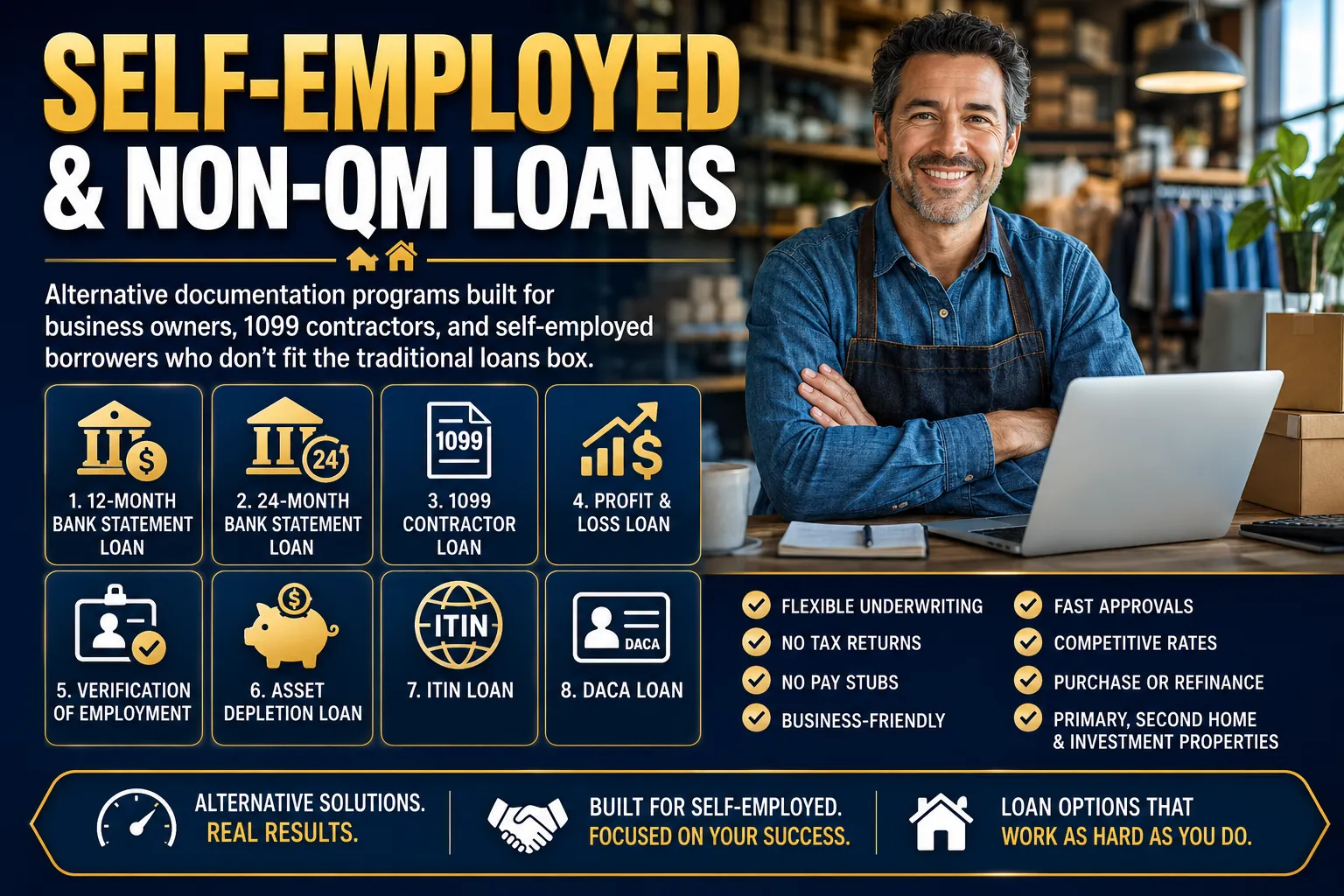
The 8 Self-Employed & Non-QM Loan Programs

1st Florida Lending Corp, a Direct Mortgage Lender based in Orlando, Florida, offers the following alternative-documentation loan programs to fit self-employed borrowers, investors, retirees, and non-traditional applicants.
01.

12-Month Bank Statement Loan

A 12-Month Bank Statement Loan allows eligible self-employed borrowers to qualify using 12 months of personal or business bank deposits instead of traditional income documents such as tax returns, W-2s, or pay stubs. This program is designed for business owners, 1099 contractors, freelancers, and other self-employed borrowers whose tax returns may not fully reflect their true cash flow because of legitimate business deductions.

Income is typically calculated by averaging eligible deposits over the most recent 12 months. When business bank statements are used, the lender may apply an expense factor to estimate net qualifying income, while personal bank statements may be reviewed differently depending on how funds flow through the accounts.

Because this is a Non-QM loan option, requirements can vary by lender. Credit score, down payment, reserves, property type, loan amount, and debt-to-income ratio are all reviewed as part of the full approval. Borrowers may also need to document self-employment history, explain large or unusual deposits, and provide complete bank statements for the full review period.

This option can be especially helpful when a borrower has strong monthly revenue but reduced taxable income due to write-offs for vehicles, equipment, payroll, depreciation, travel, marketing, or other business expenses.

Best for:

  • Self-employed borrowers with strong deposits but lower taxable income
  • Business owners, 1099 contractors, freelancers, consultants, and real estate professionals
  • Borrowers with at least 2 years of consistent self-employment or business activity
  • Applicants who cannot qualify conventionally because tax returns understate actual income
  • Buyers or homeowners seeking a purchase, refinance, or cash-out option using bank-deposit income

Common questions

02.

24-Month Bank Statement Loan

A 24-Month Bank Statement Loan allows eligible self-employed borrowers to qualify using two full years of personal or business bank statements instead of tax returns, W-2s, or traditional pay stubs. The longer review period gives underwriting a broader picture of business cash flow, which can help smooth out seasonal income changes, one-time spikes, or slower business months.

Income is typically calculated by averaging eligible deposits over the most recent 24 consecutive months. If business statements are used, an expense factor or CPA-prepared expense calculation may be applied to estimate qualifying income. If personal statements are used, deposits and transfers may be reviewed to confirm consistent income flow.

Because 24 months of documentation gives the lender more income history, this option may help borrowers qualify for stronger terms than a 12-month bank statement program, including potentially better pricing, higher loan-to-value options, or more flexible loan structures depending on credit, reserves, property type, and overall file strength.

This is a Non-QM loan option, so guidelines vary by lender. Borrowers should be prepared to provide complete bank statements for the full 24-month period, document self-employment history, explain large or unusual deposits, and meet applicable credit score, down payment, reserve, debt-to-income, and property eligibility requirements.

The 24-month option is often ideal for established business owners whose deposits are consistent over time and who want the most complete income picture presented to underwriting.

Best for:

  • Established self-employed borrowers with at least 2 years of consistent business activity
  • Business owners, freelancers, 1099 contractors, consultants, and real estate professionals with strong deposit history
  • Borrowers whose tax returns understate actual cash flow because of legitimate business deductions
  • Applicants who want stronger pricing or higher LTV options than a shorter documentation period may allow
  • Buyers or homeowners seeking purchase, refinance, or cash-out options using bank-statement income

Common questions

03.

1099 Contractor Loan

A 1099 Contractor Loan allows eligible independent contractors, freelancers, gig workers, consultants, and commission-based professionals to qualify using income reported on IRS Form 1099 instead of traditional W-2 income or full tax returns. This option is designed for borrowers with strong, verifiable 1099 income whose tax returns may not tell the full story because of business deductions or nontraditional income structure.

Income is typically reviewed using one or two years of 1099 forms, along with year-to-date earnings documentation such as pay history, contractor statements, invoices, or a CPA/tax preparer letter when required. The goal is to confirm that the borrower's contract income is stable, recurring, and likely to continue.

Because this is generally a Non-QM loan option, guidelines vary by lender. Credit score, down payment, reserves, loan amount, property type, and debt-to-income ratio are all considered. Some programs may use a percentage of gross 1099 income or apply an expense factor to account for business-related costs.

This program can be a strong alternative when a borrower's 1099 income is easier to document than bank deposits or when tax returns show reduced net income due to legitimate deductions. It may be used for purchase, refinance, or cash-out financing depending on the lender's current program guidelines.

Best for:

  • Independent contractors, freelancers, consultants, gig workers, and commission-only professionals
  • Borrowers with consistent 1099 income but limited traditional W-2 documentation
  • Applicants whose tax returns understate actual earning ability because of business deductions
  • Self-employed borrowers who prefer a cleaner income story using 1099 forms instead of full tax returns
  • Buyers or homeowners seeking purchase, refinance, or cash-out options with alternative income documentation

Common questions

04.

Profit & Loss (P&L) Only Loan

A Profit & Loss (P&L) Only Loan allows eligible self-employed borrowers to qualify using a CPA-, EA-, or licensed-accountant-prepared profit and loss statement instead of traditional tax returns or a full bank statement review. It is one of the lightest documentation paths among Non-QM income programs and can be especially useful when the borrower's accountant maintains clean, current business financials.

The lender typically uses the net income shown on the prepared P&L to determine qualifying income. Depending on the program, the P&L may cover the most recent 12 or 24 months, and the preparer may need to confirm business ownership, operating history, and that the financial statement accurately reflects the business income and expenses.

Because this option does not rely on full tax returns or months of deposit analysis, it may create a faster and cleaner file for borrowers whose income is already well-documented through professional accounting records. However, guidelines vary by lender, and some programs may still require limited supporting documents, such as a CPA letter, business license, proof of self-employment, or a small number of bank statements to validate the P&L.

This program is generally best for established self-employed borrowers with strong net business income, organized books, and a qualified third-party preparer who can support the financials. Borrowers with irregular profitability, high business expenses, or commingled personal and business funds may be better served by a 12-month or 24-month bank statement loan.

Best for:

  • Established self-employed borrowers with clean, professionally prepared financials
  • Business owners, consultants, contractors, physicians, attorneys, real estate professionals, and other high-income self-employed borrowers
  • Applicants whose tax returns understate income because of legitimate business deductions
  • Borrowers who want a lighter documentation path than bank statement or full-doc programs
  • Buyers or homeowners seeking purchase, refinance, or cash-out financing using accountant-prepared business income

Common questions

05.

Verification of Employment (VOE) Loan

A Verification of Employment (VOE) Loan allows eligible wage earners to qualify using a standalone written verification completed by the employer instead of traditional income documents such as W-2s, pay stubs, or tax returns. This streamlined Non-QM option is designed for borrowers with steady employment and verifiable income who need a lighter-documentation path.

The employer typically confirms the borrower's position, employment status, start date, income, and likelihood of continued employment through a written VOE form. Underwriting may use the verified income directly from the employer to determine qualifying income, subject to the lender's current program guidelines.

Because this program does not require standard income documentation, lenders may place more emphasis on job stability, credit score, down payment, reserves, debt-to-income ratio, property type, and overall file strength. Some programs may also require a minimum employment history with the same employer or in the same line of work.

This option can be especially helpful for salaried, hourly, bonus, commission, or variable-income employees whose employer can clearly verify income but whose traditional paperwork is incomplete, unavailable, or difficult to use for conventional underwriting.

Best for:

  • W-2 wage earners who have stable employment but want a lighter-documentation mortgage option
  • Salaried or hourly employees whose employer can complete a written verification of employment
  • Borrowers with bonus, overtime, commission, or variable income that is easier to verify directly through the employer
  • Applicants who do not have easy access to recent pay stubs, W-2s, or tax returns
  • Buyers or homeowners seeking purchase, refinance, or cash-out financing with employer-verified income

Common questions

06.

Asset Depletion Loan

An Asset Depletion Loan allows eligible borrowers to qualify by converting liquid assets into a monthly qualifying income figure instead of relying on employment income, pay stubs, W-2s, or tax returns. The lender reviews eligible assets such as checking, savings, money market accounts, CDs, brokerage accounts, stocks, bonds, mutual funds, and certain retirement accounts, then calculates how much monthly income those assets can support for mortgage qualification.

The calculation typically starts with total eligible liquid assets, then subtracts funds needed for the down payment, closing costs, and required reserves. The remaining balance is divided over a set number of months — often based on the loan term or program guidelines — to create a monthly qualifying income figure.

This approach can be especially useful for retirees, high-net-worth borrowers, investors, trust beneficiaries, and asset-rich applicants who have significant savings or investments but limited traditional income. In many cases, asset depletion income may be used by itself or combined with other income sources such as Social Security, pension income, retirement distributions, or rental income.

Guidelines vary by lender and loan type. Some programs may discount certain assets, especially retirement accounts, to account for taxes, penalties, market volatility, or access restrictions. Borrowers should be prepared to provide complete asset statements, document ownership and access to the funds, explain large deposits or transfers, and maintain required post-closing reserves.

Because qualification is based on asset strength, credit score, loan-to-value, property type, occupancy, reserves, and overall file quality remain important. This loan can be used for buyers or homeowners who need a purchase, refinance, or cash-out option when traditional income documentation does not fully support their ability to repay.

Best for:

  • Retirees or semi-retired borrowers with substantial savings or investment accounts
  • High-net-worth borrowers who are asset-rich but show limited taxable or employment income
  • Borrowers living off investments, retirement accounts, trusts, or accumulated wealth
  • Applicants between jobs, recently retired, or no longer drawing regular employment income
  • Buyers or homeowners seeking purchase, refinance, or cash-out financing using assets as qualifying income

Common questions

07.

ITIN Loan

An ITIN Loan provides homeownership financing for eligible borrowers who have an Individual Taxpayer Identification Number instead of a Social Security Number. This option is commonly used by non-U.S. citizens, resident or non-resident taxpayers, and other borrowers who file U.S. taxes with an ITIN and can document income, assets, credit, and ability to repay.

ITIN loans are typically offered through Non-QM or portfolio lending programs because many standard agency and government loan options require Social Security Number or residency documentation that ITIN borrowers may not have. Program terms, down payment requirements, credit expectations, and documentation standards can vary by lender.

Borrowers may qualify using full documentation, bank statements, 1099 income, profit-and-loss statements, or other approved alternative income methods, depending on the program. Lenders may also review filed U.S. tax returns, employment history, business ownership, rental income, or other income sources to confirm the borrower's ability to repay.

Common documentation may include a valid ITIN, passport or government-issued identification, proof of U.S. tax filing history, income documentation, asset statements, down payment funds, reserves, and credit history. Some programs may accept alternative credit references, such as rent, utilities, insurance, phone, or other recurring payment history when traditional credit is limited.

ITIN financing may be available for primary residences and, in some programs, second homes or investment properties. Because these loans are often lender-specific, borrowers should expect a full review of credit, down payment, reserves, property type, occupancy, loan amount, and overall file strength.

Best for:

  • Borrowers who file U.S. taxes with an ITIN but do not have a Social Security Number
  • Non-U.S. citizens, resident or non-resident taxpayers, and other ITIN holders seeking home financing
  • Applicants with verifiable income, documented assets, and sufficient down payment or reserves
  • Borrowers with limited traditional credit who may qualify using alternative credit history
  • Buyers purchasing a primary residence, second home, or eligible investment property through an approved ITIN loan program

Common questions

08.

DACA Loan

A DACA Loan provides mortgage financing options for eligible Deferred Action for Childhood Arrivals recipients who have valid work authorization, documented income, and the ability to repay. DACA borrowers commonly qualify through conventional, Non-QM, or portfolio loan programs when they can provide a valid Employment Authorization Document (EAD), Social Security Number or eligible taxpayer identification, credit history, income documentation, and required assets.

Because DACA status is tied to temporary work authorization, lenders typically review the expiration date on the EAD and may require evidence that the borrower's employment is stable and likely to continue. Borrowers should be prepared to document income using standard full documentation, bank statements, 1099 income, profit-and-loss statements, or another approved alternative documentation method depending on the selected loan program.

Available loan options can vary by lender and current agency or investor guidelines. Conventional financing may be available for eligible DACA borrowers who meet credit, income, down payment, occupancy, and documentation requirements, while portfolio and Non-QM lenders may offer additional flexibility for borrowers who do not fit standard agency guidelines.

DACA financing is most commonly used for primary residence purchases, though some lenders may allow refinance or cash-out options depending on program rules. Borrowers should expect a full review of credit score, employment history, income stability, down payment, reserves, property type, and overall file strength.

Since program availability and residency eligibility rules can change, DACA borrowers should confirm current lender guidelines early in the pre-approval process. A knowledgeable mortgage professional can help compare conventional, Non-QM, and portfolio options based on the borrower's documentation, credit profile, and long-term homeownership goals.

Best for:

  • DACA recipients with a valid Employment Authorization Document and stable income
  • Borrowers with established U.S. credit history and documented ability to repay
  • Primary-residence buyers who may qualify through conventional, Non-QM, or portfolio financing
  • Applicants who need a lender familiar with EAD-based documentation and residency eligibility review
  • Buyers who want to compare standard and alternative documentation options based on their employment, income, and credit profile

Common questions

Ready to talk to a licensed loan officer?

Get a no-obligation pre-approval today — most decisions in 24 hours.

Self-Employed & Non-QM: Frequently Asked Questions

Answers to common questions about alternative-documentation mortgage financing.

Disclaimer

This page is provided for general educational purposes only and does not constitute a loan commitment or offer of credit. Non-QM programs vary by investor across credit, LTV, documentation, reserves, and prepayment terms. All loans are subject to credit approval and property qualification. Rates, terms, and programs are subject to change without notice. Equal Housing Lender.