
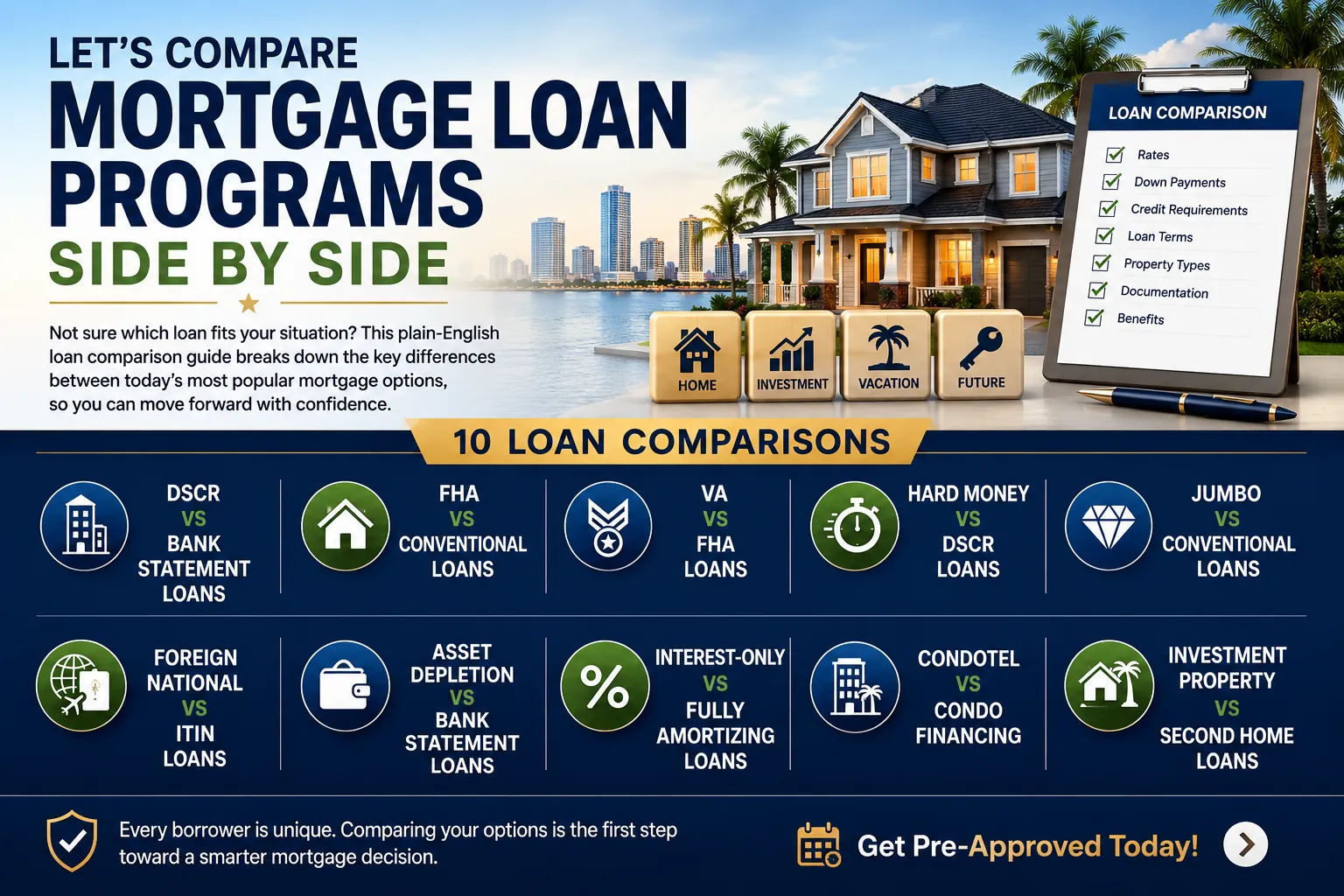
Loan Comparison Guide
The Right Mortgage Depends on You, Not the Other Way Around
There is no single "best" mortgage. The right program depends on your goals, how you document income, the type of property you're buying, your credit profile, and your timeline. A self-employed business owner, a veteran, a foreign national investor, and a first-time homebuyer may all be well qualified — yet each may be best served by a completely different loan. The comparisons below explain the real differences in plain English so you can identify the option that may fit your situation, then talk with a licensed mortgage professional to confirm the details.
Jump to a comparison
- 01. DSCR vs Bank Statement Loans
- 02. FHA vs Conventional Loans
- 03. VA vs FHA Loans
- 04. Hard Money vs DSCR Loans
- 05. Jumbo vs Conventional Loans
- 06. Foreign National vs ITIN Loans
- 07. Asset Depletion vs Bank Statement Loans
- 08. Interest-Only vs Fully Amortizing Loans
- 09. Condotel vs Condo Financing
- 10. Investment Property vs Second Home Loans
Comparison 01
DSCR vs Bank Statement Loans
Both are popular Non-QM options for borrowers who don't qualify with tax returns — but they work very differently. A DSCR loan qualifies based on the property's rental income, while a bank statement loan qualifies based on your cash flow shown in bank deposits.
| At a Glance | DSCR Loan | Bank Statement Loan |
|---|---|---|
| How you qualify | Property's rental income vs the mortgage payment (Debt Service Coverage Ratio) | 12–24 months of personal or business bank statement deposits |
| Income documents | Typically no personal income docs, tax returns, or employment verification | No tax returns; bank statements substitute for W-2s and 1040s |
| Property types | Investment properties only (long-term or short-term rentals) | Primary homes, second homes, and investment properties |
| Typical down payment | Often 20–25%, depending on credit and DSCR ratio | Often 10–15%+, depending on credit and program |
| Best-known for | Investors scaling rental portfolios, often closing in an LLC | Self-employed borrowers, business owners, 1099 contractors |
| Common use case | Buying or refinancing a rental where the rent covers the payment | Buying a primary home when tax write-offs reduce reported income |
A DSCR loan may fit you if…
- You're buying or refinancing a rental property, not a home you'll live in
- You'd rather keep personal income and tax returns out of the file
- You may want to close in an LLC or grow a portfolio of multiple rentals
A bank statement loan may fit you if…
- You're self-employed and your tax returns understate your true cash flow
- You're buying a primary residence or second home, not just a rental
- Your deposits show steady, healthy business or personal income
Which one should I choose?
Choose the loan that matches the property and the income story. If the property is a rental and its income can carry the payment, DSCR is usually the cleaner path. If you're self-employed and buying a home to live in, a bank statement loan typically fits better. Many investors end up using both — a bank statement loan for their residence and DSCR loans for their rentals.
Learn more: DSCR Loans·Bank Statement Loans
Get Pre-ApprovedComparison 02
FHA vs Conventional Loans
This is the most common comparison for first-time homebuyers. FHA loans are government-insured and forgiving on credit; conventional loans can cost less over time — especially once you can remove mortgage insurance.
| At a Glance | FHA Loan | Conventional Loan |
|---|---|---|
| Minimum down payment | Typically 3.5% with qualifying credit | As low as 3% for qualifying first-time buyers; often 5% |
| Credit flexibility | More forgiving of lower scores and past credit events | Generally rewards stronger credit with better pricing |
| Mortgage insurance | Upfront MIP plus monthly MIP; with minimum down, monthly MIP typically remains for the life of the loan | PMI can typically be removed once you reach sufficient equity (often around 20%) |
| 2026 loan limits (typical) | Floor of $541,287 in most areas; up to $1,249,125 in high-cost areas | Baseline of $832,750; up to $1,249,125 in high-cost areas |
| Property standards | FHA appraisal includes minimum property condition requirements | Standard appraisal; generally more flexible on condition |
| Occupancy | Primary residence only | Primary, second home, or investment property |
FHA may fit you if…
- Your credit score is on the lower side or still recovering
- You have limited savings and need the smaller down payment to work harder
- Your debt-to-income ratio is higher than conventional guidelines typically allow
Conventional may fit you if…
- Your credit is strong and you want the lowest long-term cost
- You plan to remove mortgage insurance as your equity grows
- You're buying a second home or investment property (FHA won't allow it)
Which one should I choose?
As a rule of thumb: weaker credit or higher debt ratios often point to FHA, while strong credit often points to conventional — because cancellable PMI and credit-based pricing can save thousands over the life of the loan. The math flips from borrower to borrower, so it's worth running both side by side before you commit.
Learn more: FHA Loans·Conventional Loans
Get Pre-ApprovedComparison 03
VA vs FHA Loans
If you're an eligible veteran, active-duty service member, or surviving spouse, the VA loan is often one of the strongest benefits you've earned — but FHA can still make sense in certain situations.
| At a Glance | VA Loan | FHA Loan |
|---|---|---|
| Who's eligible | Eligible veterans, active-duty members, certain National Guard/Reserve members, and surviving spouses | Any qualifying borrower |
| Down payment | 0% down for eligible borrowers with full entitlement | Typically 3.5% minimum |
| Monthly mortgage insurance | None | Monthly MIP, typically for the life of the loan with minimum down |
| Upfront fee | VA funding fee (varies by usage and down payment; may be waived for veterans with qualifying service-connected disability) | Upfront MIP of 1.75% of the loan amount |
| Credit flexibility | Flexible; guidelines vary by lender | Flexible; well suited to lower scores |
| Occupancy | Primary residence only | Primary residence only |
VA may fit you if…
- You're eligible and want to buy with little or no money down
- You want to avoid monthly mortgage insurance entirely
- You may qualify for a funding fee exemption due to a service-connected disability
FHA may fit you if…
- You're not VA-eligible, or your VA entitlement is tied up in another property
- A co-borrower who isn't a veteran or spouse needs to be on the loan
- The specific transaction fits FHA guidelines better in your scenario
Which one should I choose?
For most eligible veterans, the VA loan wins on the numbers: no down payment requirement and no monthly mortgage insurance are hard to beat. FHA typically enters the picture when eligibility, entitlement, or co-borrower circumstances make VA impractical. If you're eligible for both, compare total monthly cost and cash to close before deciding.
Learn more: VA Loans·FHA Loans
Get Pre-ApprovedComparison 04
Hard Money vs DSCR Loans
Both serve real estate investors, but they solve different problems. Hard money is about speed and short-term flexibility; DSCR is about long-term rental financing. Many investors use them in sequence — hard money to acquire and renovate, then a DSCR refinance to hold.
| At a Glance | Hard Money Loan | DSCR Loan |
|---|---|---|
| Loan term | Short-term, often 6–24 months | Long-term, commonly 30-year options |
| Primary basis for approval | The asset itself — purchase price, condition, and after-repair value | The property's rental income vs its mortgage payment |
| Speed to close | Often very fast — days to a couple of weeks in many cases | Typically faster than full-doc loans, slower than hard money |
| Cost profile | Higher rates and points in exchange for speed and flexibility | Generally lower rates than hard money for stabilized rentals |
| Common use case | Fix-and-flip, bridge financing, auction purchases, heavy rehab | Buy-and-hold rentals, cash-out or rate/term refinances |
| Exit strategy | Sell the property or refinance into long-term financing | Hold and collect rent; the loan is the long-term financing |
Which one should I choose?
Match the loan to your hold period. Flipping in under a year, or buying a property that won't pass a standard appraisal yet? Hard money. Keeping the property as a rental? DSCR. The classic investor play — often called BRRRR — is to buy and renovate with hard money, then refinance into a DSCR loan once the property is rented and stabilized.
Learn more: Hard Money Loans·DSCR Loans
Get Pre-ApprovedComparison 05
Jumbo vs Conventional Loans
The dividing line is the conforming loan limit. For 2026, the baseline conforming limit is $832,750 in most areas (up to $1,249,125 in designated high-cost areas). Borrow above the limit for your county and you're in jumbo territory — where guidelines change.
| At a Glance | Conventional (Conforming) | Jumbo Loan |
|---|---|---|
| Loan amount | At or below the conforming limit for the county | Above the conforming limit |
| Backing | Eligible for purchase by Fannie Mae / Freddie Mac | Held or sold outside the conforming system; lender guidelines vary more |
| Typical down payment | As low as 3–5% for qualifying borrowers | Often 10–20%, depending on loan size and profile |
| Credit expectations | Flexible range with risk-based pricing | Generally higher score expectations |
| Reserves | Often modest, depending on the file | Often several months of payments in reserves, sometimes more |
| Documentation | Standard full documentation | Full documentation, often with closer scrutiny of assets and income |
Which one should I choose?
You usually don't choose — the purchase price and your down payment decide for you. That said, buyers near the limit have options: a slightly larger down payment can sometimes bring the loan amount under the conforming limit, which may improve pricing and flexibility. If you're firmly in jumbo range, plan for stronger credit, deeper reserves, and a more detailed review of your finances.
Learn more: Jumbo Loans·Conventional Loans
Get Pre-ApprovedComparison 06
Foreign National vs ITIN Loans
Neither program requires a Social Security number — but they serve very different borrowers. Foreign national loans are built for non-residents investing in U.S. property; ITIN loans serve borrowers who live and work in the U.S. and file taxes with an Individual Taxpayer Identification Number.
| At a Glance | Foreign National Loan | ITIN Loan |
|---|---|---|
| Who it serves | Non-U.S. residents buying U.S. property, often from abroad | U.S. residents without an SSN who file taxes with an ITIN |
| U.S. credit required | Typically no; international credit or reference letters may be used | Alternative or limited U.S. credit often accepted (rent, utilities, etc.) |
| Income documentation | Foreign income docs, CPA letters, or asset-based options depending on program | Tax returns filed with ITIN, W-2s/1099s, or bank statement options |
| Typical down payment | Often 25–30% | Often 15–25%, depending on program and credit |
| Occupancy | Usually second homes and investment properties | Often primary residences, plus other occupancy types by program |
| Visa/status notes | Valid passport and visa documentation typically required | ITIN card/letter and consistent tax filing history typically required |
Which one should I choose?
It comes down to where you live. If you live abroad and want a Florida vacation home or rental property, the foreign national program is designed for you. If you live and work in the U.S., pay taxes with an ITIN, and want to buy the home you live in, the ITIN program is the fit. The documentation paths are different enough that starting in the right lane saves real time.
Learn more: Foreign National Loans·ITIN Loans
Get Pre-ApprovedComparison 07
Asset Depletion vs Bank Statement Loans
Both let you qualify without traditional tax-return income — the difference is what proves your ability to repay. Asset depletion converts your savings and investments into qualifying income; bank statement loans use the cash flowing through your accounts.
| At a Glance | Asset Depletion Loan | Bank Statement Loan |
|---|---|---|
| How income is calculated | Eligible liquid assets are divided over a set term to create a monthly "income" figure | Average monthly deposits over 12–24 months, often with an expense factor for business accounts |
| Ideal borrower | Retirees, high-net-worth individuals, recent business sellers — asset-rich, income-light | Actively self-employed borrowers with strong ongoing deposits |
| What you document | Investment, retirement, and bank account statements | Personal or business bank statements |
| Employment required | Not necessarily — assets do the qualifying | Ongoing self-employment or business activity, typically 2 years |
| Best for | Borrowers whose wealth sits in portfolios rather than paychecks | Borrowers whose tax returns understate real cash flow |
Which one should I choose?
Follow the money. If your strength is a large portfolio of savings and investments — but little reportable monthly income — asset depletion is built for you. If your strength is steady deposits from an active business, bank statements will usually produce the higher qualifying income. Some borrowers qualify under both; in that case, compare which method supports the loan amount you actually need.
Comparison 08
Interest-Only vs Fully Amortizing Loans
This isn't a loan program so much as a payment structure — and it changes the math significantly. Interest-only options appear most often on Non-QM, DSCR, and jumbo loans.
| At a Glance | Interest-Only | Fully Amortizing |
|---|---|---|
| Monthly payment (initial) | Lower — you pay interest only during the IO period (often the first 5–10 years) | Higher — every payment includes principal and interest |
| Principal reduction | None during the IO period unless you pay extra voluntarily | Built into every payment from day one |
| Payment later | Increases when the IO period ends and the loan re-amortizes over the remaining term | Stays consistent on a fixed-rate loan |
| Equity building | Relies on appreciation and voluntary principal payments | Steady equity growth through scheduled principal paydown |
| Who typically uses it | Investors maximizing cash flow; borrowers with variable income | Most homeowners planning to stay long term |
| Where it's offered | Commonly on DSCR, Non-QM, and jumbo programs | Standard across virtually all loan programs |
Which one should I choose?
Interest-only is a cash-flow tool, not a discount — you'll still owe the principal. It can make sense for an investor maximizing monthly rental cash flow, or a borrower with lumpy income who wants a lower required payment with the option to pay more. If your goal is to own your home outright and build equity predictably, fully amortizing is the straightforward choice.
Learn more: DSCR Loans·Jumbo Loans
Get Pre-ApprovedComparison 09
Condotel vs Condo Financing
In Florida, this comparison matters more than almost anywhere else. A condotel — a condo that operates like a hotel, with a rental desk, short-term stays, or hotel-style amenities — is generally considered non-warrantable, which puts it outside standard conventional and FHA financing.
| At a Glance | Condotel (Non-Warrantable) | Warrantable Condo |
|---|---|---|
| What it is | Condo unit in a project with hotel-like operations: front desk, daily rentals, rental pooling | Condo project meeting Fannie/Freddie eligibility standards |
| Financing available | Non-QM / portfolio loan programs | Conventional, FHA (if approved), VA (if approved), jumbo |
| Typical down payment | Often 25%+ | As low as 3–5% conventional for primary residences |
| Rate environment | Generally higher than warrantable condo financing | Standard market pricing |
| Typical buyer | Investors and second-home buyers wanting rental income from short-term stays | Primary residents, second-home buyers, long-term investors |
| Key diligence | Project review: rental program, HOA finances, litigation, insurance | Standard condo project review |
Which one should I choose?
Usually the property chooses for you — the same building is either warrantable or it isn't. What you can choose is to find out before you fall in love with a unit. If the project is a condotel, plan for a larger down payment and Non-QM financing, and weigh that against the short-term rental income potential. If it's warrantable, the full menu of standard loan programs is open to you.
Learn more: Condotel Financing·Conventional Loans
Get Pre-ApprovedComparison 10
Investment Property vs Second Home Loans
These two are often confused — and the difference matters, because occupancy affects your down payment, your rate, and your legal obligations. A second home is for your use; an investment property is for income.
| At a Glance | Investment Property | Second Home |
|---|---|---|
| Primary purpose | Generating rental income or long-term appreciation | Personal use — a place you and your family enjoy |
| Occupancy rules | You do not need to occupy it — tenants live there | Must be reasonably distant from your primary and available for your personal use; not a full-time rental |
| Typical down payment | Often 15–25%, depending on units and program | Often 10–15% for qualifying borrowers |
| Rate & pricing | Higher than owner-occupied to reflect added risk | Similar to primary-residence pricing on conventional loans |
| Using rental income to qualify | Yes — programs like DSCR let rent drive the approval | Generally no; you must qualify on your own income |
| Programs available | Conventional investor, DSCR, Non-QM, portfolio | Conventional, jumbo, some Non-QM |
Which one should I choose?
Be honest about how you'll really use the property — occupancy is a certification you sign, and misrepresenting it is mortgage fraud. If the home is genuinely for your family's use with occasional rental on the side, discuss whether second-home guidelines fit. If the plan is income first, finance it as an investment property from the start — you'll also unlock programs like DSCR that use the rent itself to qualify you.
Learn more: Investor Loans·DSCR Loans
Get Pre-ApprovedLoan Comparison FAQs
Straight answers to what borrowers ask most
Choosing Between Programs
Down Payments & Costs
Self-Employed & Alternative Documentation
Investors & Specialty Properties
Every Loan Scenario Is Unique
Mortgage guidelines are not one-size-fits-all. Down payment requirements, credit expectations, rates, and documentation vary by lender, borrower profile, property type, occupancy, and market conditions — and they change over time. The comparisons in this guide describe how these programs typically work, not a commitment to specific terms.
As a direct mortgage lender with 48+ loan programs, 1st Florida Lending can compare multiple options in-house — including the Non-QM and investor programs many banks don't offer.
Ready to see your options side by side?
Get a Personalized Loan Comparison
Tell us about your goals and we'll match real programs to your situation — real numbers, side by side. No obligation, no pressure.
1st Florida Lending · NMLS #XXXXX · Equal Housing Lender
Educational content only. Not a commitment to lend. Loan approval is subject to credit review, income verification, and property qualification. Rates, terms, and program guidelines are subject to change without notice. 1st Florida Lending is an Equal Housing Lender licensed in Florida.